





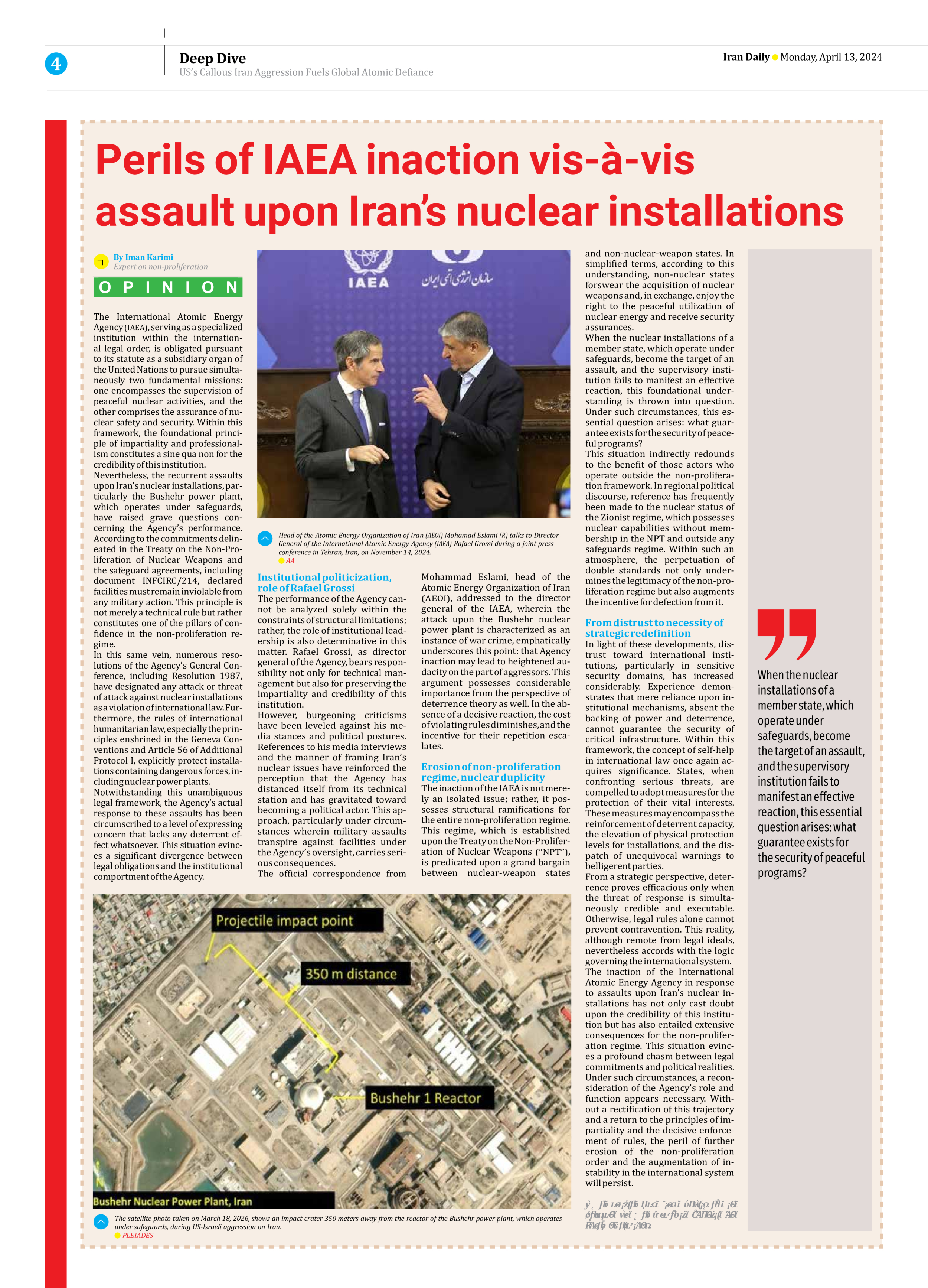


Perils of IAEA inaction vis-à-vis assault upon Iran’s nuclear installations
By Iman Karimi
Expert on non-proliferation
The International Atomic Energy Agency (IAEA), serving as a specialized institution within the international legal order, is obligated pursuant to its statute as a subsidiary organ of the United Nations to pursue simultaneously two fundamental missions: one encompasses the supervision of peaceful nuclear activities, and the other comprises the assurance of nuclear safety and security. Within this framework, the foundational principle of impartiality and professionalism constitutes a sine qua non for the credibility of this institution.
Nevertheless, the recurrent assaults upon Iran’s nuclear installations, particularly the Bushehr power plant, which operates under safeguards, have raised grave questions concerning the Agency’s performance. According to the commitments delineated in the Treaty on the Non-Proliferation of Nuclear Weapons and the safeguard agreements, including document INFCIRC/214, declared facilities must remain inviolable from any military action. This principle is not merely a technical rule but rather constitutes one of the pillars of confidence in the non-proliferation regime.
In this same vein, numerous resolutions of the Agency’s General Conference, including Resolution 1987, have designated any attack or threat of attack against nuclear installations as a violation of international law. Furthermore, the rules of international humanitarian law, especially the principles enshrined in the Geneva Conventions and Article 56 of Additional Protocol I, explicitly protect installations containing dangerous forces, including nuclear power plants.
Notwithstanding this unambiguous legal framework, the Agency’s actual response to these assaults has been circumscribed to a level of expressing concern that lacks any deterrent effect whatsoever. This situation evinces a significant divergence between legal obligations and the institutional comportment of the Agency.
Institutional politicization, role of Rafael Grossi
The performance of the Agency cannot be analyzed solely within the constraints of structural limitations; rather, the role of institutional leadership is also determinative in this matter. Rafael Grossi, as director general of the Agency, bears responsibility not only for technical management but also for preserving the impartiality and credibility of this institution.
However, burgeoning criticisms have been leveled against his media stances and political postures. References to his media interviews and the manner of framing Iran’s nuclear issues have reinforced the perception that the Agency has distanced itself from its technical station and has gravitated toward becoming a political actor. This approach, particularly under circumstances wherein military assaults transpire against facilities under the Agency’s oversight, carries serious consequences.
The official correspondence from Mohammad Eslami, head of the Atomic Energy Organization of Iran (AEOI), addressed to the director general of the IAEA, wherein the attack upon the Bushehr nuclear power plant is characterized as an instance of war crime, emphatically underscores this point: that Agency inaction may lead to heightened audacity on the part of aggressors. This argument possesses considerable importance from the perspective of deterrence theory as well. In the absence of a decisive reaction, the cost of violating rules diminishes, and the incentive for their repetition escalates.
Erosion of non-proliferation regime, nuclear duplicity
The inaction of the IAEA is not merely an isolated issue; rather, it possesses structural ramifications for the entire non-proliferation regime. This regime, which is established upon the Treaty on the Non-Proliferation of Nuclear Weapons (“NPT”), is predicated upon a grand bargain between nuclear-weapon states and non-nuclear-weapon states. In simplified terms, according to this understanding, non-nuclear states forswear the acquisition of nuclear weapons and, in exchange, enjoy the right to the peaceful utilization of nuclear energy and receive security assurances.
When the nuclear installations of a member state, which operate under safeguards, become the target of an assault, and the supervisory institution fails to manifest an effective reaction, this foundational understanding is thrown into question. Under such circumstances, this essential question arises: what guarantee exists for the security of peaceful programs?
This situation indirectly redounds to the benefit of those actors who operate outside the non-proliferation framework. In regional political discourse, reference has frequently been made to the nuclear status of the Zionist regime, which possesses nuclear capabilities without membership in the NPT and outside any safeguards regime. Within such an atmosphere, the perpetuation of double standards not only undermines the legitimacy of the non-proliferation regime but also augments the incentive for defection from it.
From distrust to necessity of strategic redefinition
In light of these developments, distrust toward international institutions, particularly in sensitive security domains, has increased considerably. Experience demonstrates that mere reliance upon institutional mechanisms, absent the backing of power and deterrence, cannot guarantee the security of critical infrastructure. Within this framework, the concept of self-help in international law once again acquires significance. States, when confronting serious threats, are compelled to adopt measures for the protection of their vital interests. These measures may encompass the reinforcement of deterrent capacity, the elevation of physical protection levels for installations, and the dispatch of unequivocal warnings to belligerent parties.
From a strategic perspective, deterrence proves efficacious only when the threat of response is simultaneously credible and executable. Otherwise, legal rules alone cannot prevent contravention. This reality, although remote from legal ideals, nevertheless accords with the logic governing the international system.
The inaction of the International Atomic Energy Agency in response to assaults upon Iran’s nuclear installations has not only cast doubt upon the credibility of this institution but has also entailed extensive consequences for the non-proliferation regime. This situation evinces a profound chasm between legal commitments and political realities. Under such circumstances, a reconsideration of the Agency’s role and function appears necessary. Without a rectification of this trajectory and a return to the principles of impartiality and the decisive enforcement of rules, the peril of further erosion of the non-proliferation order and the augmentation of instability in the international system will persist.
The article was first published in Persian by the Strategic Council on Foreign Relations.