





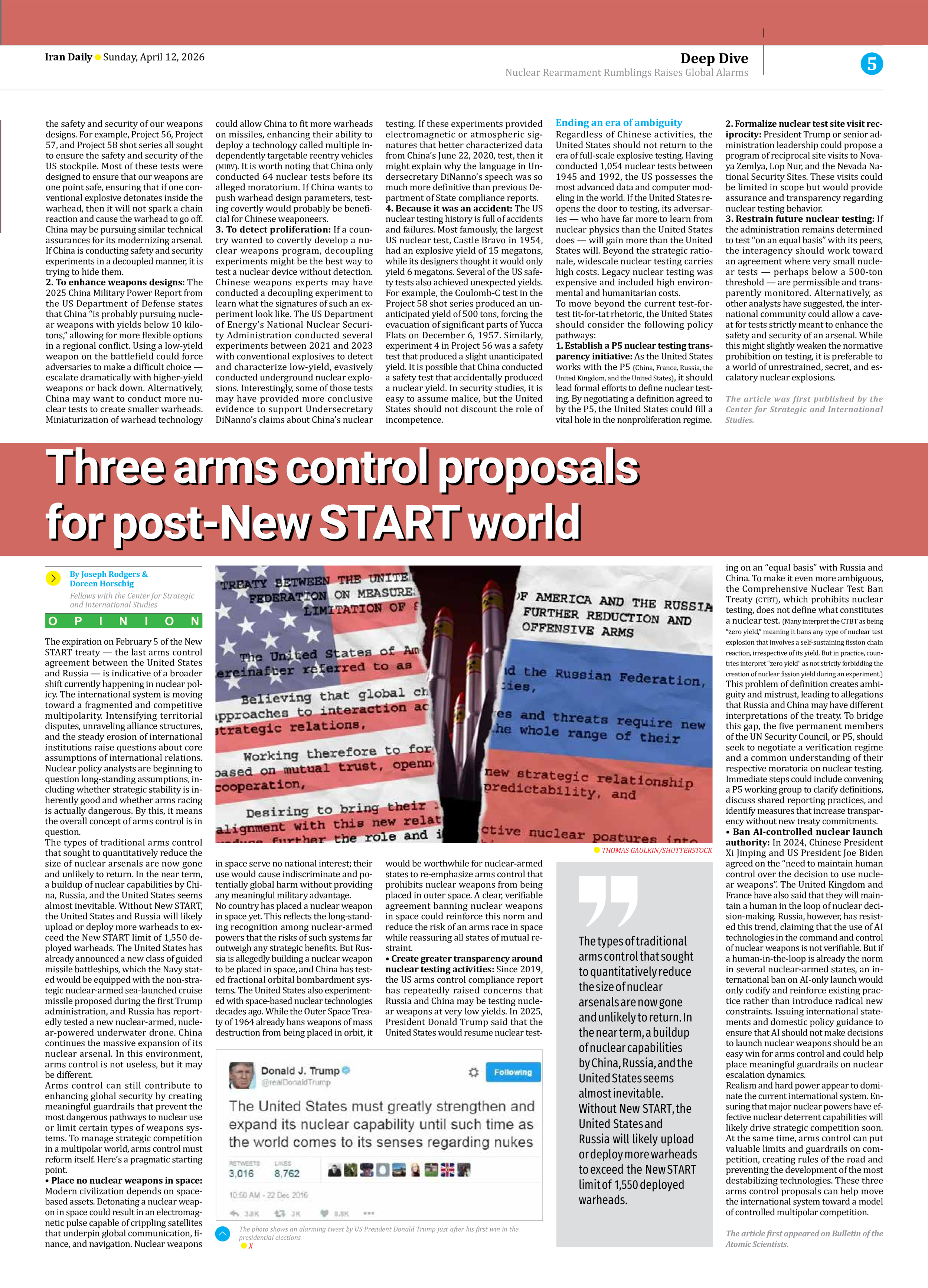


Three arms control proposals for post-New START world
By Joseph Rodgers &
Doreen Horschig
Fellows with the Center for Strategic
and International Studies
The expiration on February 5 of the New START treaty — the last arms control agreement between the United States and Russia — is indicative of a broader shift currently happening in nuclear policy. The international system is moving toward a fragmented and competitive multipolarity. Intensifying territorial disputes, unraveling alliance structures, and the steady erosion of international institutions raise questions about core assumptions of international relations. Nuclear policy analysts are beginning to question long-standing assumptions, including whether strategic stability is inherently good and whether arms racing is actually dangerous. By this, it means the overall concept of arms control is in question.
The types of traditional arms control that sought to quantitatively reduce the size of nuclear arsenals are now gone and unlikely to return. In the near term, a buildup of nuclear capabilities by China, Russia, and the United States seems almost inevitable. Without New START, the United States and Russia will likely upload or deploy more warheads to exceed the New START limit of 1,550 deployed warheads. The United States has already announced a new class of guided missile battleships, which the Navy stated would be equipped with the non-strategic nuclear-armed sea-launched cruise missile proposed during the first Trump administration, and Russia has reportedly tested a new nuclear-armed, nuclear-powered underwater drone. China continues the massive expansion of its nuclear arsenal. In this environment, arms control is not useless, but it may be different.
Arms control can still contribute to enhancing global security by creating meaningful guardrails that prevent the most dangerous pathways to nuclear use or limit certain types of weapons systems. To manage strategic competition in a multipolar world, arms control must reform itself. Here’s a pragmatic starting point.
• Place no nuclear weapons in space: Modern civilization depends on space-based assets. Detonating a nuclear weapon in space could result in an electromagnetic pulse capable of crippling satellites that underpin global communication, finance, and navigation. Nuclear weapons in space serve no national interest; their use would cause indiscriminate and potentially global harm without providing any meaningful military advantage.
No country has placed a nuclear weapon in space yet. This reflects the long-standing recognition among nuclear-armed powers that the risks of such systems far outweigh any strategic benefits. But Russia is allegedly building a nuclear weapon to be placed in space, and China has tested fractional orbital bombardment systems. The United States also experimented with space-based nuclear technologies decades ago. While the Outer Space Treaty of 1964 already bans weapons of mass destruction from being placed in orbit, it would be worthwhile for nuclear-armed states to re-emphasize arms control that prohibits nuclear weapons from being placed in outer space. A clear, verifiable agreement banning nuclear weapons in space could reinforce this norm and reduce the risk of an arms race in space while reassuring all states of mutual restraint.
• Create greater transparency around nuclear testing activities: Since 2019, the US arms control compliance report has repeatedly raised concerns that Russia and China may be testing nuclear weapons at very low yields. In 2025, President Donald Trump said that the United States would resume nuclear testing on an “equal basis” with Russia and China. To make it even more ambiguous, the Comprehensive Nuclear Test Ban Treaty (CTBT), which prohibits nuclear testing, does not define what constitutes a nuclear test. (Many interpret the CTBT as being “zero yield,” meaning it bans any type of nuclear test explosion that involves a self-sustaining fission chain reaction, irrespective of its yield. But in practice, countries interpret “zero yield” as not strictly forbidding the creation of nuclear fission yield during an experiment.) This problem of definition creates ambiguity and mistrust, leading to allegations that Russia and China may have different interpretations of the treaty. To bridge this gap, the five permanent members of the UN Security Council, or P5, should seek to negotiate a verification regime and a common understanding of their respective moratoria on nuclear testing. Immediate steps could include convening a P5 working group to clarify definitions, discuss shared reporting practices, and identify measures that increase transparency without new treaty commitments.
• Ban AI-controlled nuclear launch authority: In 2024, Chinese President Xi Jinping and US President Joe Biden agreed on the “need to maintain human control over the decision to use nuclear weapons”. The United Kingdom and France have also said that they will maintain a human in the loop of nuclear decision-making. Russia, however, has resisted this trend, claiming that the use of AI technologies in the command and control of nuclear weapons is not verifiable. But if a human-in-the-loop is already the norm in several nuclear-armed states, an international ban on AI-only launch would only codify and reinforce existing practice rather than introduce radical new constraints. Issuing international statements and domestic policy guidance to ensure that AI should not make decisions to launch nuclear weapons should be an easy win for arms control and could help place meaningful guardrails on nuclear escalation dynamics.
Realism and hard power appear to dominate the current international system. Ensuring that major nuclear powers have effective nuclear deterrent capabilities will likely drive strategic competition soon. At the same time, arms control can put valuable limits and guardrails on competition, creating rules of the road and preventing the development of the most destabilizing technologies. These three arms control proposals can help move the international system toward a model of controlled multipolar competition.
The article first appeared on Bulletin of the Atomic Scientists.