







Protracted war on Iran could slash global growth by 1 point: WB
A prolonged US-Israeli war against Iran would seriously damage global economic growth and price stability, with the reduction in economic growth potentially reaching one percentage point, according to World Bank President Ajay Banga.
According to Tasnim news agency, Banga announced that war in West Asia could reduce global economic growth and have widespread consequences, even if the announced ceasefire remains in place.
Banga added that in a base scenario with an early end to the war, global economic growth would decrease by 0.3 to 0.4 percentage points (pp), but if conflicts continue, this reduction could reach one percentage point. He also predicted that the inflation rate may increase by 200 to 300 basis points (bp), and if the war continues, this figure could rise by up to 0.9 percentage points more.
After 40 days of US-Israeli war against Iran that began on February 28, Iran and the United States announced a 15-day ceasefire early Wednesday morning with Pakistan's mediation.
Based on World Bank estimates, economic growth in emerging markets and developing countries in 2026 will decrease to 3.65%, down from the 4% predicted in October. In a pessimistic scenario with a prolonged war, growth could fall to 2.6%. The inflation rate in these countries for 2026 is projected at about 4.9%, a 3% increase from the previous estimate, and could reach 6.7% in a severe scenario.
According to the report, the war, which has left thousands dead in the West Asian region, has caused a 50% increase in oil prices and disrupted supplies of oil, gas, fertilizer, helium and other commodities, while also affecting sectors such as tourism and air transport.
Referring to the fragility of the announced two-week ceasefire, the World Bank president said continued attacks between Iran and Israel show the situation remains unstable. "The key question is whether this ceasefire and the upcoming negotiations will lead to a lasting peace and the reopening of the Strait of Hormuz," he said.
Banga further stated that if negotiations fail and hostilities resume, "Will there be an even larger or longer-term impact on energy infrastructure?"
Following initial US and Israeli air strikes in February, Iran effectively closed the Strait of Hormuz, a chokepoint through which approximately one-fifth of global oil supplies transit.
8 energy facilities face output disruptions
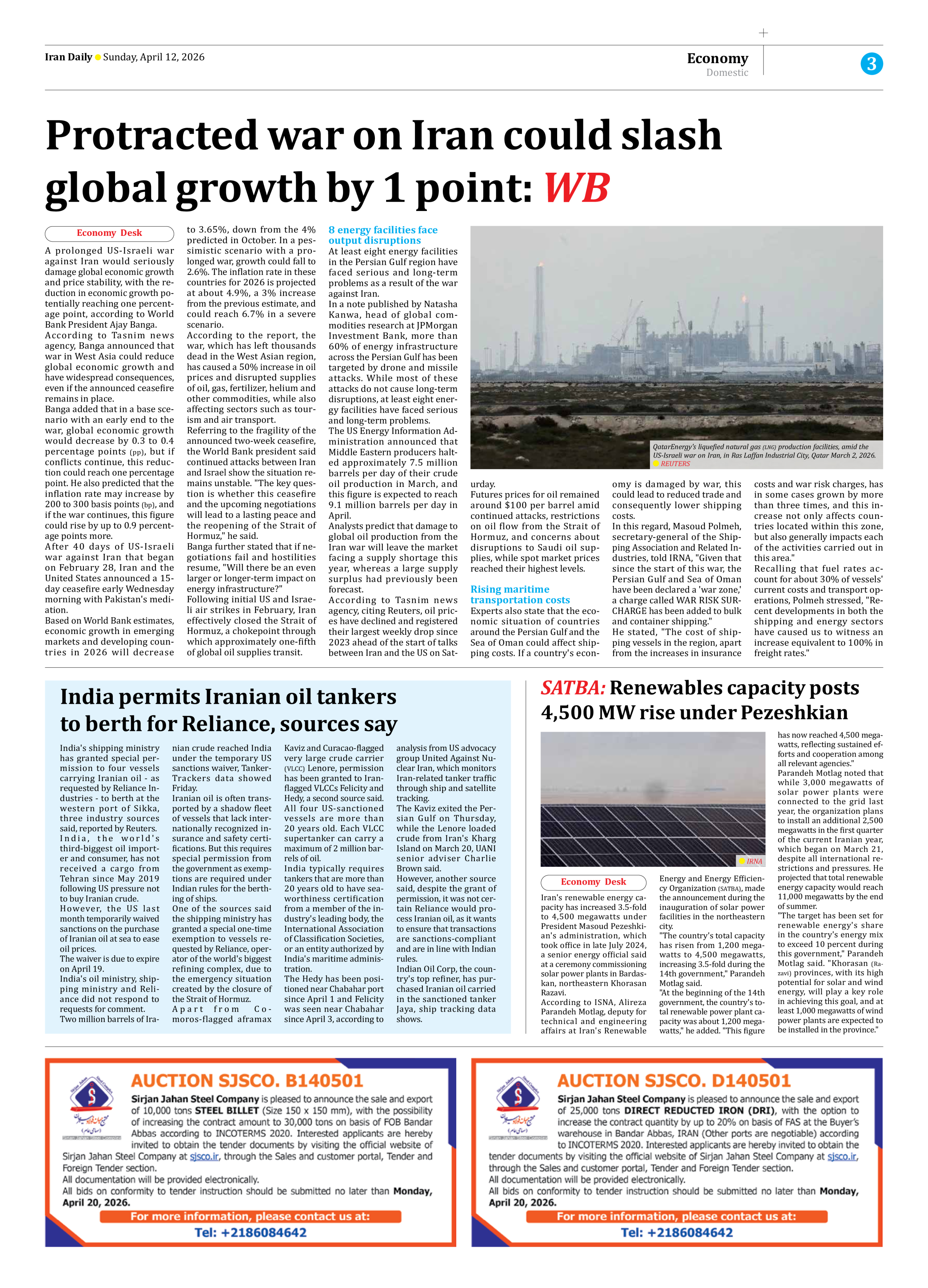
At least eight energy facilities in the Persian Gulf region have faced serious and long-term problems as a result of the war against Iran.
In a note published by Natasha Kanwa, head of global commodities research at JPMorgan Investment Bank, more than 60% of energy infrastructure across the Persian Gulf has been targeted by drone and missile attacks. While most of these attacks do not cause long-term disruptions, at least eight energy facilities have faced serious and long-term problems.
The US Energy Information Administration announced that Middle Eastern producers halted approximately 7.5 million barrels per day of their crude oil production in March, and this figure is expected to reach 9.1 million barrels per day in April.
Analysts predict that damage to global oil production from the Iran war will leave the market facing a supply shortage this year, whereas a large supply surplus had previously been forecast.
According to Tasnim news agency, citing Reuters, oil prices have declined and registered their largest weekly drop since 2023 ahead of the start of talks between Iran and the US on Saturday.
Futures prices for oil remained around $100 per barrel amid continued attacks, restrictions on oil flow from the Strait of Hormuz, and concerns about disruptions to Saudi oil supplies, while spot market prices reached their highest levels.
Rising maritime transportation costs
Experts also state that the economic situation of countries around the Persian Gulf and the Sea of Oman could affect shipping costs. If a country's economy is damaged by war, this could lead to reduced trade and consequently lower shipping costs.
In this regard, Masoud Polmeh, secretary-general of the Shipping Association and Related Industries, told IRNA, "Given that since the start of this war, the Persian Gulf and Sea of Oman have been declared a 'war zone,' a charge called WAR RISK SURCHARGE has been added to bulk and container shipping."
He stated, "The cost of shipping vessels in the region, apart from the increases in insurance costs and war risk charges, has in some cases grown by more than three times, and this increase not only affects countries located within this zone, but also generally impacts each of the activities carried out in this area."
Recalling that fuel rates account for about 30% of vessels' current costs and transport operations, Polmeh stressed, "Recent developments in both the shipping and energy sectors have caused us to witness an increase equivalent to 100% in freight rates."