







Tehran, Washington hold high-stakes peace talks in Islamabad
Senior Iranian and American officials held a “face-to-face” meeting on Saturday in Islamabad for the highest-level talks between Tehran and Washington in half a century as they sought to bring an end to their six-week conflict.
The talks followed a Pakistan-brokered ceasefire agreement which temporarily ended an unprovoked aggression by the US and the Israeli regime against Iran, which began on February 28.
Strikes by the US and Israel have targeted Iran’s military sites, medical centers, schools, universities and many other civilian structures.
The aggression has claimed the lives of thousands of Iranians and inflicted severe damage to the country’s infrastructure. Leader of the Islamic Revolution Ayatollah Seyyed Ali Khamenei as well as many military officials have been martyred in the attacks.
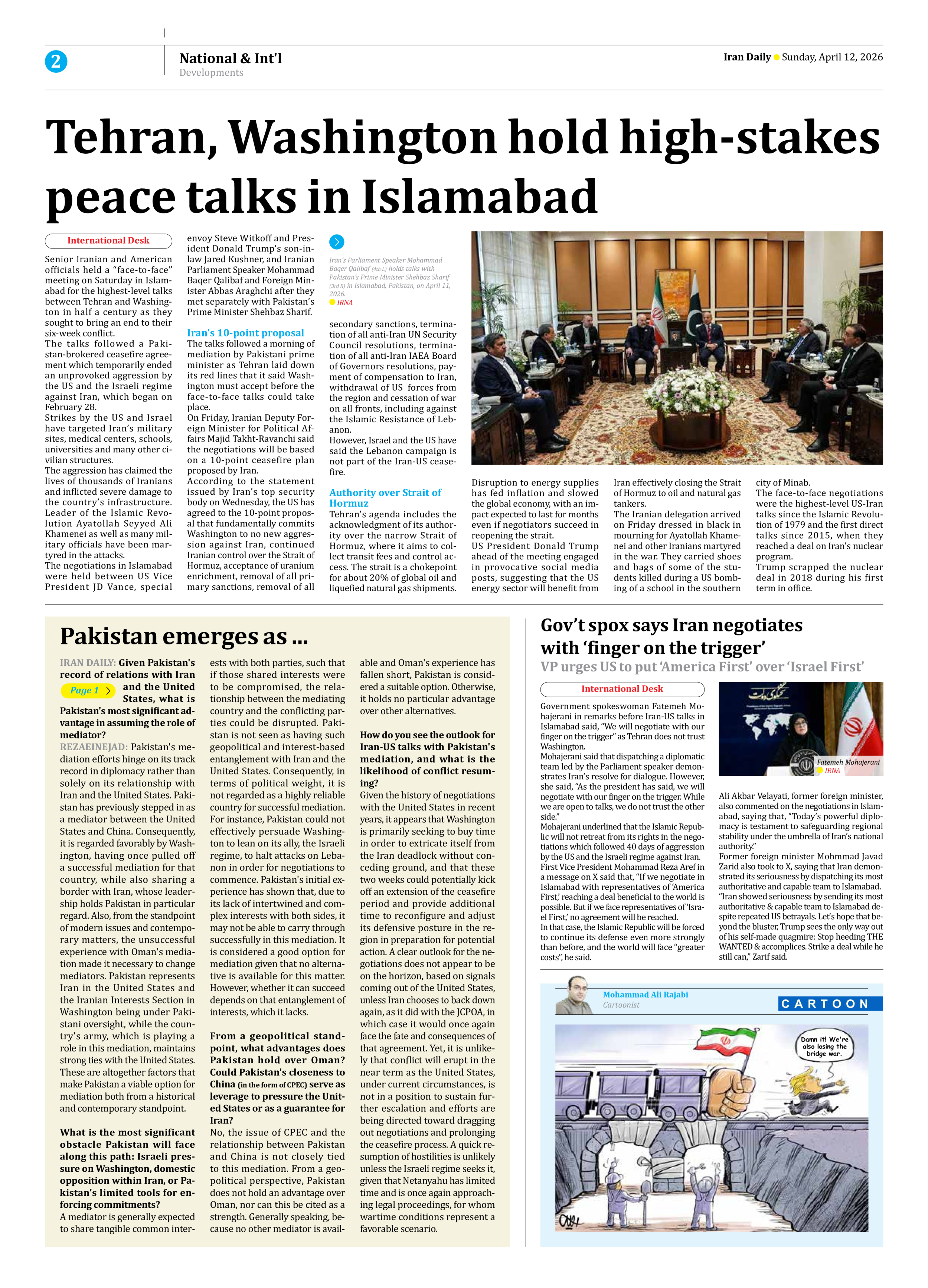
The negotiations in Islamabad were held between US Vice President JD Vance, special envoy Steve Witkoff and President Donald Trump’s son-in-law Jared Kushner, and Iranian Parliament Speaker Mohammad Baqer Qalibaf and Foreign Minister Abbas Araghchi after they met separately with Pakistan’s Prime Minister Shehbaz Sharif.
Iran’s 10-point proposal
The talks followed a morning of mediation by Pakistani prime minister as Tehran laid down its red lines that it said Washington must accept before the face-to-face talks could take place.
On Friday, Iranian Deputy Foreign Minister for Political Affairs Majid Takht-Ravanchi said the negotiations will be based on a 10-point ceasefire plan proposed by Iran.
According to the statement issued by Iran’s top security body on Wednesday, the US has agreed to the 10-point proposal that fundamentally commits Washington to no new aggression against Iran, continued Iranian control over the Strait of Hormuz, acceptance of uranium enrichment, removal of all primary sanctions, removal of all secondary sanctions, termination of all anti-Iran UN Security Council resolutions, termination of all anti-Iran IAEA Board of Governors resolutions, payment of compensation to Iran, withdrawal of US forces from the region and cessation of war on all fronts, including against the Islamic Resistance of Lebanon.
However, Israel and the US have said the Lebanon campaign is not part of the Iran-US ceasefire.
Authority over Strait of Hormuz
Tehran’s agenda includes the acknowledgment of its authority over the narrow Strait of Hormuz, where it aims to collect transit fees and control access. The strait is a chokepoint for about 20% of global oil and liquefied natural gas shipments.
Disruption to energy supplies has fed inflation and slowed the global economy, with an impact expected to last for months even if negotiators succeed in reopening the strait.
US President Donald Trump ahead of the meeting engaged in provocative social media posts, suggesting that the US energy sector will benefit from Iran effectively closing the Strait of Hormuz to oil and natural gas tankers.
The Iranian delegation arrived on Friday dressed in black in mourning for Ayatollah Khamenei and other Iranians martyred in the war. They carried shoes and bags of some of the students killed during a US bombing of a school in the southern city of Minab.
The face-to-face negotiations were the highest-level US-Iran talks since the Islamic Revolution of 1979 and the first direct talks since 2015, when they reached a deal on Iran’s nuclear program.
Trump scrapped the nuclear deal in 2018 during his first term in office.