







Conditioning Hormuz transit perfectly legal
By Reza Nasri
International Lawyer
Iran’s legal position regarding the Strait of Hormuz rests on a firm and multi-layered foundation in international law that has been consistently articulated, formally recorded, and never relinquished.
First, the applicable treaty framework does not support the imposition of the “transit passage” regime on Iran. The United Nations Convention on the Law of the Sea (UNCLOS) introduced transit passage as a novel legal construct, granting expansive rights — including overflight and submerged navigation — to foreign military assets. However, Iran never ratified UNCLOS and explicitly rejected this regime upon signature. Under general principles of treaty law, a state cannot be bound by provisions of a treaty it has not ratified, particularly where it has expressly objected to those provisions at the time of signature.
This position is reinforced by the doctrine of the persistent objector. Even if one assumes, arguendo, that transit passage has evolved into customary international law, Iran has consistently and openly rejected its applicability. As such, it is not bound by that rule.
Second, in the absence of a universally binding transit passage regime, the governing law reverts to earlier treaty law and customary principles, most notably the 1958 Geneva Convention on the Territorial Sea and the Contiguous Zone. Both Iran and key user states, such as the United States, are not parties to UNCLOS, creating a legal vacuum in which reliance on earlier treaty regimes is not only appropriate but necessary.
Under this framework, the right of passage through territorial seas is not unlimited. It is conditioned on innocent passage, a well-established rule allowing coastal states to regulate navigation to protect their security and public order. Crucially, innocent passage excludes activities that threaten the coastal state, including military operations, intelligence gathering, and acts connected to hostile conduct.
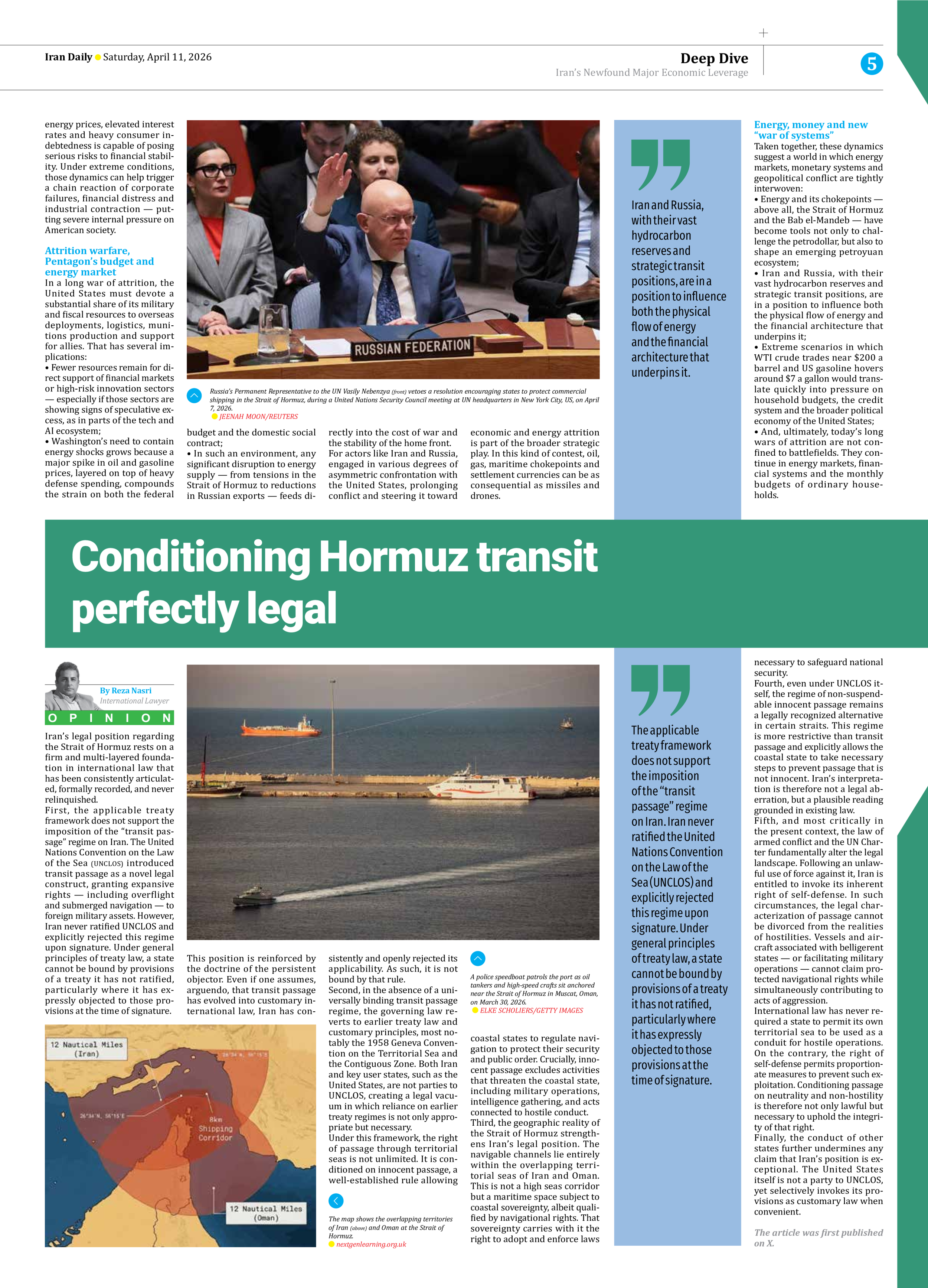
Third, the geographic reality of the Strait of Hormuz strengthens Iran’s legal position. The navigable channels lie entirely within the overlapping territorial seas of Iran and Oman. This is not a high seas corridor but a maritime space subject to coastal sovereignty, albeit qualified by navigational rights. That sovereignty carries with it the right to adopt and enforce laws necessary to safeguard national security.
Fourth, even under UNCLOS itself, the regime of non-suspendable innocent passage remains a legally recognized alternative in certain straits. This regime is more restrictive than transit passage and explicitly allows the coastal state to take necessary steps to prevent passage that is not innocent. Iran’s interpretation is therefore not a legal aberration, but a plausible reading grounded in existing law.
Fifth, and most critically in the present context, the law of armed conflict and the UN Charter fundamentally alter the legal landscape. Following an unlawful use of force against it, Iran is entitled to invoke its inherent right of self-defense. In such circumstances, the legal characterization of passage cannot be divorced from the realities of hostilities. Vessels and aircraft associated with belligerent states — or facilitating military operations — cannot claim protected navigational rights while simultaneously contributing to acts of aggression.
International law has never required a state to permit its own territorial sea to be used as a conduit for hostile operations. On the contrary, the right of self-defense permits proportionate measures to prevent such exploitation. Conditioning passage on neutrality and non-hostility is therefore not only lawful but necessary to uphold the integrity of that right.
Finally, the conduct of other states further undermines any claim that Iran’s position is exceptional. The United States itself is not a party to UNCLOS, yet selectively invokes its provisions as customary law when convenient.
The article was first published on X.