







From petrodollar to petroyuan
Iran’s emerging role in geopolitics of energy
By Reza Mokhtar
Senior energy
researcher
By Seyed Hamid Hosseini
Spokesperson for OPEX
Over the past half-century, the petrodollar has underpinned the global financial order. Since the 1970s, pricing and settling most of the world’s oil and gas trade in US dollars has allowed Washington to finance massive budget deficits and deploy the dollar as a tool of sanctions, pressure and financial control.
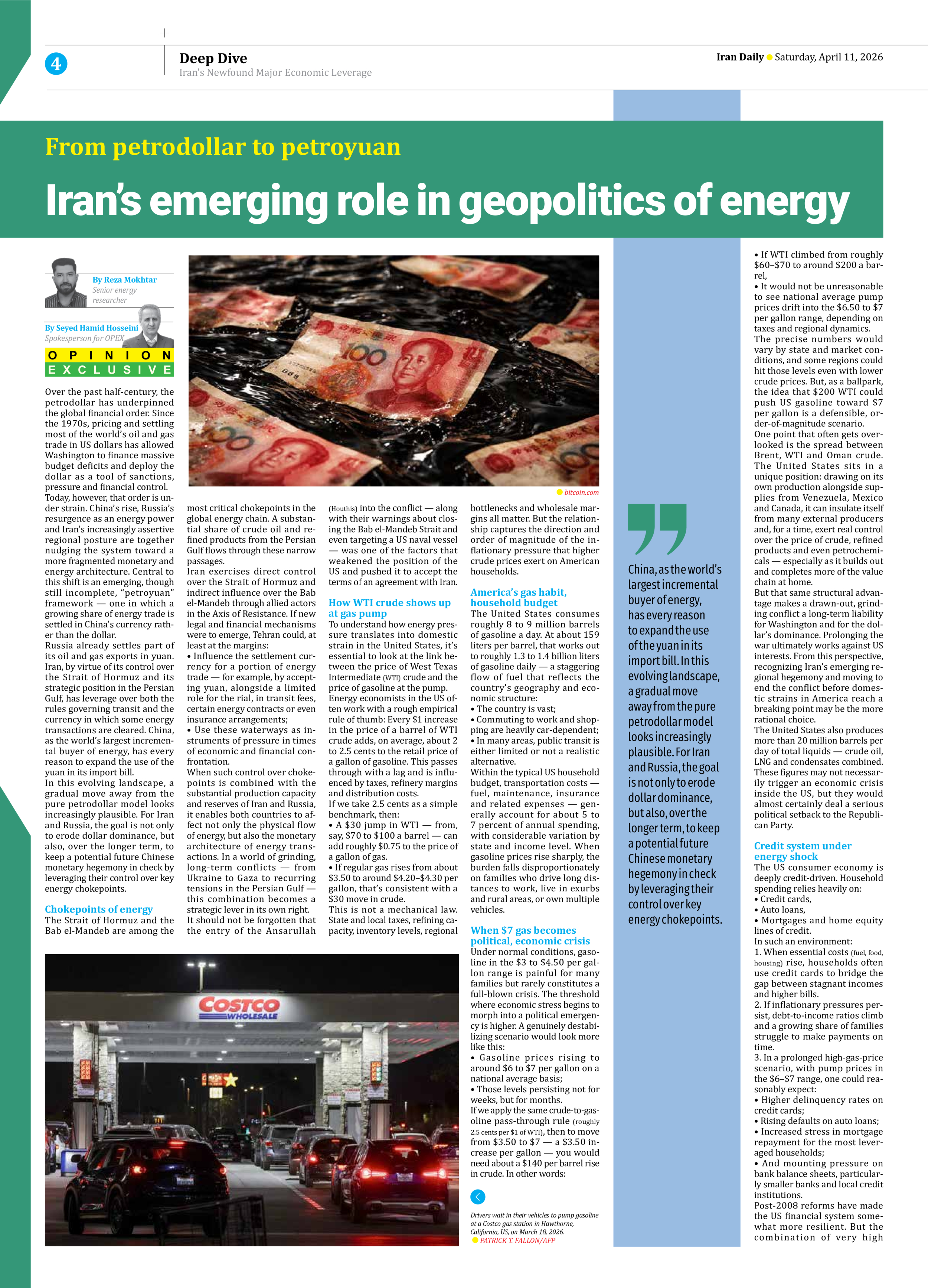
Today, however, that order is under strain. China’s rise, Russia’s resurgence as an energy power and Iran’s increasingly assertive regional posture are together nudging the system toward a more fragmented monetary and energy architecture. Central to this shift is an emerging, though still incomplete, “petroyuan” framework — one in which a growing share of energy trade is settled in China’s currency rather than the dollar.
Russia already settles part of its oil and gas exports in yuan. Iran, by virtue of its control over the Strait of Hormuz and its strategic position in the Persian Gulf, has leverage over both the rules governing transit and the currency in which some energy transactions are cleared. China, as the world’s largest incremental buyer of energy, has every reason to expand the use of the yuan in its import bill.
In this evolving landscape, a gradual move away from the pure petrodollar model looks increasingly plausible. For Iran and Russia, the goal is not only to erode dollar dominance, but also, over the longer term, to keep a potential future Chinese monetary hegemony in check by leveraging their control over key energy chokepoints.
Chokepoints of energy
The Strait of Hormuz and the Bab el‑Mandeb are among the most critical chokepoints in the global energy chain. A substantial share of crude oil and refined products from the Persian Gulf flows through these narrow passages.
Iran exercises direct control over the Strait of Hormuz and indirect influence over the Bab el‑Mandeb through allied actors in the Axis of Resistance. If new legal and financial mechanisms were to emerge, Tehran could, at least at the margins:
• Influence the settlement currency for a portion of energy trade — for example, by accepting yuan, alongside a limited role for the rial, in transit fees, certain energy contracts or even insurance arrangements;
• Use these waterways as instruments of pressure in times of economic and financial confrontation.
When such control over chokepoints is combined with the substantial production capacity and reserves of Iran and Russia, it enables both countries to affect not only the physical flow of energy, but also the monetary architecture of energy transactions. In a world of grinding, long-term conflicts — from Ukraine to Gaza to recurring tensions in the Persian Gulf — this combination becomes a strategic lever in its own right.
It should not be forgotten that the entry of the Ansarullah (Houthis) into the conflict — along with their warnings about closing the Bab el‑Mandeb Strait and even targeting a US naval vessel — was one of the factors that weakened the position of the US and pushed it to accept the terms of an agreement with Iran.
How WTI crude shows up at gas pump
To understand how energy pressure translates into domestic strain in the United States, it’s essential to look at the link between the price of West Texas Intermediate (WTI) crude and the price of gasoline at the pump.
Energy economists in the US often work with a rough empirical rule of thumb: Every $1 increase in the price of a barrel of WTI crude adds, on average, about 2 to 2.5 cents to the retail price of a gallon of gasoline. This passes through with a lag and is influenced by taxes, refinery margins and distribution costs.
If we take 2.5 cents as a simple benchmark, then:
• A $30 jump in WTI — from, say, $70 to $100 a barrel — can add roughly $0.75 to the price of a gallon of gas.
• If regular gas rises from about $3.50 to around $4.20–$4.30 per gallon, that’s consistent with a $30 move in crude.
This is not a mechanical law. State and local taxes, refining capacity, inventory levels, regional bottlenecks and wholesale margins all matter. But the relationship captures the direction and order of magnitude of the inflationary pressure that higher crude prices exert on American households.
America’s gas habit, household budget
The United States consumes roughly 8 to 9 million barrels of gasoline a day. At about 159 liters per barrel, that works out to roughly 1.3 to 1.4 billion liters of gasoline daily — a staggering flow of fuel that reflects the country’s geography and economic structure:
• The country is vast;
• Commuting to work and shopping are heavily car‑dependent;
• In many areas, public transit is either limited or not a realistic alternative.
Within the typical US household budget, transportation costs — fuel, maintenance, insurance and related expenses — generally account for about 5 to 7 percent of annual spending, with considerable variation by state and income level. When gasoline prices rise sharply, the burden falls disproportionately on families who drive long distances to work, live in exurbs and rural areas, or own multiple vehicles.
When $7 gas becomes political, economic crisis
Under normal conditions, gasoline in the $3 to $4.50 per gallon range is painful for many families but rarely constitutes a full‑blown crisis. The threshold where economic stress begins to morph into a political emergency is higher. A genuinely destabilizing scenario would look more like this:
• Gasoline prices rising to around $6 to $7 per gallon on a national average basis;
• Those levels persisting not for weeks, but for months.
If we apply the same crude‑to‑gasoline pass‑through rule (roughly 2.5 cents per $1 of WTI), then to move from $3.50 to $7 — a $3.50 increase per gallon — you would need about a $140 per barrel rise in crude. In other words:
• If WTI climbed from roughly $60–$70 to around $200 a barrel,
• It would not be unreasonable to see national average pump prices drift into the $6.50 to $7 per gallon range, depending on taxes and regional dynamics.
The precise numbers would vary by state and market conditions, and some regions could hit those levels even with lower crude prices. But, as a ballpark, the idea that $200 WTI could push US gasoline toward $7 per gallon is a defensible, order‑of‑magnitude scenario.
One point that often gets overlooked is the spread between Brent, WTI and Oman crude. The United States sits in a unique position: drawing on its own production alongside supplies from Venezuela, Mexico and Canada, it can insulate itself from many external producers and, for a time, exert real control over the price of crude, refined products and even petrochemicals — especially as it builds out and completes more of the value chain at home.
But that same structural advantage makes a drawn‑out, grinding conflict a long‑term liability for Washington and for the dollar’s dominance. Prolonging the war ultimately works against US interests. From this perspective, recognizing Iran’s emerging regional hegemony and moving to end the conflict before domestic strains in America reach a breaking point may be the more rational choice.
The United States also produces more than 20 million barrels per day of total liquids — crude oil, LNG and condensates combined. These figures may not necessarily trigger an economic crisis inside the US, but they would almost certainly deal a serious political setback to the Republican Party.
Credit system under energy shock
The US consumer economy is deeply credit‑driven. Household spending relies heavily on:
• Credit cards,
• Auto loans,
• Mortgages and home equity lines of credit.
In such an environment:
1. When essential costs (fuel, food, housing) rise, households often use credit cards to bridge the gap between stagnant incomes and higher bills.
2. If inflationary pressures persist, debt‑to‑income ratios climb and a growing share of families struggle to make payments on time.
3. In a prolonged high‑gas‑price scenario, with pump prices in the $6–$7 range, one could reasonably expect:
• Higher delinquency rates on credit cards;
• Rising defaults on auto loans;
• Increased stress in mortgage repayment for the most leveraged households;
• And mounting pressure on bank balance sheets, particularly smaller banks and local credit institutions.
Post‑2008 reforms have made the US financial system somewhat more resilient. But the combination of very high
energy prices, elevated interest rates and heavy consumer indebtedness is capable of posing serious risks to financial stability. Under extreme conditions, those dynamics can help trigger a chain reaction of corporate failures, financial distress and industrial contraction — putting severe internal pressure on American society.
Attrition warfare, Pentagon’s budget and energy market
In a long war of attrition, the United States must devote a substantial share of its military and fiscal resources to overseas deployments, logistics, munitions production and support for allies. That has several implications:
• Fewer resources remain for direct support of financial markets or high‑risk innovation sectors — especially if those sectors are showing signs of speculative excess, as in parts of the tech and AI ecosystem;
• Washington’s need to contain energy shocks grows because a major spike in oil and gasoline prices, layered on top of heavy defense spending, compounds the strain on both the federal budget and the domestic social contract;
• In such an environment, any significant disruption to energy supply — from tensions in the Strait of Hormuz to reductions in Russian exports — feeds directly into the cost of war and the stability of the home front.
For actors like Iran and Russia, engaged in various degrees of asymmetric confrontation with the United States, prolonging conflict and steering it toward economic and energy attrition is part of the broader strategic play. In this kind of contest, oil, gas, maritime chokepoints and settlement currencies can be as consequential as missiles and drones.
Energy, money and new “war of systems”
Taken together, these dynamics suggest a world in which energy markets, monetary systems and geopolitical conflict are tightly interwoven:
• Energy and its chokepoints — above all, the Strait of Hormuz and the Bab el‑Mandeb — have become tools not only to challenge the petrodollar, but also to shape an emerging petroyuan ecosystem;
• Iran and Russia, with their vast hydrocarbon reserves and strategic transit positions, are in a position to influence both the physical flow of energy and the financial architecture that underpins it;
• Extreme scenarios in which WTI crude trades near $200 a barrel and US gasoline hovers around $7 a gallon would translate quickly into pressure on household budgets, the credit system and the broader political economy of the United States;
• And, ultimately, today’s long wars of attrition are not confined to battlefields. They continue in energy markets, financial systems and the monthly budgets of ordinary households.