





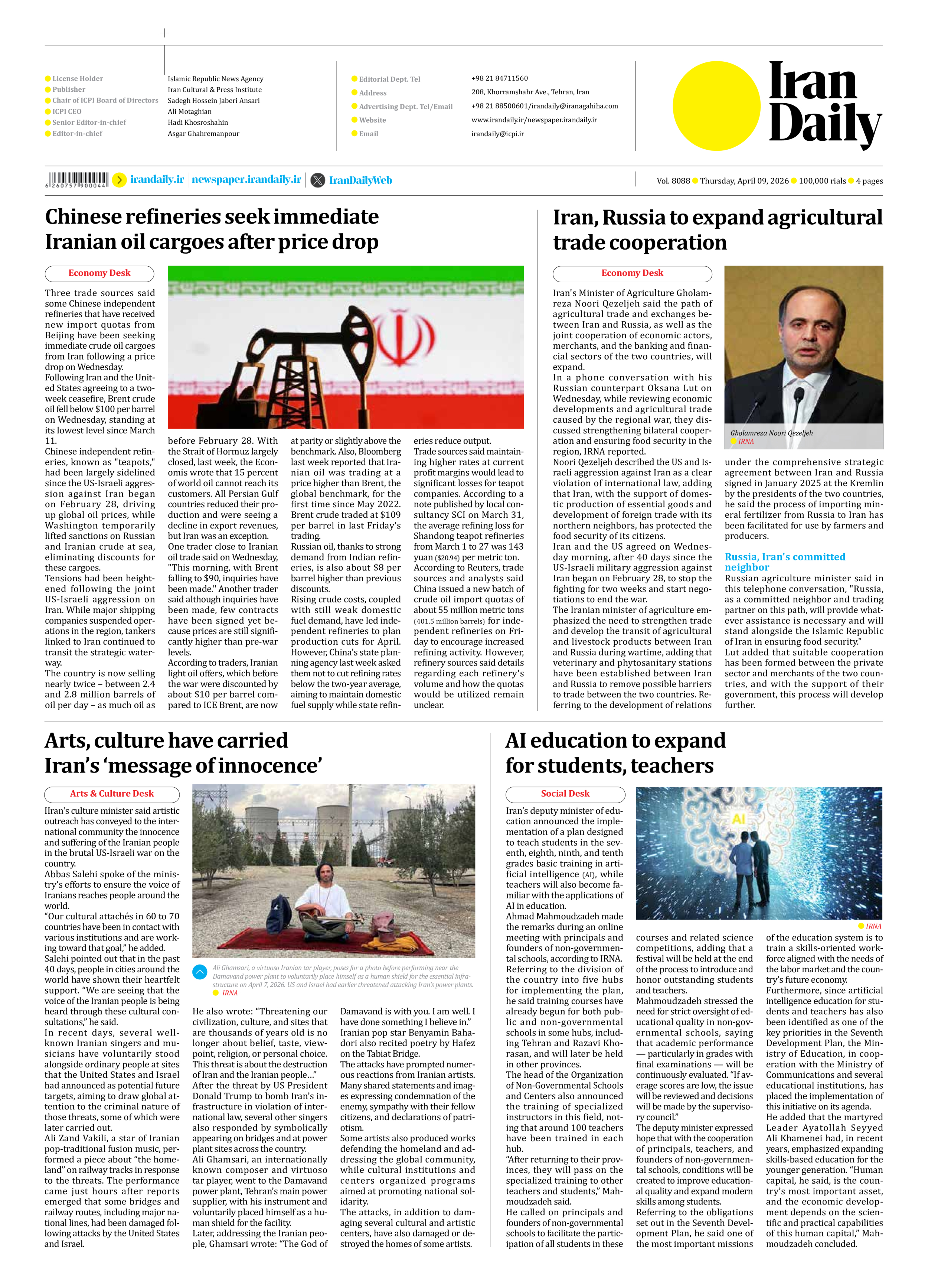


Chinese refineries seek immediate Iranian oil cargoes after price drop
Three trade sources said some Chinese independent refineries that have received new import quotas from Beijing have been seeking immediate crude oil cargoes from Iran following a price drop on Wednesday.
Following Iran and the United States agreeing to a two-week ceasefire, Brent crude oil fell below $100 per barrel on Wednesday, standing at its lowest level since March 11.
Chinese independent refineries, known as "teapots," had been largely sidelined since the US-Israeli aggression against Iran began on February 28, driving up global oil prices, while Washington temporarily lifted sanctions on Russian and Iranian crude at sea, eliminating discounts for these cargoes.
Tensions had been heightened following the joint US-Israeli aggression on Iran. While major shipping companies suspended operations in the region, tankers linked to Iran continued to transit the strategic waterway.
The country is now selling nearly twice – between 2.4 and 2.8 million barrels of oil per day – as much oil as before February 28. With the Strait of Hormuz largely closed, last week, the Economis wrote that 15 percent of world oil cannot reach its customers. All Persian Gulf countries reduced their production and were seeing a decline in export revenues, but Iran was an exception.
One trader close to Iranian oil trade said on Wednesday, "This morning, with Brent falling to $90, inquiries have been made." Another trader said although inquiries have been made, few contracts have been signed yet because prices are still significantly higher than pre-war levels.
According to traders, Iranian light oil offers, which before the war were discounted by about $10 per barrel compared to ICE Brent, are now at parity or slightly above the benchmark. Also, Bloomberg last week reported that Iranian oil was trading at a price higher than Brent, the global benchmark, for the first time since May 2022. Brent crude traded at $109 per barrel in last Friday's trading.
Russian oil, thanks to strong demand from Indian refineries, is also about $8 per barrel higher than previous discounts.
Rising crude costs, coupled with still weak domestic fuel demand, have led independent refineries to plan production cuts for April. However, China's state planning agency last week asked them not to cut refining rates below the two-year average, aiming to maintain domestic fuel supply while state refineries reduce output.
Trade sources said maintaining higher rates at current profit margins would lead to significant losses for teapot companies. According to a note published by local consultancy SCI on March 31, the average refining loss for Shandong teapot refineries from March 1 to 27 was 143 yuan ($20.94) per metric ton.
According to Reuters, trade sources and analysts said China issued a new batch of crude oil import quotas of about 55 million metric tons (401.5 million barrels) for independent refineries on Friday to encourage increased refining activity. However, refinery sources said details regarding each refinery's volume and how the quotas would be utilized remain unclear.