







Pattern of violations against Iranian children from Minab to history
By Mohammad Mehdi
Seyed Nasseri
Researcher & Int’l Law Lecturer at Shahid Beheshti University
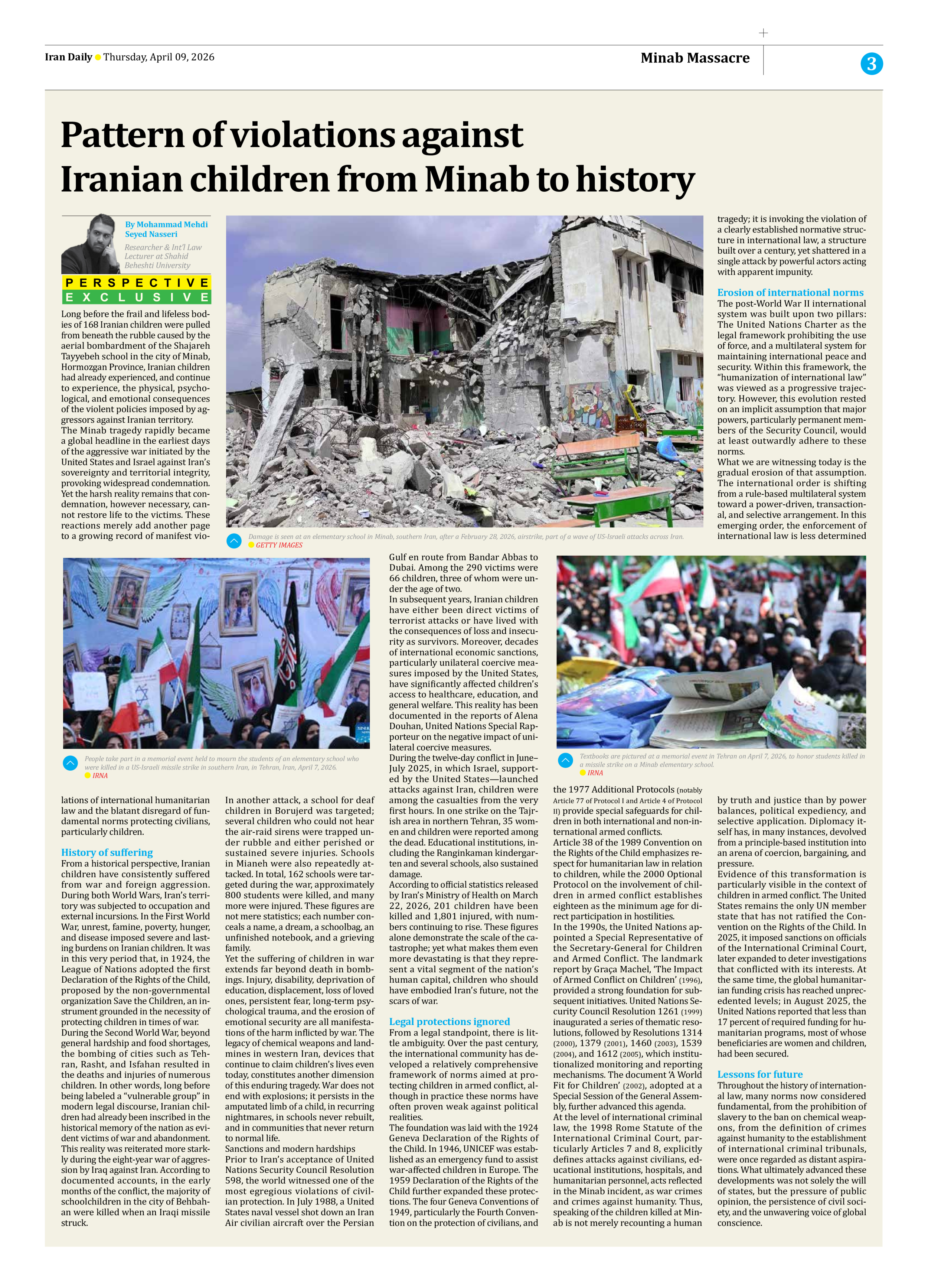
Long before the frail and lifeless bodies of 168 Iranian children were pulled from beneath the rubble caused by the aerial bombardment of the Shajareh Tayyebeh school in the city of Minab, Hormozgan Province, Iranian children had already experienced, and continue to experience, the physical, psychological, and emotional consequences of the violent policies imposed by aggressors against Iranian territory.
The Minab tragedy rapidly became a global headline in the earliest days of the aggressive war initiated by the United States and Israel against Iran’s sovereignty and territorial integrity, provoking widespread condemnation. Yet the harsh reality remains that condemnation, however necessary, cannot restore life to the victims. These reactions merely add another page to a growing record of manifest violations of international humanitarian law and the blatant disregard of fundamental norms protecting civilians, particularly children.
History of suffering
From a historical perspective, Iranian children have consistently suffered from war and foreign aggression. During both World Wars, Iran’s territory was subjected to occupation and external incursions. In the First World War, unrest, famine, poverty, hunger, and disease imposed severe and lasting burdens on Iranian children. It was in this very period that, in 1924, the League of Nations adopted the first Declaration of the Rights of the Child, proposed by the non-governmental organization Save the Children, an instrument grounded in the necessity of protecting children in times of war.
During the Second World War, beyond general hardship and food shortages, the bombing of cities such as Tehran, Rasht, and Isfahan resulted in the deaths and injuries of numerous children. In other words, long before being labeled a “vulnerable group” in modern legal discourse, Iranian children had already been inscribed in the historical memory of the nation as evident victims of war and abandonment.
This reality was reiterated more starkly during the eight-year war of aggression by Iraq against Iran. According to documented accounts, in the early months of the conflict, the majority of schoolchildren in the city of Behbahan were killed when an Iraqi missile struck.
In another attack, a school for deaf children in Borujerd was targeted; several children who could not hear the air-raid sirens were trapped under rubble and either perished or sustained severe injuries. Schools in Mianeh were also repeatedly attacked. In total, 162 schools were targeted during the war, approximately 800 students were killed, and many more were injured. These figures are not mere statistics; each number conceals a name, a dream, a schoolbag, an unfinished notebook, and a grieving family.
Yet the suffering of children in war extends far beyond death in bombings. Injury, disability, deprivation of education, displacement, loss of loved ones, persistent fear, long-term psychological trauma, and the erosion of emotional security are all manifestations of the harm inflicted by war. The legacy of chemical weapons and landmines in western Iran, devices that continue to claim children’s lives even today, constitutes another dimension of this enduring tragedy. War does not end with explosions; it persists in the amputated limb of a child, in recurring nightmares, in schools never rebuilt, and in communities that never return to normal life.
Sanctions and modern hardships
Prior to Iran’s acceptance of United Nations Security Council Resolution 598, the world witnessed one of the most egregious violations of civilian protection. In July 1988, a United States naval vessel shot down an Iran Air civilian aircraft over the Persian Gulf en route from Bandar Abbas to Dubai. Among the 290 victims were 66 children, three of whom were under the age of two.
In subsequent years, Iranian children have either been direct victims of terrorist attacks or have lived with the consequences of loss and insecurity as survivors. Moreover, decades of international economic sanctions, particularly unilateral coercive measures imposed by the United States, have significantly affected children’s access to healthcare, education, and general welfare. This reality has been documented in the reports of Alena Douhan, United Nations Special Rapporteur on the negative impact of unilateral coercive measures.
During the twelve-day conflict in June–July 2025, in which Israel, supported by the United States—launched attacks against Iran, children were among the casualties from the very first hours. In one strike on the Tajrish area in northern Tehran, 35 women and children were reported among the dead. Educational institutions, including the Ranginkaman kindergarten and several schools, also sustained damage.
According to official statistics released by Iran’s Ministry of Health on March 22, 2026, 201 children have been killed and 1,801 injured, with numbers continuing to rise. These figures alone demonstrate the scale of the catastrophe; yet what makes them even more devastating is that they represent a vital segment of the nation’s human capital, children who should have embodied Iran’s future, not the scars of war.
Legal protections ignored
From a legal standpoint, there is little ambiguity. Over the past century, the international community has developed a relatively comprehensive framework of norms aimed at protecting children in armed conflict, although in practice these norms have often proven weak against political realities.
The foundation was laid with the 1924 Geneva Declaration of the Rights of the Child. In 1946, UNICEF was established as an emergency fund to assist war-affected children in Europe. The 1959 Declaration of the Rights of the Child further expanded these protections. The four Geneva Conventions of 1949, particularly the Fourth Convention on the protection of civilians, and the 1977 Additional Protocols (notably Article 77 of Protocol I and Article 4 of Protocol II) provide special safeguards for children in both international and non-international armed conflicts.
Article 38 of the 1989 Convention on the Rights of the Child emphasizes respect for humanitarian law in relation to children, while the 2000 Optional Protocol on the involvement of children in armed conflict establishes eighteen as the minimum age for direct participation in hostilities.
In the 1990s, the United Nations appointed a Special Representative of the Secretary-General for Children and Armed Conflict. The landmark report by Graça Machel, ‘The Impact of Armed Conflict on Children’ (1996), provided a strong foundation for subsequent initiatives. United Nations Security Council Resolution 1261 (1999) inaugurated a series of thematic resolutions, followed by Resolutions 1314 (2000), 1379 (2001), 1460 (2003), 1539 (2004), and 1612 (2005), which institutionalized monitoring and reporting mechanisms. The document ‘A World Fit for Children’ (2002), adopted at a Special Session of the General Assembly, further advanced this agenda.
At the level of international criminal law, the 1998 Rome Statute of the International Criminal Court, particularly Articles 7 and 8, explicitly defines attacks against civilians, educational institutions, hospitals, and humanitarian personnel, acts reflected in the Minab incident, as war crimes and crimes against humanity. Thus, speaking of the children killed at Minab is not merely recounting a human tragedy; it is invoking the violation of a clearly established normative structure in international law, a structure built over a century, yet shattered in a single attack by powerful actors acting with apparent impunity.
Erosion of international norms
The post-World War II international system was built upon two pillars: The United Nations Charter as the legal framework prohibiting the use of force, and a multilateral system for maintaining international peace and security. Within this framework, the “humanization of international law” was viewed as a progressive trajectory. However, this evolution rested on an implicit assumption that major powers, particularly permanent members of the Security Council, would at least outwardly adhere to these norms.
What we are witnessing today is the gradual erosion of that assumption. The international order is shifting from a rule-based multilateral system toward a power-driven, transactional, and selective arrangement. In this emerging order, the enforcement of international law is less determined by truth and justice than by power balances, political expediency, and selective application. Diplomacy itself has, in many instances, devolved from a principle-based institution into an arena of coercion, bargaining, and pressure.
Evidence of this transformation is particularly visible in the context of children in armed conflict. The United States remains the only UN member state that has not ratified the Convention on the Rights of the Child. In 2025, it imposed sanctions on officials of the International Criminal Court, later expanded to deter investigations that conflicted with its interests. At the same time, the global humanitarian funding crisis has reached unprecedented levels; in August 2025, the United Nations reported that less than 17 percent of required funding for humanitarian programs, most of whose beneficiaries are women and children, had been secured.
Lessons for future
Throughout the history of international law, many norms now considered fundamental, from the prohibition of slavery to the ban on chemical weapons, from the definition of crimes against humanity to the establishment of international criminal tribunals, were once regarded as distant aspirations. What ultimately advanced these developments was not solely the will of states, but the pressure of public opinion, the persistence of civil society, and the unwavering voice of global conscience.