





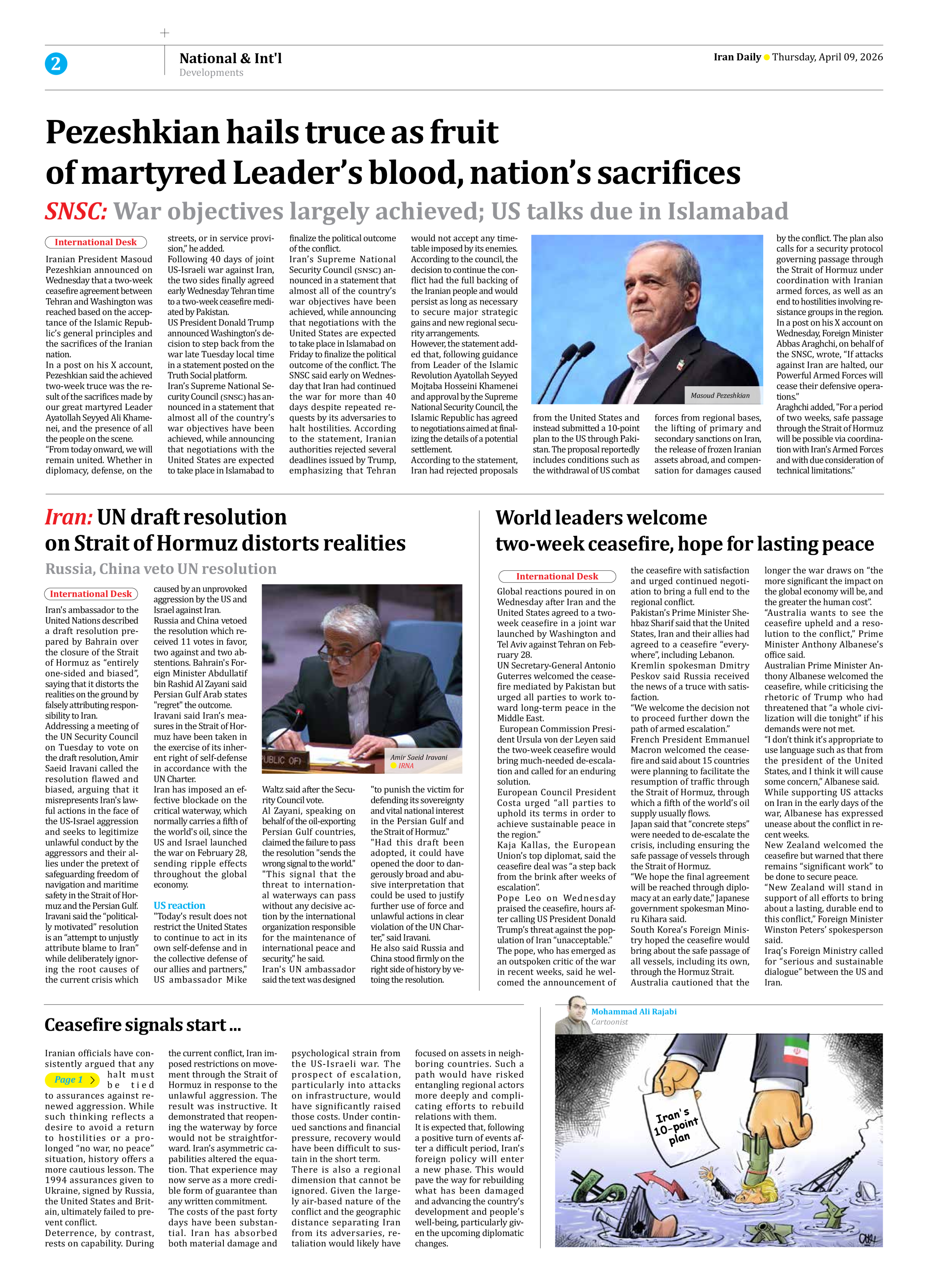


Iran: UN draft resolution on Strait of Hormuz distorts realities
Russia, China veto UN resolution
Iran's ambassador to the United Nations described a draft resolution prepared by Bahrain over the closure of the Strait of Hormuz as “entirely one-sided and biased”, saying that it distorts the realities on the ground by falsely attributing responsibility to Iran.
Addressing a meeting of the UN Security Council on Tuesday to vote on the draft resolution, Amir Saeid Iravani called the resolution flawed and biased, arguing that it misrepresents Iran's lawful actions in the face of the US-Israel aggression and seeks to legitimize unlawful conduct by the aggressors and their allies under the pretext of safeguarding freedom of navigation and maritime safety in the Strait of Hormuz and the Persian Gulf.
Iravani said the “politically motivated” resolution is an “attempt to unjustly attribute blame to Iran” while deliberately ignoring the root causes of the current crisis which caused by an unprovoked aggression by the US and Israel against Iran.
Russia and China vetoed the resolution which received 11 votes in favor, two against and two abstentions. Bahrain's Foreign Minister Abdullatif bin Rashid Al Zayani said Persian Gulf Arab states "regret" the outcome.
Iravani said Iran’s measures in the Strait of Hormuz have been taken in the exercise of its inherent right of self-defense in accordance with the UN Charter.
Iran has imposed an effective blockade on the critical waterway, which normally carries a fifth of the world's oil, since the US and Israel launched the war on February 28, sending ripple effects throughout the global economy.
US reaction
"Today's result does not restrict the United States to continue to act in its own self-defense and in the collective defense of our allies and partners," US ambassador Mike Waltz said after the Security Council vote.
Al Zayani, speaking on behalf of the oil-exporting Persian Gulf countries, claimed the failure to pass the resolution "sends the wrong signal to the world."
"This signal that the threat to international waterways can pass without any decisive action by the international organization responsible for the maintenance of international peace and security," he said.
Iran's UN ambassador said the text was designed "to punish the victim for defending its sovereignty and vital national interest in the Persian Gulf and the Strait of Hormuz."
"Had this draft been adopted, it could have opened the door to dangerously broad and abusive interpretation that could be used to justify further use of force and unlawful actions in clear violation of the UN Charter," said Iravani.
He also said Russia and China stood firmly on the right side of history by vetoing the resolution.