







Iran speaks with one voice, chanting victory
National unity from streets to battlefield
By Sadeq Dehqan
Staff writer
Nearly 40 days have passed since the military aggression by the United States and Israel on Iran. The war, which US President Donald Trump claimed was intended to help the Iranian people, has since led to the destruction of schools, universities, hospitals and infrastructure used by civilians across the country.
In response, Iran has carried out wide-ranging missile and drone strikes targeting Israeli-occupied territories as well as US and Israeli military bases and interests across the region. Despite deliberate media blackout efforts by the adversary, only a portion of the scale of these strikes has surfaced in the news. Much of what has emerged has come through footage captured on personal mobile phones, circulating beyond official channels.
Yet beyond the battlefield and beyond what is reflected in fragmented media coverage, another development has been unfolding. It is visible not in official statements, but in the streets and squares of cities across Iran. What has received far less attention in foreign-based media is the scale, intensity and persistence of public gatherings, where people have been turning out night after night to show support for the country’s armed forces in the face of the enemy.
In Tehran, as in other parts of the country, the atmosphere has shifted in noticeable ways. The city continues to function, but signs of heightened alert are visible across different areas. Checkpoints have been set up by military and police forces, along with volunteer units, to maintain security and monitor suspicious movements. Civilians cooperate as they pass through these checkpoints, slowing down, complying with checks and, in many cases, exchanging brief greetings or words of encouragement with officers before moving on.
Normal life goes on
Despite wartime conditions, daily life continues. Pedestrians move steadily along sidewalks and through intersections. Street vendors call out to attract customers. Shops remain open and illuminated, while cafés continue to serve customers, with the scent of coffee drifting into the air. The scene conveys a sense of continuity and resilience. At moments, it becomes easy to lose sight of the fact that a war is under way.
That sense is interrupted from time to time. At irregular intervals, the sound of an explosion echoes from another part of the city. The reaction is brief but revealing. Passersby pause, look up toward the sky or in the direction of the sound, and sometimes point out what they believe may have been targeted. Within moments, however, the pause ends, and movement resumes as people continue on their way.
At different hours of the day, convoys of motorcycles and cars move through the city. They carry the national tricolor flag and broadcast revolutionary and patriotic songs through loudspeakers. As they drive through streets and intersections, they draw attention and create a noticeable surge of energy along their routes. For those who experienced the eight-year war with Iraq in the 1980s, these scenes evoke a strong sense of familiarity.
Nightly rallies & chants
of support
As night falls, the city takes on a more defined character. Public squares, which serve as ordinary gathering points during the day, gradually fill and transform into visible spaces of collective presence. Over time, they become stages where expressions of resilience and solidarity are openly displayed.
Each night, the gatherings grow larger and more coordinated. People come together to support the armed forces and to send a clear message to the adversary. Through their presence and their chants, they signal that they are not prepared to back down under any circumstances.
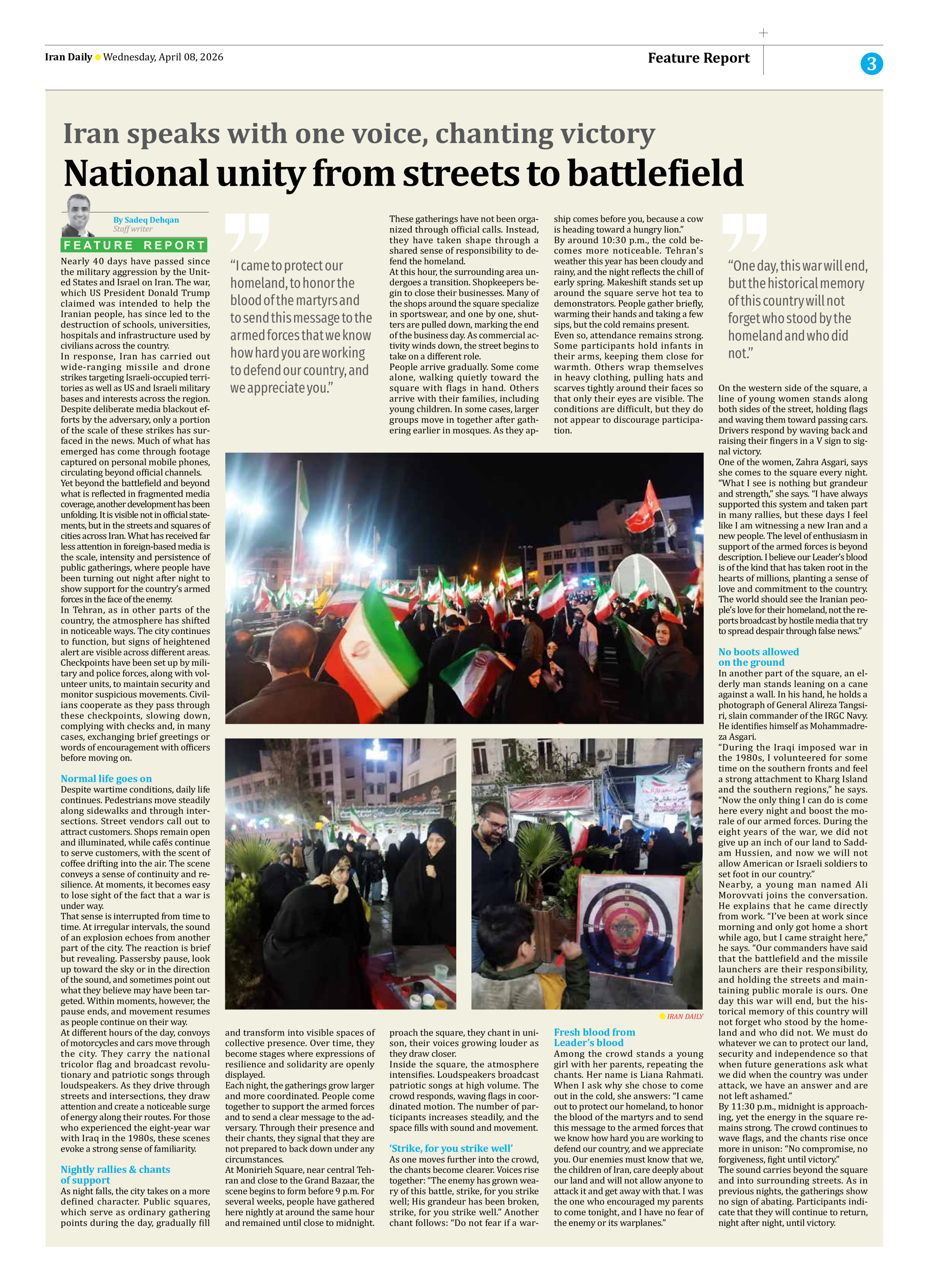
At Monirieh Square, near central Tehran and close to the Grand Bazaar, the scene begins to form before 9 p.m. For several weeks, people have gathered here nightly at around the same hour and remained until close to midnight. These gatherings have not been organized through official calls. Instead, they have taken shape through a shared sense of responsibility to defend the homeland.
At this hour, the surrounding area undergoes a transition. Shopkeepers begin to close their businesses. Many of the shops around the square specialize in sportswear, and one by one, shutters are pulled down, marking the end of the business day. As commercial activity winds down, the street begins to take on a different role.
People arrive gradually. Some come alone, walking quietly toward the square with flags in hand. Others arrive with their families, including young children. In some cases, larger groups move in together after gathering earlier in mosques. As they approach the square, they chant in unison, their voices growing louder as they draw closer.
Inside the square, the atmosphere intensifies. Loudspeakers broadcast patriotic songs at high volume. The crowd responds, waving flags in coordinated motion. The number of participants increases steadily, and the space fills with sound and movement.
‘Strike, for you strike well’
As one moves further into the crowd, the chants become clearer. Voices rise together: “The enemy has grown weary of this battle, strike, for you strike well; His grandeur has been broken, strike, for you strike well.” Another chant follows: “Do not fear if a warship comes before you, because a cow is heading toward a hungry lion.”
By around 10:30 p.m., the cold becomes more noticeable. Tehran’s weather this year has been cloudy and rainy, and the night reflects the chill of early spring. Makeshift stands set up around the square serve hot tea to demonstrators. People gather briefly, warming their hands and taking a few sips, but the cold remains present.
Even so, attendance remains strong. Some participants hold infants in their arms, keeping them close for warmth. Others wrap themselves in heavy clothing, pulling hats and scarves tightly around their faces so that only their eyes are visible. The conditions are difficult, but they do not appear to discourage participation.
Fresh blood from
Leader’s blood
Among the crowd stands a young girl with her parents, repeating the chants. Her name is Liana Rahmati. When I ask why she chose to come out in the cold, she answers: “I came out to protect our homeland, to honor the blood of the martyrs and to send this message to the armed forces that we know how hard you are working to defend our country, and we appreciate you. Our enemies must know that we, the children of Iran, care deeply about our land and will not allow anyone to attack it and get away with that. I was the one who encouraged my parents to come tonight, and I have no fear of the enemy or its warplanes.”
On the western side of the square, a line of young women stands along both sides of the street, holding flags and waving them toward passing cars. Drivers respond by waving back and raising their fingers in a V sign to signal victory.
One of the women, Zahra Asgari, says she comes to the square every night. “What I see is nothing but grandeur and strength,” she says. “I have always supported this system and taken part in many rallies, but these days I feel like I am witnessing a new Iran and a new people. The level of enthusiasm in support of the armed forces is beyond description. I believe our Leader’s blood is of the kind that has taken root in the hearts of millions, planting a sense of love and commitment to the country. The world should see the Iranian people’s love for their homeland, not the reports broadcast by hostile media that try to spread despair through false news.”
No boots allowed
on the ground
In another part of the square, an elderly man stands leaning on a cane against a wall. In his hand, he holds a photograph of General Alireza Tangsiri, slain commander of the IRGC Navy. He identifies himself as Mohammadreza Asgari.
“During the Iraqi imposed war in the 1980s, I volunteered for some time on the southern fronts and feel a strong attachment to Kharg Island and the southern regions,” he says. “Now the only thing I can do is come here every night and boost the morale of our armed forces. During the eight years of the war, we did not give up an inch of our land to Saddam Hussien, and now we will not allow American or Israeli soldiers to set foot in our country.”
Nearby, a young man named Ali Morovvati joins the conversation. He explains that he came directly from work. “I’ve been at work since morning and only got home a short while ago, but I came straight here,” he says. “Our commanders have said that the battlefield and the missile launchers are their responsibility, and holding the streets and maintaining public morale is ours. One day this war will end, but the historical memory of this country will not forget who stood by the homeland and who did not. We must do whatever we can to protect our land, security and independence so that when future generations ask what we did when the country was under attack, we have an answer and are not left ashamed.”
By 11:30 p.m., midnight is approaching, yet the energy in the square remains strong. The crowd continues to wave flags, and the chants rise once more in unison: “No compromise, no forgiveness, fight until victory.”
The sound carries beyond the square and into surrounding streets. As in previous nights, the gatherings show no sign of abating. Participants indicate that they will continue to return, night after night, until victory.