







Energy minister vows full grid stability amid US threats
Iran's Minister of Energy Abbas Ali-Abadi said Monday the country's power supply to all sensitive facilities is fully operational, with surplus electricity available to meet domestic demand, following renewed US threats to target Iranian infrastructure.
“All sensitive centers across the country are receiving power, and we currently have excess electricity that can cover the needs of our people,” Ali-Abadi said, while urging citizens to avoid wasteful consumption.
“We have excess power,” he stated, reaffirming the government’s ability to serve citizens without disruption.
He urged the public to avoid wasteful consumption and use energy resources responsibly. “We must use these valuable resources wisely,” he said, stressing that electricity is a product of immense effort and sacrifice.
The minister's comments came as US President Donald Trump, in a series of social media posts and interviews on Sunday, threatened to bomb Iranian infrastructure and “destroy” the country if the Strait of Hormuz remains closed after 48 hours.
Iran has prohibited ships of hostile states from passing through the Strait of Hormuz since a US-Israeli attack began on February 28.
Trump's threat to target infrastructure drew widespread condemnation internationally and within Iran.
The American-Zionist aggression, among the primary sites struck, has targeted civilian and infrastructure positions.
Sector ready for crisis conditions
Meanwhile, Mostafa Rajabi Mashhadi, Deputy Minister of Energy, visited operational teams in Tehran, underscoring the sector’s readiness for crisis conditions.
During a visit to the Tehran Regional Electricity Company, he highlighted the deployment of advanced smart-grid technologies and domestic technical capabilities aimed at enhancing network stability, particularly in the capital. “The system is prepared,” Rajabi Mashhadi said, noting that real-time monitoring and rapid response units have been instrumental in maintaining service despite enemy strikes.
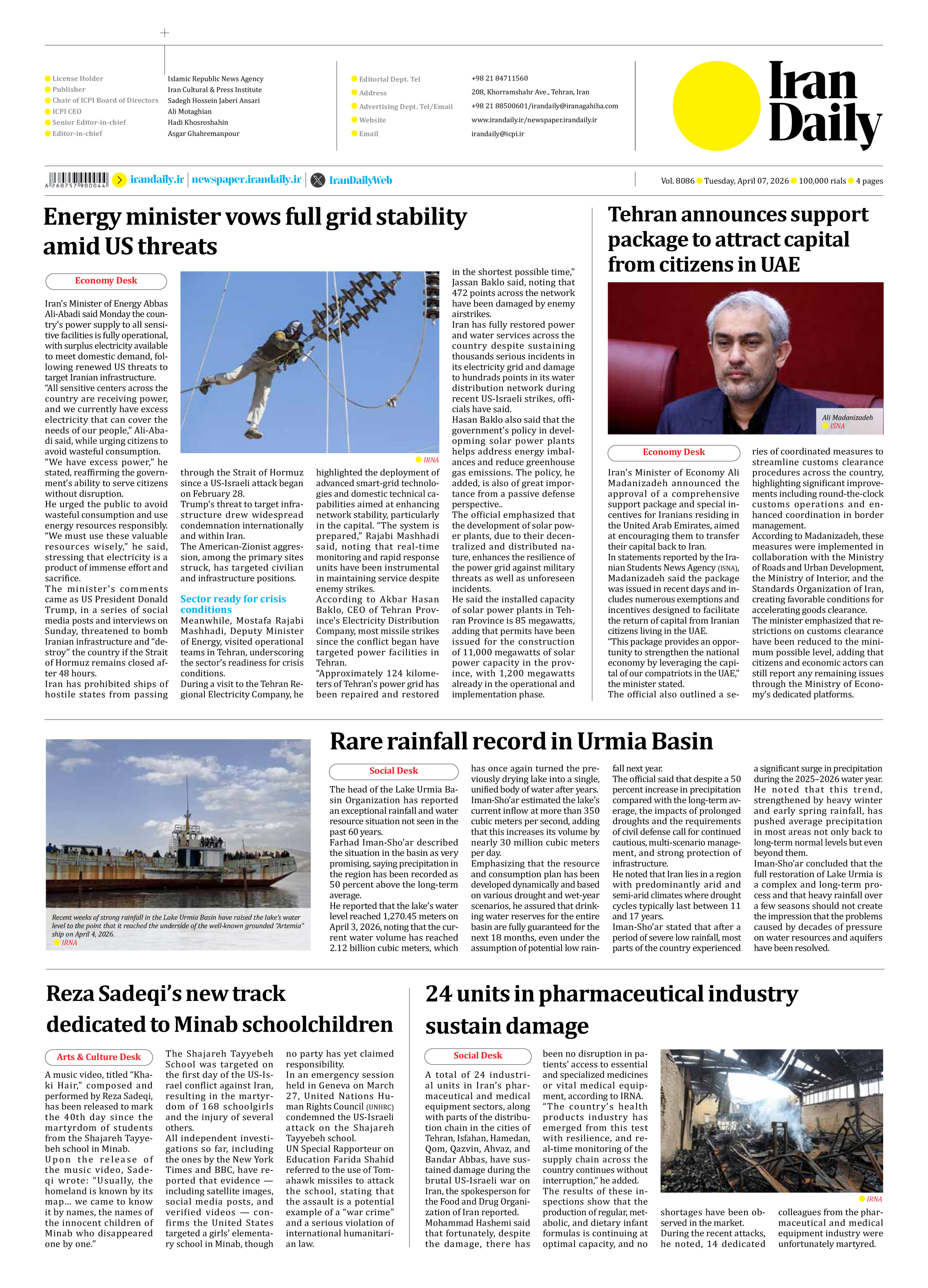
According to Akbar Hasan Baklo, CEO of Tehran Province's Electricity Distribution Company, most missile strikes since the conflict began have targeted power facilities in Tehran.
“Approximately 124 kilometers of Tehran's power grid has been repaired and restored in the shortest possible time,” Jassan Baklo said, noting that 472 points across the network have been damaged by enemy airstrikes.
Iran has fully restored power and water services across the country despite sustaining thousands serious incidents in its electricity grid and damage to hundrads points in its water distribution network during recent US-Israeli strikes, officials have said.
Hasan Baklo also said that the government's policy in developming solar power plants helps address energy imbalances and reduce greenhouse gas emissions. The policy, he added, is also of great importance from a passive defense perspective..
The official emphasized that the development of solar power plants, due to their decentralized and distributed nature, enhances the resilience of the power grid against military threats as well as unforeseen incidents.
He said the installed capacity of solar power plants in Tehran Province is 85 megawatts, adding that permits have been issued for the construction of 11,000 megawatts of solar power capacity in the province, with 1,200 megawatts already in the operational and implementation phase.