





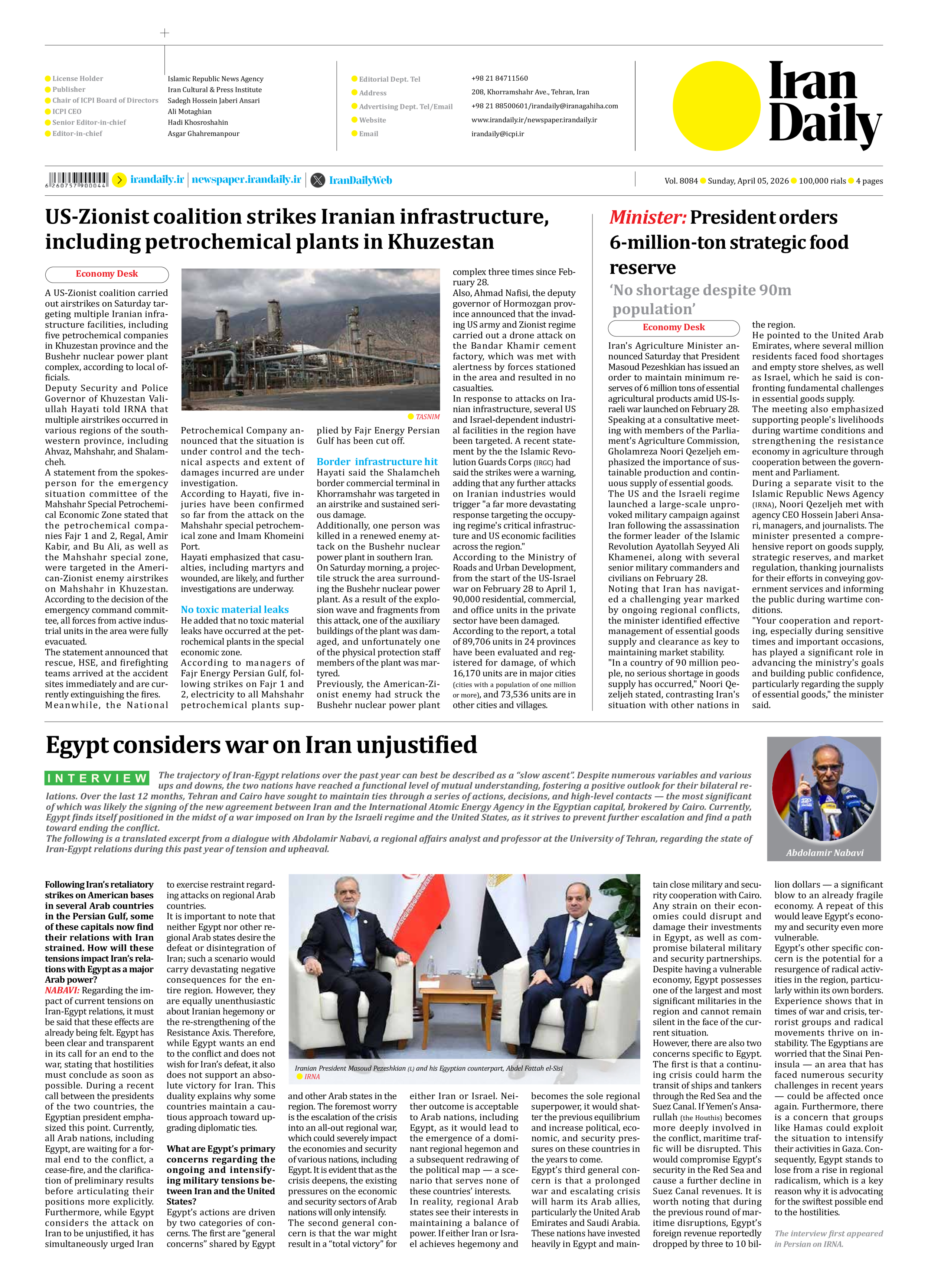


Egypt considers war on Iran unjustified
The trajectory of Iran-Egypt relations over the past year can best be described as a “slow ascent”. Despite numerous variables and various ups and downs, the two nations have reached a functional level of mutual understanding, fostering a positive outlook for their bilateral relations. Over the last 12 months, Tehran and Cairo have sought to maintain ties through a series of actions, decisions, and high-level contacts — the most significant of which was likely the signing of the new agreement between Iran and the International Atomic Energy Agency in the Egyptian capital, brokered by Cairo. Currently, Egypt finds itself positioned in the midst of a war imposed on Iran by the Israeli regime and the United States, as it strives to prevent further escalation and find a path toward ending the conflict. The following is a translated excerpt from a dialogue with Abdolamir Nabavi, a regional affairs analyst and professor at the University of Tehran, regarding the state of Iran-Egypt relations during this past year of tension and upheaval.
Following Iran’s retaliatory strikes on American bases in several Arab countries in the Persian Gulf, some of these capitals now find their relations with Iran strained. How will these tensions impact Iran’s relations with Egypt as a major Arab power?
NABAVI: Regarding the impact of current tensions on Iran-Egypt relations, it must be said that these effects are already being felt. Egypt has been clear and transparent in its call for an end to the war, stating that hostilities must conclude as soon as possible. During a recent call between the presidents of the two countries, the Egyptian president emphasized this point. Currently, all Arab nations, including Egypt, are waiting for a formal end to the conflict, a cease-fire, and the clarification of preliminary results before articulating their positions more explicitly. Furthermore, while Egypt considers the attack on Iran to be unjustified, it has simultaneously urged Iran to exercise restraint regarding attacks on regional Arab countries.
It is important to note that neither Egypt nor other regional Arab states desire the defeat or disintegration of Iran; such a scenario would carry devastating negative consequences for the entire region. However, they are equally unenthusiastic about Iranian hegemony or the re-strengthening of the Resistance Axis. Therefore, while Egypt wants an end to the conflict and does not wish for Iran’s defeat, it also does not support an absolute victory for Iran. This duality explains why some countries maintain a cautious approach toward upgrading diplomatic ties.
What are Egypt’s primary concerns regarding the ongoing and intensifying military tensions between Iran and the United States?
Egypt’s actions are driven by two categories of concerns. The first are “general concerns” shared by Egypt and other Arab states in the region. The foremost worry is the escalation of the crisis into an all-out regional war, which could severely impact the economies and security of various nations, including Egypt. It is evident that as the crisis deepens, the existing pressures on the economic and security sectors of Arab nations will only intensify.
The second general concern is that the war might result in a “total victory” for either Iran or Israel. Neither outcome is acceptable to Arab nations, including Egypt, as it would lead to the emergence of a dominant regional hegemon and a subsequent redrawing of the political map — a scenario that serves none of these countries’ interests.
In reality, regional Arab states see their interests in maintaining a balance of power. If either Iran or Israel achieves hegemony and becomes the sole regional superpower, it would shatter the previous equilibrium and increase political, economic, and security pressures on these countries in the years to come.
Egypt’s third general concern is that a prolonged war and escalating crisis will harm its Arab allies, particularly the United Arab Emirates and Saudi Arabia. These nations have invested heavily in Egypt and maintain close military and security cooperation with Cairo. Any strain on their economies could disrupt and damage their investments in Egypt, as well as compromise bilateral military and security partnerships. Despite having a vulnerable economy, Egypt possesses one of the largest and most significant militaries in the region and cannot remain silent in the face of the current situation.
However, there are also two concerns specific to Egypt. The first is that a continuing crisis could harm the transit of ships and tankers through the Red Sea and the Suez Canal. If Yemen’s Ansarullah (the Houthis) becomes more deeply involved in the conflict, maritime traffic will be disrupted. This would compromise Egypt’s security in the Red Sea and cause a further decline in Suez Canal revenues. It is worth noting that during the previous round of maritime disruptions, Egypt’s foreign revenue reportedly dropped by three to 10 billion dollars — a significant blow to an already fragile economy. A repeat of this would leave Egypt’s economy and security even more vulnerable.
Egypt’s other specific concern is the potential for a resurgence of radical activities in the region, particularly within its own borders. Experience shows that in times of war and crisis, terrorist groups and radical movements thrive on instability. The Egyptians are worried that the Sinai Peninsula — an area that has faced numerous security challenges in recent years — could be affected once again. Furthermore, there is a concern that groups like Hamas could exploit the situation to intensify their activities in Gaza. Consequently, Egypt stands to lose from a rise in regional radicalism, which is a key reason why it is advocating for the swiftest possible end to the hostilities.
The interview first appeared in Persian on IRNA.