







Minister calls for urgent action to protect cultural heritage
The Minister of Cultural Heritage, Tourism and Handicrafts said that the extensive destruction of Iran’s historical sites during the recent US-Israeli attacks amounts to “a deliberate assault on Iran’s civilizational identity,” stressing that targeting cultural heritage reflects the collapse of the moral and legal norms governing international conflicts.
Seyyed Reza Salehi-Amiri said in an interview with Al Jazeera that while explaining the extent of the damage caused during the recent US and Israeli attacks on Iran, he described these actions as “a targeted attack on the historical memory and national identity of Iranians".
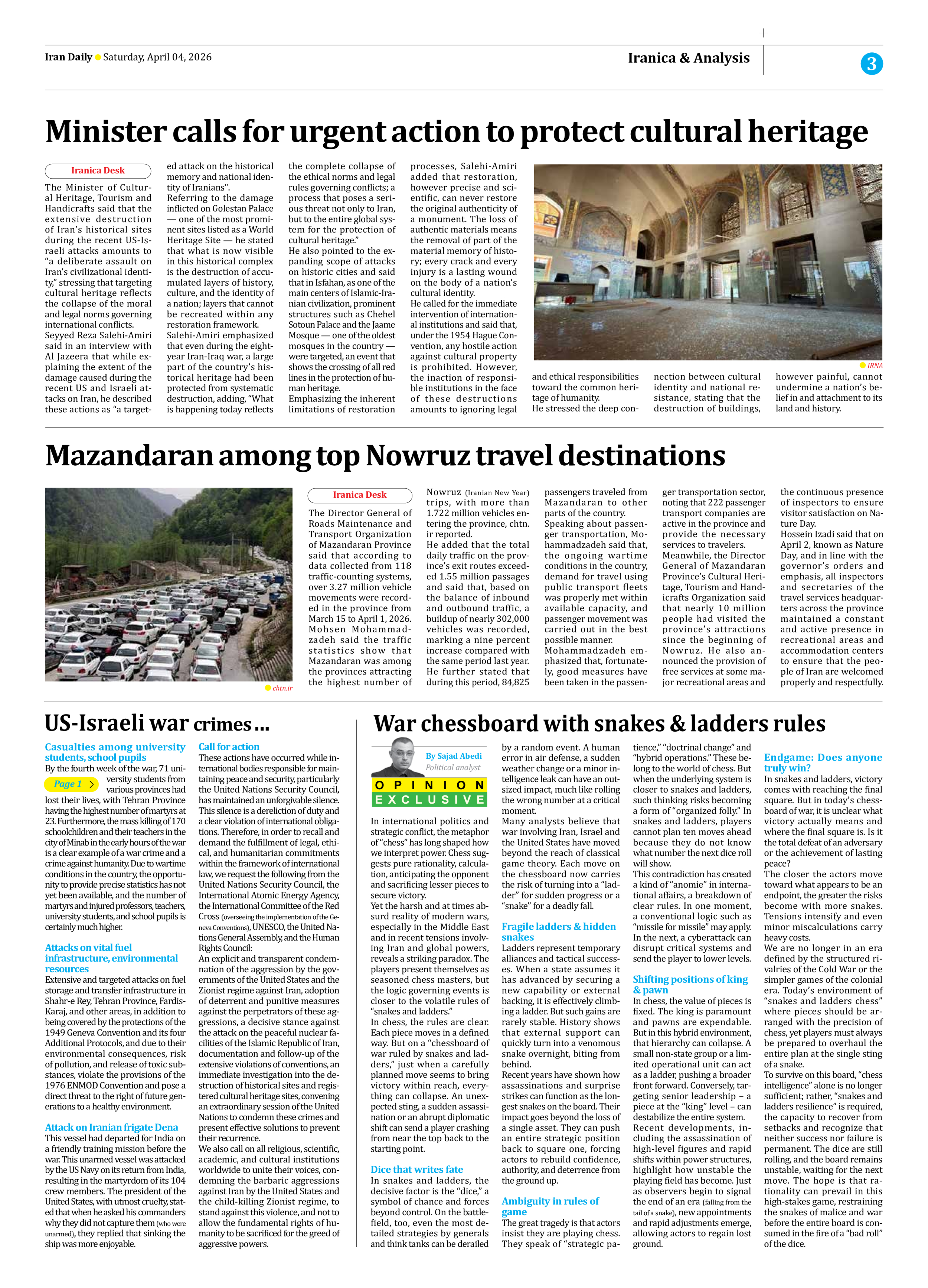
Referring to the damage inflicted on Golestan Palace — one of the most prominent sites listed as a World Heritage Site — he stated that what is now visible in this historical complex is the destruction of accumulated layers of history, culture, and the identity of a nation; layers that cannot be recreated within any restoration framework.
Salehi-Amiri emphasized that even during the eight-year Iran-Iraq war, a large part of the country’s historical heritage had been protected from systematic destruction, adding, “What is happening today reflects the complete collapse of the ethical norms and legal rules governing conflicts; a process that poses a serious threat not only to Iran, but to the entire global system for the protection of cultural heritage.”
He also pointed to the expanding scope of attacks on historic cities and said that in Isfahan, as one of the main centers of Islamic-Iranian civilization, prominent structures such as Chehel Sotoun Palace and the Jaame Mosque — one of the oldest mosques in the country — were targeted, an event that shows the crossing of all red lines in the protection of human heritage.
Emphasizing the inherent limitations of restoration processes, Salehi-Amiri added that restoration, however precise and scientific, can never restore the original authenticity of a monument. The loss of authentic materials means the removal of part of the material memory of history; every crack and every injury is a lasting wound on the body of a nation’s cultural identity.
He called for the immediate intervention of international institutions and said that, under the 1954 Hague Convention, any hostile action against cultural property is prohibited. However, the inaction of responsible institutions in the face of these destructions amounts to ignoring legal and ethical responsibilities toward the common heritage of humanity.
He stressed the deep connection between cultural identity and national resistance, stating that the destruction of buildings, however painful, cannot undermine a nation’s belief in and attachment to its land and history.