







Araghchi cautions UNSC against Hormuz Strait resolution
Deputy FM: Iran, Oman to formulate protocol for navigation in Hormuz
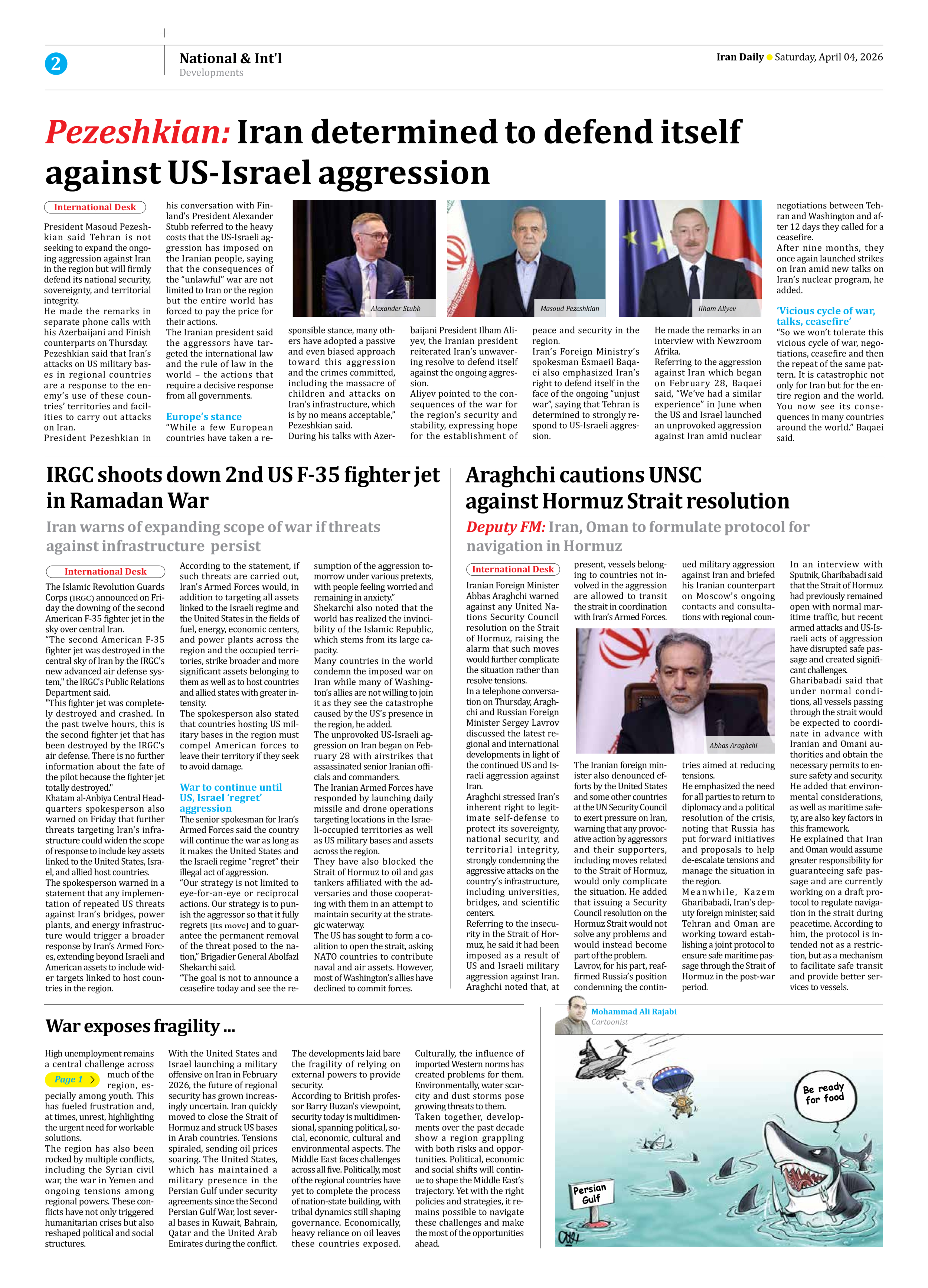
Iranian Foreign Minister Abbas Araghchi warned against any United Nations Security Council resolution on the Strait of Hormuz, raising the alarm that such moves would further complicate the situation rather than resolve tensions.
In a telephone conversation on Thursday, Araghchi and Russian Foreign Minister Sergey Lavrov discussed the latest regional and international developments in light of the continued US and Israeli aggression against Iran.
Araghchi stressed Iran’s inherent right to legitimate self-defense to protect its sovereignty, national security, and territorial integrity, strongly condemning the aggressive attacks on the country’s infrastructure, including universities, bridges, and scientific centers.
Referring to the insecurity in the Strait of Hormuz, he said it had been imposed as a result of US and Israeli military aggression against Iran. Araghchi noted that, at present, vessels belonging to countries not involved in the aggression are allowed to transit the strait in coordination with Iran’s Armed Forces.
The Iranian foreign minister also denounced efforts by the United States and some other countries at the UN Security Council to exert pressure on Iran, warning that any provocative action by aggressors and their supporters, including moves related to the Strait of Hormuz, would only complicate the situation. He added that issuing a Security Council resolution on the Hormuz Strait would not solve any problems and would instead become part of the problem.
Lavrov, for his part, reaffirmed Russia’s position condemning the continued military aggression against Iran and briefed his Iranian counterpart on Moscow’s ongoing contacts and consultations with regional countries aimed at reducing tensions.
He emphasized the need for all parties to return to diplomacy and a political resolution of the crisis, noting that Russia has put forward initiatives and proposals to help de-escalate tensions and manage the situation in the region.
Meanwhile, Kazem Gharibabadi, Iran's deputy foreign minister, said Tehran and Oman are working toward establishing a joint protocol to ensure safe maritime passage through the Strait of Hormuz in the post-war period.
In an interview with Sputnik, Gharibabadi said that the Strait of Hormuz had previously remained open with normal maritime traffic, but recent armed attacks and US-Israeli acts of aggression have disrupted safe passage and created significant challenges.
Gharibabadi said that under normal conditions, all vessels passing through the strait would be expected to coordinate in advance with Iranian and Omani authorities and obtain the necessary permits to ensure safety and security. He added that environmental considerations, as well as maritime safety, are also key factors in this framework.
He explained that Iran and Oman would assume greater responsibility for guaranteeing safe passage and are currently working on a draft protocol to regulate navigation in the strait during peacetime. According to him, the protocol is intended not as a restriction, but as a mechanism to facilitate safe transit and provide better services to vessels.