







Impact of US-Israeli war on Mideast energy
Senior energy researcher
As US and Israeli military confrontation with Iran enters a new phase, an analysis published by Iran Daily on March 10 warned that the real blow would land not on the battlefield, but along the world’s vital energy arteries. Its central argument was blunt: Iran’s most consequential strikes against the United States are economic, not military. Yet possible US and Israeli attacks on Iranian energy infrastructure — particularly Kharg Island — have added a new dimension to the crisis and require a reassessment of that analysis.
This article divides the consequences into two categories: direct effects, chiefly on crude oil and natural gas/LNG, and indirect effects, including refined petroleum products and the industrial chains tied to them. Drawing on figures from sources such as the US Energy Information Administration, the International Energy Agency and Congressional Research Service reporting, the conclusion is stark: the fallout would not stop with the Persian Gulf states. The shock would ripple into Europe, Asia and even the United States, carrying not only economic costs but the risk of a wider humanitarian emergency.
Direct effects: crude oil & LNG
The most immediate and severe consequences would be felt in the flow of crude oil and liquefied natural gas. According to EIA estimates, some 20.9 million barrels of oil and petroleum products pass through the Strait of Hormuz each day, accounting for about 20% of global liquid fuels consumption and almost a quarter of the world’s seaborne oil trade. Put more precisely, it represents an extraordinarily large share of the oil actually moving through global commercial markets between producers and consumers. More than 89% of that flow heads to Asia — especially China, India and Japan — while a substantial portion of the world’s LNG trade, much of it from Qatar, also passes through the same narrow corridor.
Even a short disruption would send prices sharply higher. Brent crude, which traded near $71 before the war, could easily climb above $110 a barrel, with more pessimistic scenarios pushing it toward $150 or even $200. That risk is magnified by the structure of the global refining system. Many refineries were configured specifically for the heavier, sourer grades of Persian Gulf crude, with particular API specifications. Replacing those barrels with lighter alternatives — including US shale — is not simply a matter of swapping one stream for another. It often requires blending, operational adjustments or months of process changes. Strategic reserves can cushion expectations and calm markets temporarily, but they are not a durable substitute for a sustained interruption in the world’s most critical energy chokepoint.
Production losses would not be quickly reversed after the fighting stops. Repairing wells, pipelines, storage systems and export terminals takes time, often months. The result is that energy inflation would likely persist well beyond the end of active combat. Such a shock would hit not only Iran, whose oil exports rely heavily on Kharg Island, but also the wider Persian Gulf export economies — Saudi Arabia, the United Arab Emirates, Kuwait, Iraq, Oman, Bahrain and Jordan — where public finances remain deeply tied to hydrocarbon revenue.
The humanitarian implications could also be severe. Asian and European importers, which absorb the vast majority of Hormuz traffic, would face sharply higher energy costs. Past energy shocks have quickly translated into higher food prices, especially in lower-income economies already vulnerable to supply disruptions. In South and East Asia, where hundreds of millions of people depend indirectly on affordable imported energy, a prolonged disruption could push millions closer to or below the poverty line and intensify migration pressures across the region.
Indirect effects: refined products, sulfur, gasoline, diesel & jet fuel
The damage would extend far beyond crude and gas. Refined products and their industrial byproducts play a central role in modern economies. Sulfur, for instance — more than 70% of which is produced as a byproduct of oil and gas refining — is essential to phosphate fertilizer production. If refinery operations are disrupted, fertilizer prices could surge, just as they did during previous global energy shocks. That would raise input costs for agriculture and reduce yields in key crops such as wheat, rice and soybeans, making food more expensive and heightening food-security risks in fertilizer-importing regions, including parts of South Asia and Africa.
Gasoline and diesel would present another layer of disruption. Millions of barrels of refined fuels move through the Strait of Hormuz every day. A sharp rise in transport costs would reverberate across industrial supply chains, raising production costs in steel, autos, chemicals and manufacturing more broadly. Jet fuel disruptions would also drive up air travel costs, striking directly at Persian Gulf economies that depend heavily on aviation, logistics and tourism. For the United Arab Emirates in particular, where Dubai and Abu Dhabi have built growth models around global connectivity, sustained fuel price pressure would cut into one of the pillars of its economic strategy.
This indirect chain of effects could push the regional economy toward a deeper crisis. Economies built around trade, tourism, finance and imported labor would face capital flight, rising operating costs and a deterioration in investor confidence. In that sense, a prolonged disruption in the Strait of Hormuz risks producing not just inflation, but a broader mix of inflation and stagnation across the global economy.
Particular blow to US
The crisis would not spare the United States. A severe contraction in globally traded oil volumes would put pressure on the broader dollar-based energy order, even if it did not displace it outright. The United States remains exposed to global price shocks regardless of its domestic production levels, and a sustained spike in energy costs could push inflation sharply higher. American agriculture, too, would be hit by more expensive diesel and fertilizer inputs. Rising food, transport and energy costs would weigh directly on household budgets, making mortgage and auto payments harder to sustain for millions of families.
That combination — energy inflation, food inflation and tighter household finances — could create conditions for a sharp slowdown and potentially destabilize credit markets. The comparison would not be identical to 2008, but the transmission mechanism could be faster: higher costs feeding directly into weakened consumption, tighter credit and broader financial stress.
Let’s not forget that the United States is a vast country. Every day it consumes more than 1.3 billion liters of gasoline, over 650 million liters of diesel, and about 270 million liters of jet fuel.
To better understand this, consider two points. First, Iran’s daily consumption of gasoline, diesel, and jet fuel is approximately 130 million liters, 110 million liters, and 10 million liters, respectively. Second, the United States has a larger and more diversified fuel consumption basket than any other country; therefore, the share of energy in its consumer price inflation is significant.
Kharg Island: heart of Iran’s oil exports
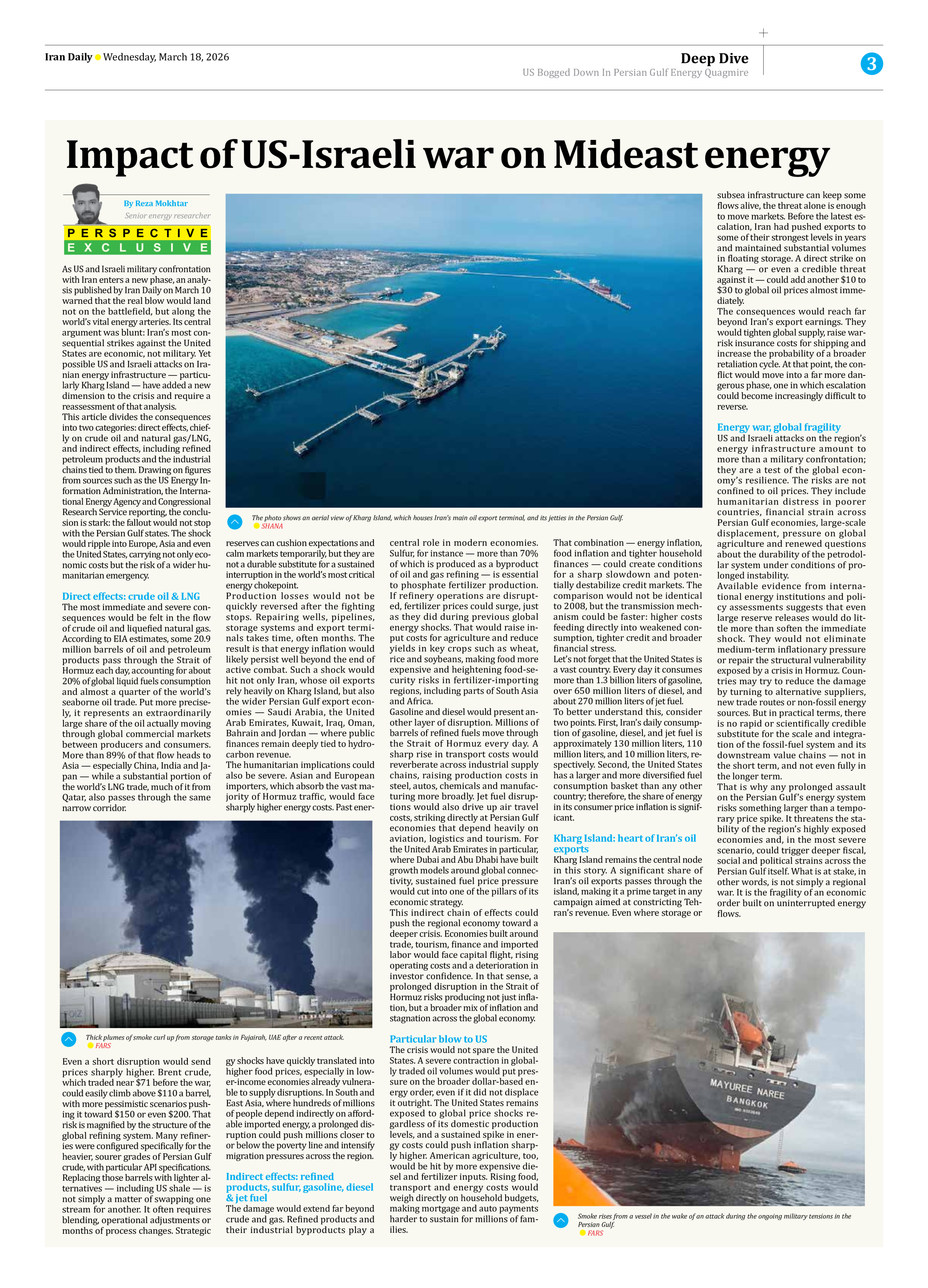
Kharg Island remains the central node in this story. A significant share of Iran’s oil exports passes through the island, making it a prime target in any campaign aimed at constricting Tehran’s revenue. Even where storage or subsea infrastructure can keep some flows alive, the threat alone is enough to move markets. Before the latest escalation, Iran had pushed exports to some of their strongest levels in years and maintained substantial volumes in floating storage. A direct strike on Kharg — or even a credible threat against it — could add another $10 to $30 to global oil prices almost immediately.
The consequences would reach far beyond Iran’s export earnings. They would tighten global supply, raise war-risk insurance costs for shipping and increase the probability of a broader retaliation cycle. At that point, the conflict would move into a far more dangerous phase, one in which escalation could become increasingly difficult to reverse.
Energy war, global fragility
US and Israeli attacks on the region’s energy infrastructure amount to more than a military confrontation; they are a test of the global economy’s resilience. The risks are not confined to oil prices. They include humanitarian distress in poorer countries, financial strain across Persian Gulf economies, large-scale displacement, pressure on global agriculture and renewed questions about the durability of the petrodollar system under conditions of prolonged instability.
Available evidence from international energy institutions and policy assessments suggests that even large reserve releases would do little more than soften the immediate shock. They would not eliminate medium-term inflationary pressure or repair the structural vulnerability exposed by a crisis in Hormuz. Countries may try to reduce the damage by turning to alternative suppliers, new trade routes or non-fossil energy sources. But in practical terms, there is no rapid or scientifically credible substitute for the scale and integration of the fossil-fuel system and its downstream value chains — not in the short term, and not even fully in the longer term.
That is why any prolonged assault on the Persian Gulf’s energy system risks something larger than a temporary price spike. It threatens the stability of the region’s highly exposed economies and, in the most severe scenario, could trigger deeper fiscal, social and political strains across the Persian Gulf itself. What is at stake, in other words, is not simply a regional war. It is the fragility of an economic order built on uninterrupted energy flows.