





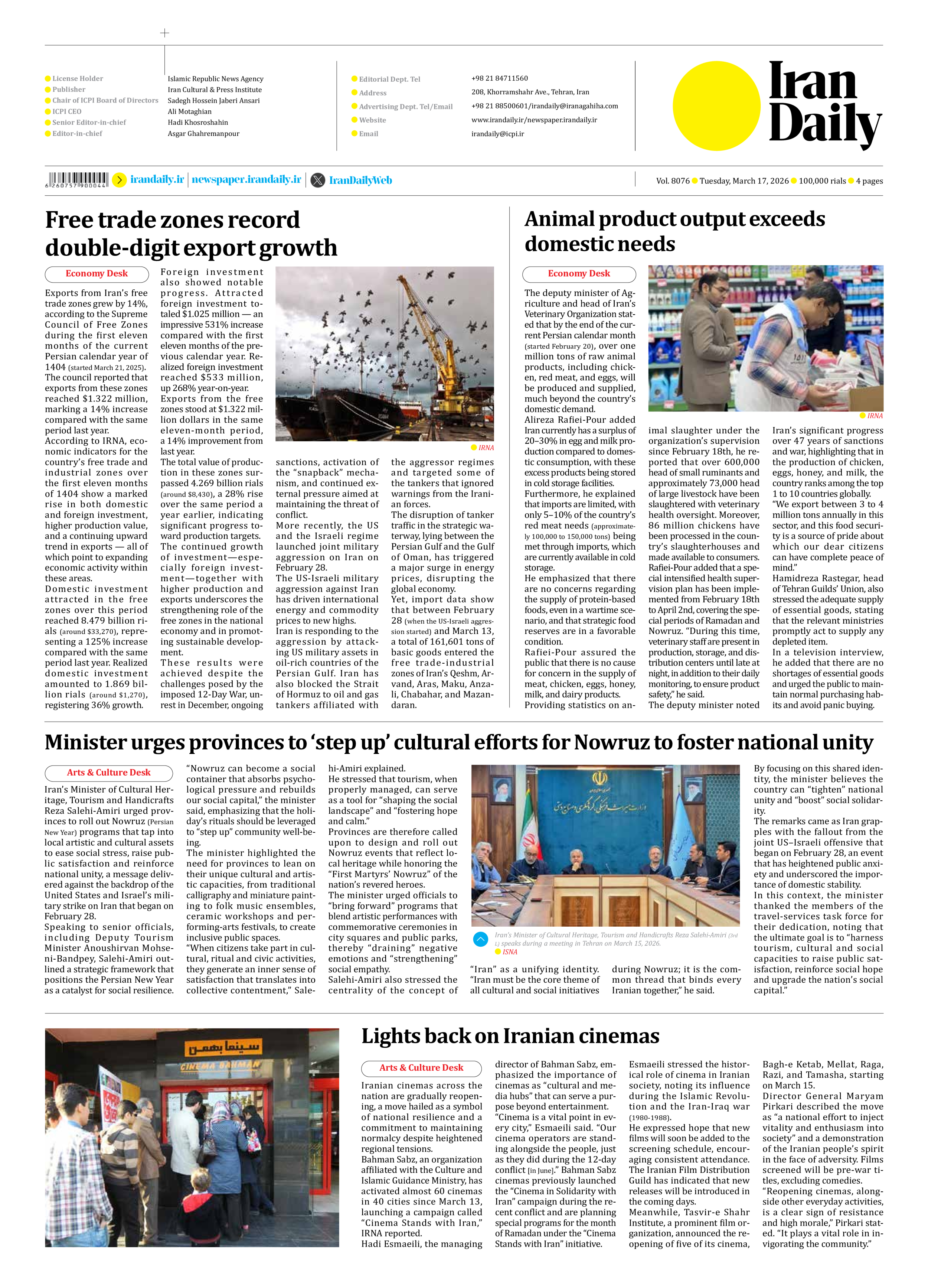


Free trade zones record double‑digit export growth
Exports from Iran’s free trade zones grew by 14%, according to the Supreme Council of Free Zones during the first eleven months of the current Persian calendar year of 1404 (started March 21, 2025).
The council reported that exports from these zones reached $1.322 million, marking a 14% increase compared with the same period last year.
According to IRNA, economic indicators for the country’s free trade and industrial zones over the first eleven months of 1404 show a marked rise in both domestic and foreign investment, higher production value, and a continuing upward trend in exports — all of which point to expanding economic activity within these areas.
Domestic investment attracted in the free zones over this period reached 8.479 billion rials (around $33,270), representing a 125% increase compared with the same period last year. Realized domestic investment amounted to 1.869 billion rials (around $1,270), registering 36% growth.
Foreign investment also showed notable progress. Attracted foreign investment totaled $1.025 million — an impressive 531% increase compared with the first eleven months of the previous calendar year. Realized foreign investment reached $533 million, up 268% year‑on‑year.
Exports from the free zones stood at $1.322 million dollars in the same eleven‑month period, a 14% improvement from last year.
The total value of production in these zones surpassed 4.269 billion rials (around $8,430), a 28% rise over the same period a year earlier, indicating significant progress toward production targets.
The continued growth of investment—especially foreign investment—together with higher production and exports underscores the strengthening role of the free zones in the national economy and in promoting sustainable development.
These results were achieved despite the challenges posed by the imposed 12‑Day War, unrest in December, ongoing sanctions, activation of the “snapback” mechanism, and continued external pressure aimed at maintaining the threat of conflict.
More recently, the US and the Israeli regime launched joint military aggression on Iran on February 28.
The US-Israeli military aggression against Iran has driven international energy and commodity prices to new highs.
Iran is responding to the aggression by attacking US military assets in oil-rich countries of the Persian Gulf. Iran has also blocked the Strait of Hormuz to oil and gas tankers affiliated with the aggressor regimes and targeted some of the tankers that ignored warnings from the Iranian forces.
The disruption of tanker traffic in the strategic waterway, lying between the Persian Gulf and the Gulf of Oman, has triggered a major surge in energy prices, disrupting the global economy.
Yet, import data show that between February 28 (when the US-Israeli aggression started) and March 13, a total of 161,601 tons of basic goods entered the free trade‑industrial zones of Iran’s Qeshm, Arvand, Aras, Maku, Anzali, Chabahar, and Mazandaran.