





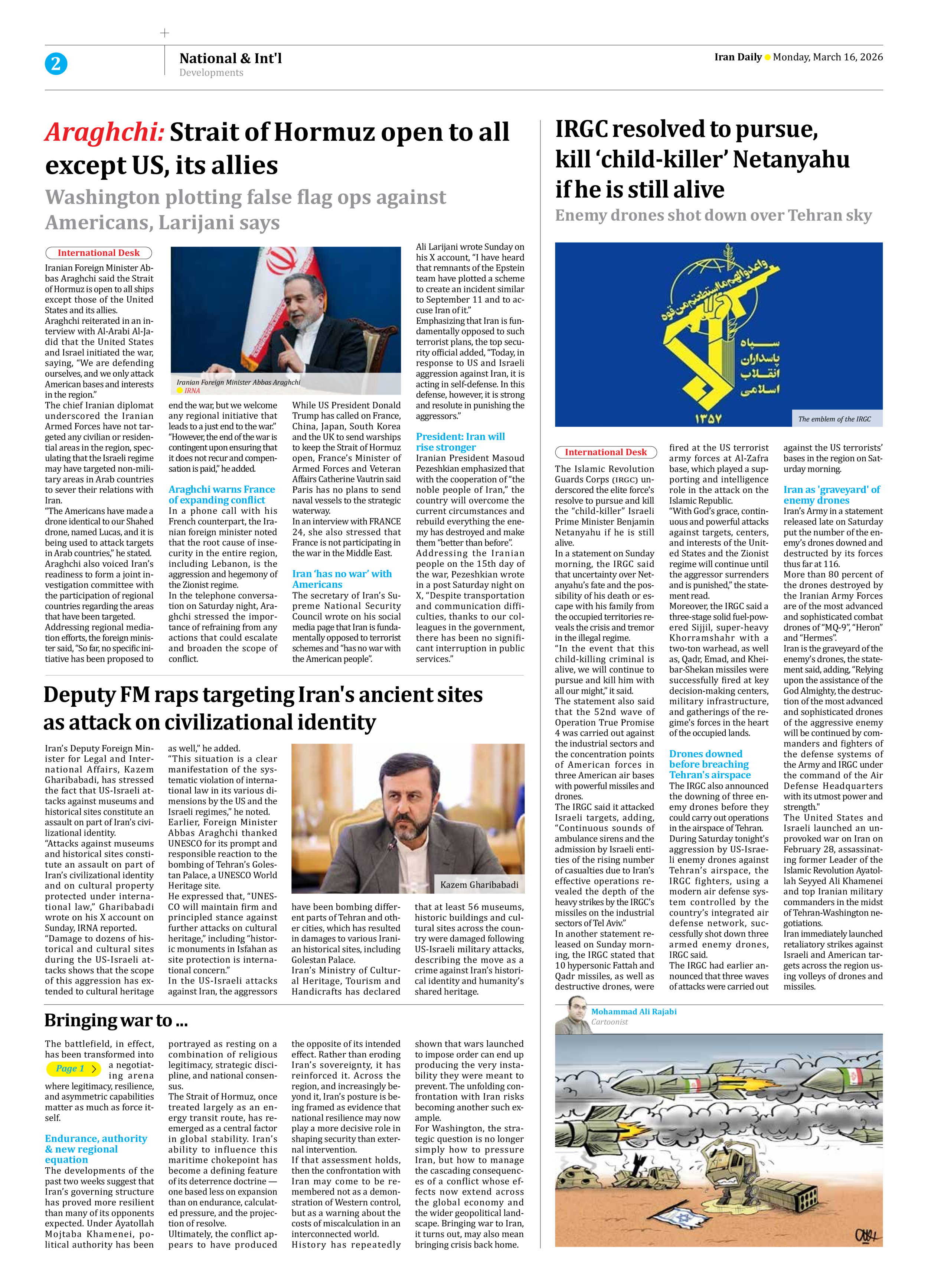


Bringing war to ...
Page 1
The battlefield, in effect, has been transformed into a negotiating arena where legitimacy, resilience, and asymmetric capabilities matter as much as force itself.
Endurance, authority & new regional equation
The developments of the past two weeks suggest that Iran’s governing structure has proved more resilient than many of its opponents expected. Under Ayatollah Mojtaba Khamenei, political authority has been portrayed as resting on a combination of religious legitimacy, strategic discipline, and national consensus.
The Strait of Hormuz, once treated largely as an energy transit route, has re-emerged as a central factor in global stability. Iran’s ability to influence this maritime chokepoint has become a defining feature of its deterrence doctrine — one based less on expansion than on endurance, calculated pressure, and the projection of resolve.
Ultimately, the conflict appears to have produced the opposite of its intended effect. Rather than eroding Iran’s sovereignty, it has reinforced it. Across the region, and increasingly beyond it, Iran’s posture is being framed as evidence that national resilience may now play a more decisive role in shaping security than external intervention.
If that assessment holds, then the confrontation with Iran may come to be remembered not as a demonstration of Western control, but as a warning about the costs of miscalculation in an interconnected world.
History has repeatedly shown that wars launched to impose order can end up producing the very instability they were meant to prevent. The unfolding confrontation with Iran risks becoming another such example.
For Washington, the strategic question is no longer simply how to pressure Iran, but how to manage the cascading consequences of a conflict whose effects now extend across the global economy and the wider geopolitical landscape. Bringing war to Iran, it turns out, may also mean bringing crisis back home.