







Urgent mission to save Iran’s collective historical treasures
To understand the anxiety of heritage guardians, one must possess a heart that quickens at the sight of stone plinths, magnificent muqarnas, and the turquoise tilework of ancient monuments. One must pause before intricate stucco, dazzling mirror-work, and the dance of light through stained-glass Orsi windows to truly grasp the depth of devotion to ancestral legacy — a heritage that forms the core of a nation’s identity and historical memory.
Yet today, as the shadow of the US-Zionist imposed war looms over the region and the face of cities begins to wither, concern for the fate of historical buildings, sites, and urban fabrics is felt more acutely than ever. War, a brutal phenomenon indifferent to cultural values, has always posed a grave threat to historical monuments — treasures that belong not just to one nation, but to the collective heritage of humanity, chtn.ir wrote.
Iran’s history, however, proves that this land has endured countless crises, wars, and upheavals, yet its civilizational legacy remains standing. From historical invasions to socio-political transformations, many of Iran's most precious works have weathered the storms of time. But this historical resilience does not diminish the current fears of the country’s heritage custodians.
Recent days have brought reports of damage to several of Iran’s landmarks. Foremost among these is the damage to parts of the Golestan Palace, the capital’s only UNESCO World Heritage site, which suffered losses following an airstrike on the Arg Square.
Subsequent reports detailed damage to other historical structures in Tehran, including the old Parliament building (Senate Building), the Old Gendarmerie Building, and several other protected sites.
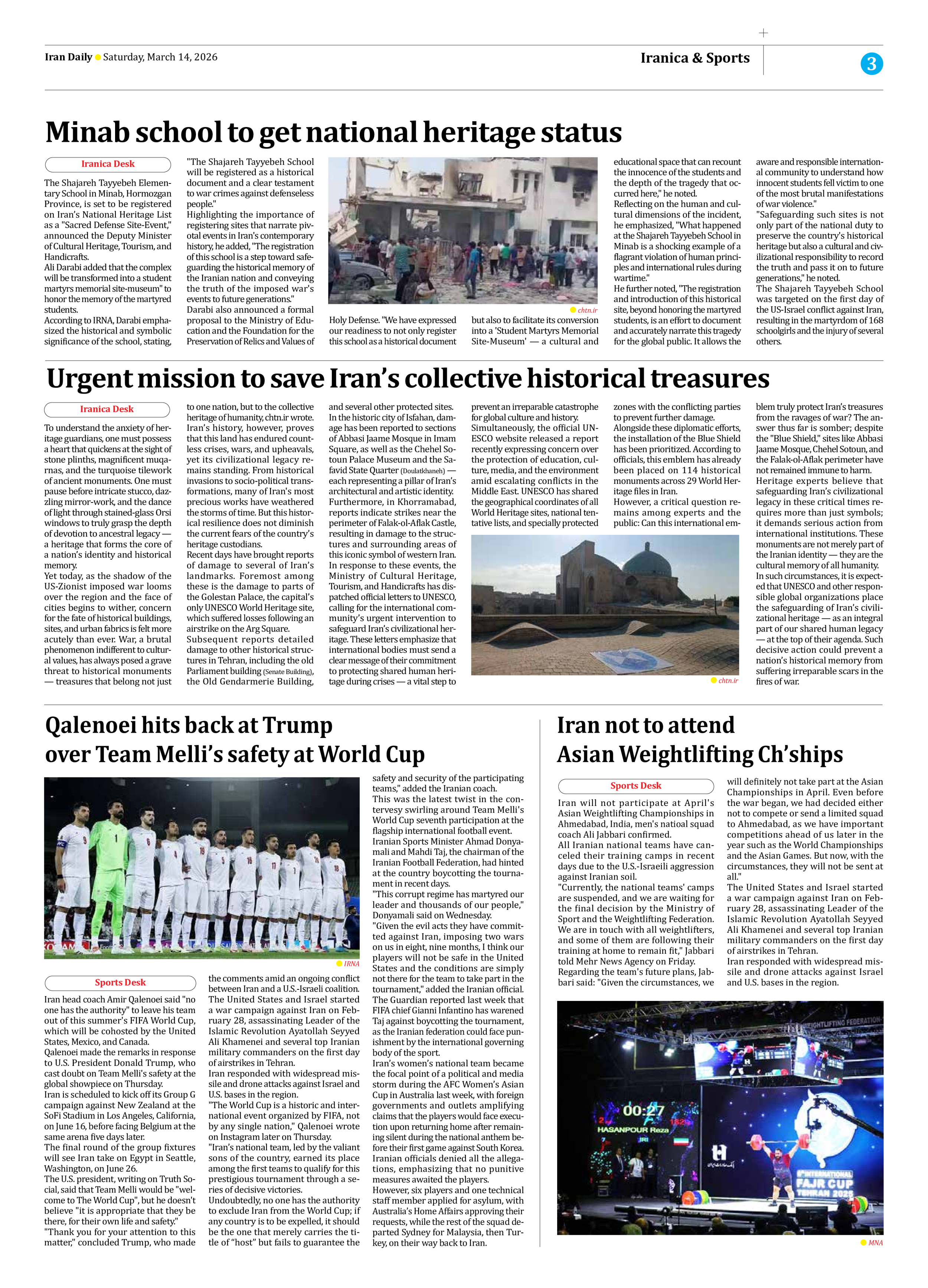
In the historic city of Isfahan, damage has been reported to sections of Abbasi Jaame Mosque in Imam Square, as well as the Chehel Sotoun Palace Museum and the Safavid State Quarter (Doulatkhaneh) — each representing a pillar of Iran’s architectural and artistic identity.
Furthermore, in Khorramabad, reports indicate strikes near the perimeter of Falak-ol-Aflak Castle, resulting in damage to the structures and surrounding areas of this iconic symbol of western Iran.
In response to these events, the Ministry of Cultural Heritage, Tourism, and Handicrafts has dispatched official letters to UNESCO, calling for the international community’s urgent intervention to safeguard Iran’s civilizational heritage. These letters emphasize that international bodies must send a clear message of their commitment to protecting shared human heritage during crises — a vital step to prevent an irreparable catastrophe for global culture and history.
Simultaneously, the official UNESCO website released a report recently expressing concern over the protection of education, culture, media, and the environment amid escalating conflicts in the Middle East. UNESCO has shared the geographical coordinates of all World Heritage sites, national tentative lists, and specially protected zones with the conflicting parties to prevent further damage.
Alongside these diplomatic efforts, the installation of the Blue Shield has been prioritized. According to officials, this emblem has already been placed on 114 historical monuments across 29 World Heritage files in Iran.
However, a critical question remains among experts and the public: Can this international emblem truly protect Iran’s treasures from the ravages of war? The answer thus far is somber; despite the "Blue Shield," sites like Abbasi Jaame Mosque, Chehel Sotoun, and the Falak-ol-Aflak perimeter have not remained immune to harm.
Heritage experts believe that safeguarding Iran’s civilizational legacy in these critical times requires more than just symbols; it demands serious action from international institutions. These monuments are not merely part of the Iranian identity — they are the cultural memory of all humanity.
In such circumstances, it is expected that UNESCO and other responsible global organizations place the safeguarding of Iran’s civilizational heritage — as an integral part of our shared human legacy — at the top of their agenda. Such decisive action could prevent a nation’s historical memory from suffering irreparable scars in the fires of war.