




Building materials exports to Eurasia jumps 30%, trade official says
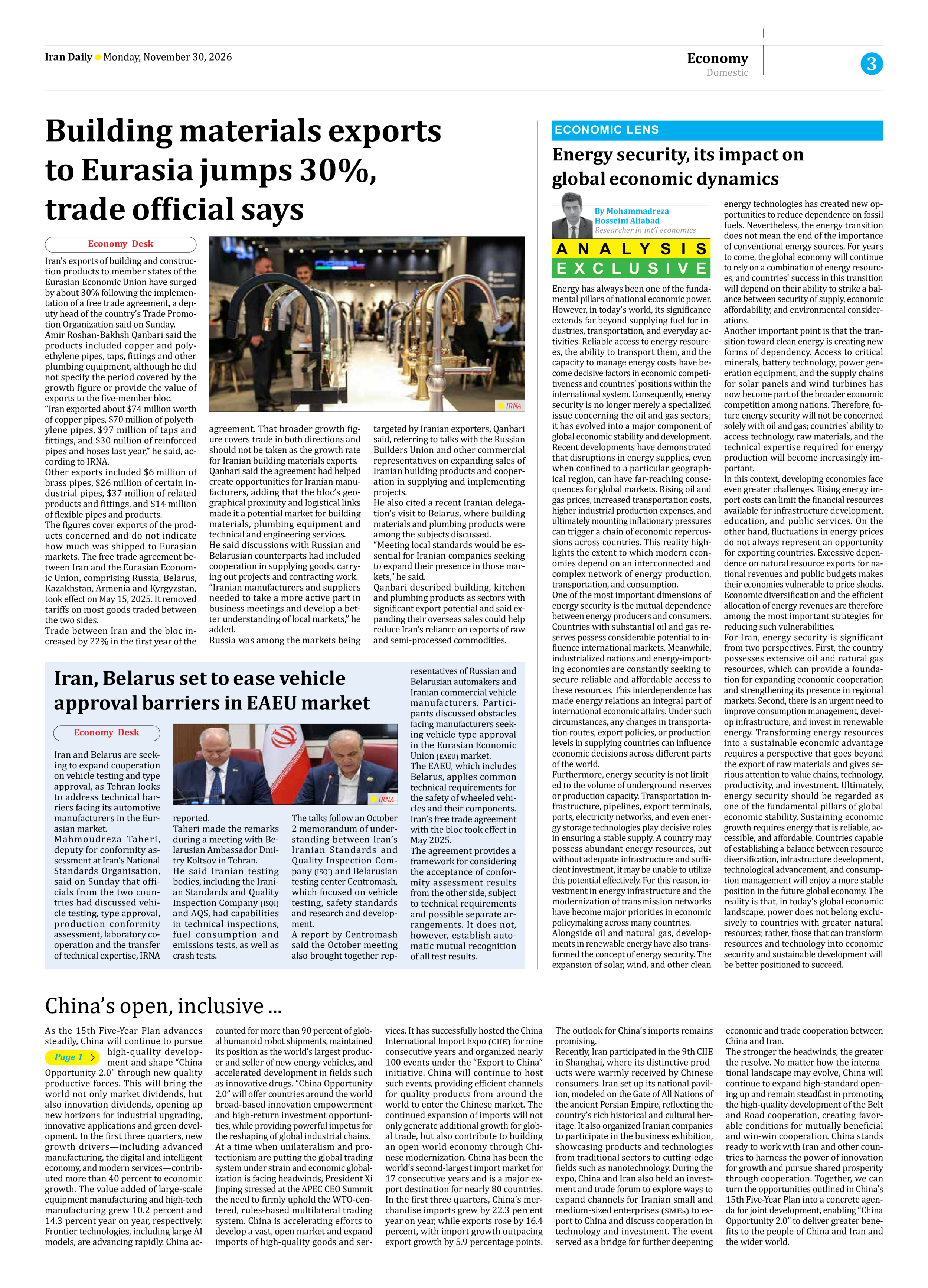
Iran’s exports of building and construction products to member states of the Eurasian Economic Union have surged by about 30% following the implementation of a free trade agreement, a deputy head of the country’s Trade Promotion Organization said on Sunday.
Amir Roshan-Bakhsh Qanbari said the products included copper and polyethylene pipes, taps, fittings and other plumbing equipment, although he did not specify the period covered by the growth figure or provide the value of exports to the five-member bloc.
“Iran exported about $74 million worth of copper pipes, $70 million of polyethylene pipes, $97 million of taps and fittings, and $30 million of reinforced pipes and hoses last year,” he said, according to IRNA.
Other exports included $6 million of brass pipes, $26 million of certain industrial pipes, $37 million of related products and fittings, and $14 million of flexible pipes and products.
The figures cover exports of the products concerned and do not indicate how much was shipped to Eurasian markets. The free trade agreement between Iran and the Eurasian Economic Union, comprising Russia, Belarus, Kazakhstan, Armenia and Kyrgyzstan, took effect on May 15, 2025. It removed tariffs on most goods traded between the two sides.
Trade between Iran and the bloc increased by 22% in the first year of the agreement. That broader growth figure covers trade in both directions and should not be taken as the growth rate for Iranian building materials exports.
Qanbari said the agreement had helped create opportunities for Iranian manufacturers, adding that the bloc’s geographical proximity and logistical links made it a potential market for building materials, plumbing equipment and technical and engineering services.
He said discussions with Russian and Belarusian counterparts had included cooperation in supplying goods, carrying out projects and contracting work.
“Iranian manufacturers and suppliers needed to take a more active part in business meetings and develop a better understanding of local markets,” he added.
Russia was among the markets being targeted by Iranian exporters, Qanbari said, referring to talks with the Russian Builders Union and other commercial representatives on expanding sales of Iranian building products and cooperation in supplying and implementing projects.
He also cited a recent Iranian delegation’s visit to Belarus, where building materials and plumbing products were among the subjects discussed.
“Meeting local standards would be essential for Iranian companies seeking to expand their presence in those markets,” he said.
Qanbari described building, kitchen and plumbing products as sectors with significant export potential and said expanding their overseas sales could help reduce Iran’s reliance on exports of raw and semi-processed commodities.