




Iran commissions five oil projects to raise daily gas production capacity by 32mcm
Iran has commissioned five development, infrastructure and environmental projects comprising 10 schemes, increasing the country’s daily sweet gas production capacity by 32 million cubic meters, the Oil Ministry’s Shana news agency reported on Saturday.
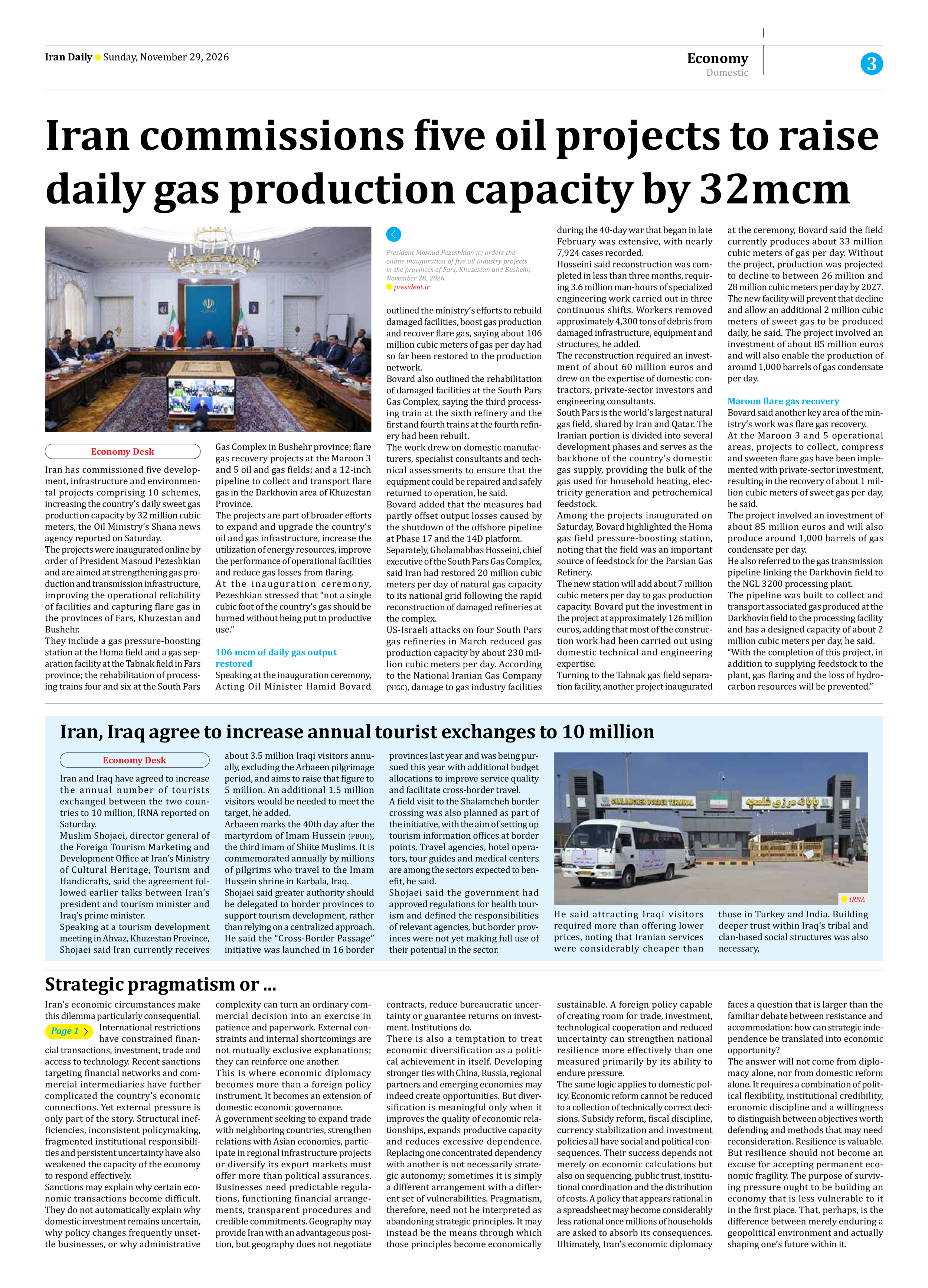
The projects were inaugurated online by order of President Masoud Pezeshkian and are aimed at strengthening gas production and transmission infrastructure, improving the operational reliability of facilities and capturing flare gas in the provinces of Fars, Khuzestan and Bushehr.
They include a gas pressure-boosting station at the Homa field and a gas separation facility at the Tabnak field in Fars province; the rehabilitation of processing trains four and six at the South Pars Gas Complex in Bushehr province; flare gas recovery projects at the Maroon 3 and 5 oil and gas fields; and a 12-inch pipeline to collect and transport flare gas in the Darkhovin area of Khuzestan Province.
The projects are part of broader efforts to expand and upgrade the country’s oil and gas infrastructure, increase the utilization of energy resources, improve the performance of operational facilities and reduce gas losses from flaring.
At the inauguration ceremony, Pezeshkian stressed that “not a single cubic foot of the country’s gas should be burned without being put to productive use.”
106 mcm of daily gas output restored
Speaking at the inauguration ceremony, Acting Oil Minister Hamid Bovard outlined the ministry’s efforts to rebuild damaged facilities, boost gas production and recover flare gas, saying about 106 million cubic meters of gas per day had so far been restored to the production network.
Bovard also outlined the rehabilitation of damaged facilities at the South Pars Gas Complex, saying the third processing train at the sixth refinery and the first and fourth trains at the fourth refinery had been rebuilt.
The work drew on domestic manufacturers, specialist consultants and technical assessments to ensure that the equipment could be repaired and safely returned to operation, he said.
Bovard added that the measures had partly offset output losses caused by the shutdown of the offshore pipeline at Phase 17 and the 14D platform.
Separately, Gholamabbas Hosseini, chief executive of the South Pars Gas Complex, said Iran had restored 20 million cubic meters per day of natural gas capacity to its national grid following the rapid reconstruction of damaged refineries at the complex.
US-Israeli attacks on four South Pars gas refineries in March reduced gas production capacity by about 230 million cubic meters per day. According to the National Iranian Gas Company (NIGC), damage to gas industry facilities during the 40-day war that began in late February was extensive, with nearly 7,924 cases recorded.
Hosseini said reconstruction was completed in less than three months, requiring 3.6 million man-hours of specialized engineering work carried out in three continuous shifts. Workers removed approximately 4,300 tons of debris from damaged infrastructure, equipment and structures, he added.
The reconstruction required an investment of about 60 million euros and drew on the expertise of domestic contractors, private-sector investors and engineering consultants.
South Pars is the world’s largest natural gas field, shared by Iran and Qatar. The Iranian portion is divided into several development phases and serves as the backbone of the country’s domestic gas supply, providing the bulk of the gas used for household heating, electricity generation and petrochemical feedstock.
Among the projects inaugurated on Saturday, Bovard highlighted the Homa gas field pressure-boosting station, noting that the field was an important source of feedstock for the Parsian Gas Refinery.
The new station will add about 7 million cubic meters per day to gas production capacity. Bovard put the investment in the project at approximately 126 million euros, adding that most of the construction work had been carried out using domestic technical and engineering expertise.
Turning to the Tabnak gas field separation facility, another project inaugurated at the ceremony, Bovard said the field currently produces about 33 million cubic meters of gas per day. Without the project, production was projected to decline to between 26 million and 28 million cubic meters per day by 2027.
The new facility will prevent that decline and allow an additional 2 million cubic meters of sweet gas to be produced daily, he said. The project involved an investment of about 85 million euros and will also enable the production of around 1,000 barrels of gas condensate per day.
Maroon flare gas recovery
Bovard said another key area of the ministry’s work was flare gas recovery.
At the Maroon 3 and 5 operational areas, projects to collect, compress and sweeten flare gas have been implemented with private-sector investment, resulting in the recovery of about 1 million cubic meters of sweet gas per day, he said.
The project involved an investment of about 85 million euros and will also produce around 1,000 barrels of gas condensate per day.
He also referred to the gas transmission pipeline linking the Darkhovin field to the NGL 3200 processing plant.
The pipeline was built to collect and transport associated gas produced at the Darkhovin field to the processing facility and has a designed capacity of about 2 million cubic meters per day, he said.
“With the completion of this project, in addition to supplying feedstock to the plant, gas flaring and the loss of hydrocarbon resources will be prevented.”