




Tehran, Tashkent seek joint Silk Road tourism routes
Iran and Uzbekistan are seeking to develop joint tourism routes along the historic Silk Road, boost direct flights and expand cultural exchanges, as Tehran pushes to turn shared heritage into practical tourism cooperation.
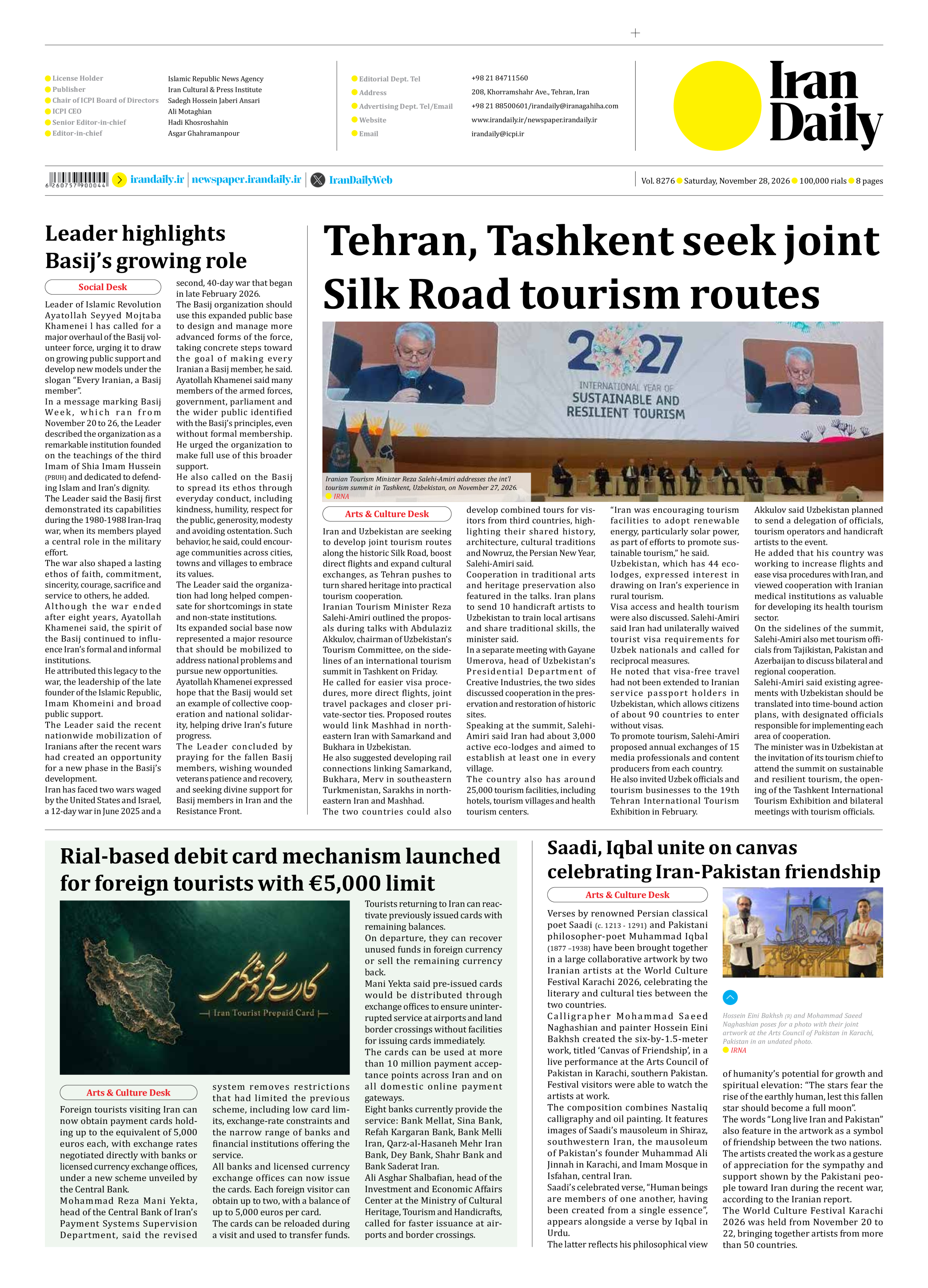
Iranian Tourism Minister Reza Salehi-Amiri outlined the proposals during talks with Abdulaziz Akkulov, chairman of Uzbekistan’s Tourism Committee, on the sidelines of an international tourism summit in Tashkent on Friday.
He called for easier visa procedures, more direct flights, joint travel packages and closer private-sector ties. Proposed routes would link Mashhad in northeastern Iran with Samarkand and Bukhara in Uzbekistan.
He also suggested developing rail connections linking Samarkand, Bukhara, Merv in southeastern Turkmenistan, Sarakhs in northeastern Iran and Mashhad.
The two countries could also develop combined tours for visitors from third countries, highlighting their shared history, architecture, cultural traditions and Nowruz, the Persian New Year, Salehi-Amiri said.
Cooperation in traditional arts and heritage preservation also featured in the talks. Iran plans to send 10 handicraft artists to Uzbekistan to train local artisans and share traditional skills, the minister said.
In a separate meeting with Gayane Umerova, head of Uzbekistan’s Presidential Department of Creative Industries, the two sides discussed cooperation in the preservation and restoration of historic sites.
Speaking at the summit, Salehi-Amiri said Iran had about 3,000 active eco-lodges and aimed to establish at least one in every village.
The country also has around 25,000 tourism facilities, including hotels, tourism villages and health tourism centers.
“Iran was encouraging tourism facilities to adopt renewable energy, particularly solar power, as part of efforts to promote sustainable tourism,” he said.
Uzbekistan, which has 44 eco-lodges, expressed interest in drawing on Iran’s experience in rural tourism.
Visa access and health tourism were also discussed. Salehi-Amiri said Iran had unilaterally waived tourist visa requirements for Uzbek nationals and called for reciprocal measures.
He noted that visa-free travel had not been extended to Iranian service passport holders in Uzbekistan, which allows citizens of about 90 countries to enter without visas.
To promote tourism, Salehi-Amiri proposed annual exchanges of 15 media professionals and content producers from each country.
He also invited Uzbek officials and tourism businesses to the 19th Tehran International Tourism Exhibition in February.
Akkulov said Uzbekistan planned to send a delegation of officials, tourism operators and handicraft artists to the event.
He added that his country was working to increase flights and ease visa procedures with Iran, and viewed cooperation with Iranian medical institutions as valuable for developing its health tourism sector.
On the sidelines of the summit, Salehi-Amiri also met tourism officials from Tajikistan, Pakistan and Azerbaijan to discuss bilateral and regional cooperation.
Salehi-Amiri said existing agreements with Uzbekistan should be translated into time-bound action plans, with designated officials responsible for implementing each area of cooperation.
The minister was in Uzbekistan at the invitation of its tourism chief to attend the summit on sustainable and resilient tourism, the opening of the Tashkent International Tourism Exhibition and bilateral meetings with tourism officials.