




Government pressing ahead with North-South corridor despite constraints
Tehran stays committed to key INSTC: Russian official
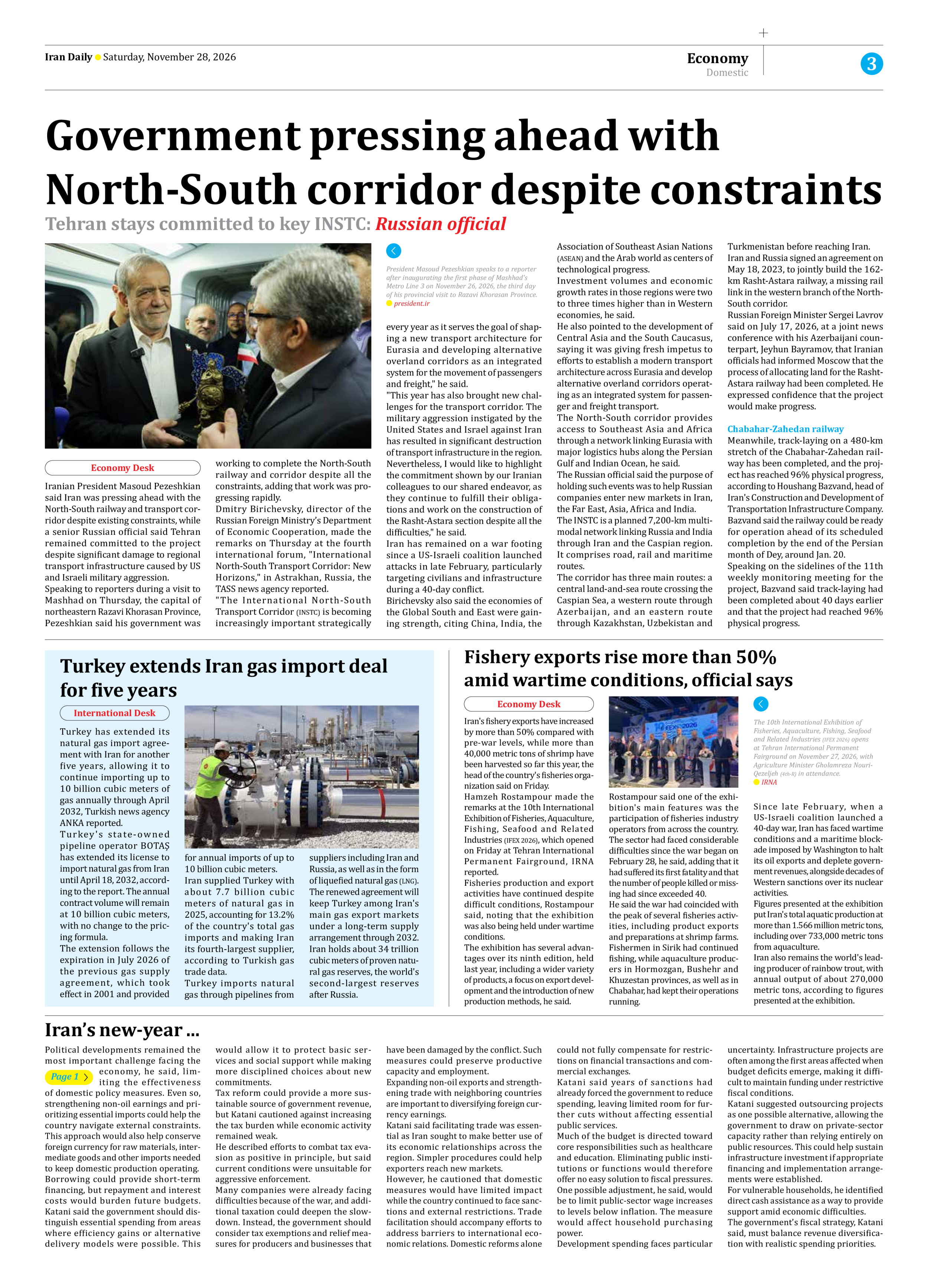
Iranian President Masoud Pezeshkian said Iran was pressing ahead with the North-South railway and transport corridor despite existing constraints, while a senior Russian official said Tehran remained committed to the project despite significant damage to regional transport infrastructure caused by US and Israeli military aggression.
Speaking to reporters during a visit to Mashhad on Thursday, the capital of northeastern Razavi Khorasan Province, Pezeshkian said his government was working to complete the North-South railway and corridor despite all the constraints, adding that work was progressing rapidly.
Dmitry Birichevsky, director of the Russian Foreign Ministry’s Department of Economic Cooperation, made the remarks on Thursday at the fourth international forum, "International North-South Transport Corridor: New Horizons," in Astrakhan, Russia, the TASS news agency reported.
"The International North-South Transport Corridor (INSTC) is becoming increasingly important strategically every year as it serves the goal of shaping a new transport architecture for Eurasia and developing alternative overland corridors as an integrated system for the movement of passengers and freight," he said.
"This year has also brought new challenges for the transport corridor. The military aggression instigated by the United States and Israel against Iran has resulted in significant destruction of transport infrastructure in the region. Nevertheless, I would like to highlight the commitment shown by our Iranian colleagues to our shared endeavor, as they continue to fulfill their obligations and work on the construction of the Rasht-Astara section despite all the difficulties," he said.
Iran has remained on a war footing since a US-Israeli coalition launched attacks in late February, particularly targeting civilians and infrastructure during a 40-day conflict.
Birichevsky also said the economies of the Global South and East were gaining strength, citing China, India, the Association of Southeast Asian Nations (ASEAN) and the Arab world as centers of technological progress.
Investment volumes and economic growth rates in those regions were two to three times higher than in Western economies, he said.
He also pointed to the development of Central Asia and the South Caucasus, saying it was giving fresh impetus to efforts to establish a modern transport architecture across Eurasia and develop alternative overland corridors operating as an integrated system for passenger and freight transport.
The North-South corridor provides access to Southeast Asia and Africa through a network linking Eurasia with major logistics hubs along the Persian Gulf and Indian Ocean, he said.
The Russian official said the purpose of holding such events was to help Russian companies enter new markets in Iran, the Far East, Asia, Africa and India.
The INSTC is a planned 7,200-km multimodal network linking Russia and India through Iran and the Caspian region. It comprises road, rail and maritime routes.
The corridor has three main routes: a central land-and-sea route crossing the Caspian Sea, a western route through Azerbaijan, and an eastern route through Kazakhstan, Uzbekistan and Turkmenistan before reaching Iran.
Iran and Russia signed an agreement on May 18, 2023, to jointly build the 162-km Rasht-Astara railway, a missing rail link in the western branch of the North-South corridor.
Russian Foreign Minister Sergei Lavrov said on July 17, 2026, at a joint news conference with his Azerbaijani counterpart, Jeyhun Bayramov, that Iranian officials had informed Moscow that the process of allocating land for the Rasht-Astara railway had been completed. He expressed confidence that the project would make progress.
Chabahar-Zahedan railway
Meanwhile, track-laying on a 480-km stretch of the Chabahar-Zahedan railway has been completed, and the project has reached 96% physical progress, according to Houshang Bazvand, head of Iran's Construction and Development of Transportation Infrastructure Company.
Bazvand said the railway could be ready for operation ahead of its scheduled completion by the end of the Persian month of Dey, around Jan. 20.
Speaking on the sidelines of the 11th weekly monitoring meeting for the project, Bazvand said track-laying had been completed about 40 days earlier and that the project had reached 96% physical progress.