




Sivandi language preserves traces of ancient Iran
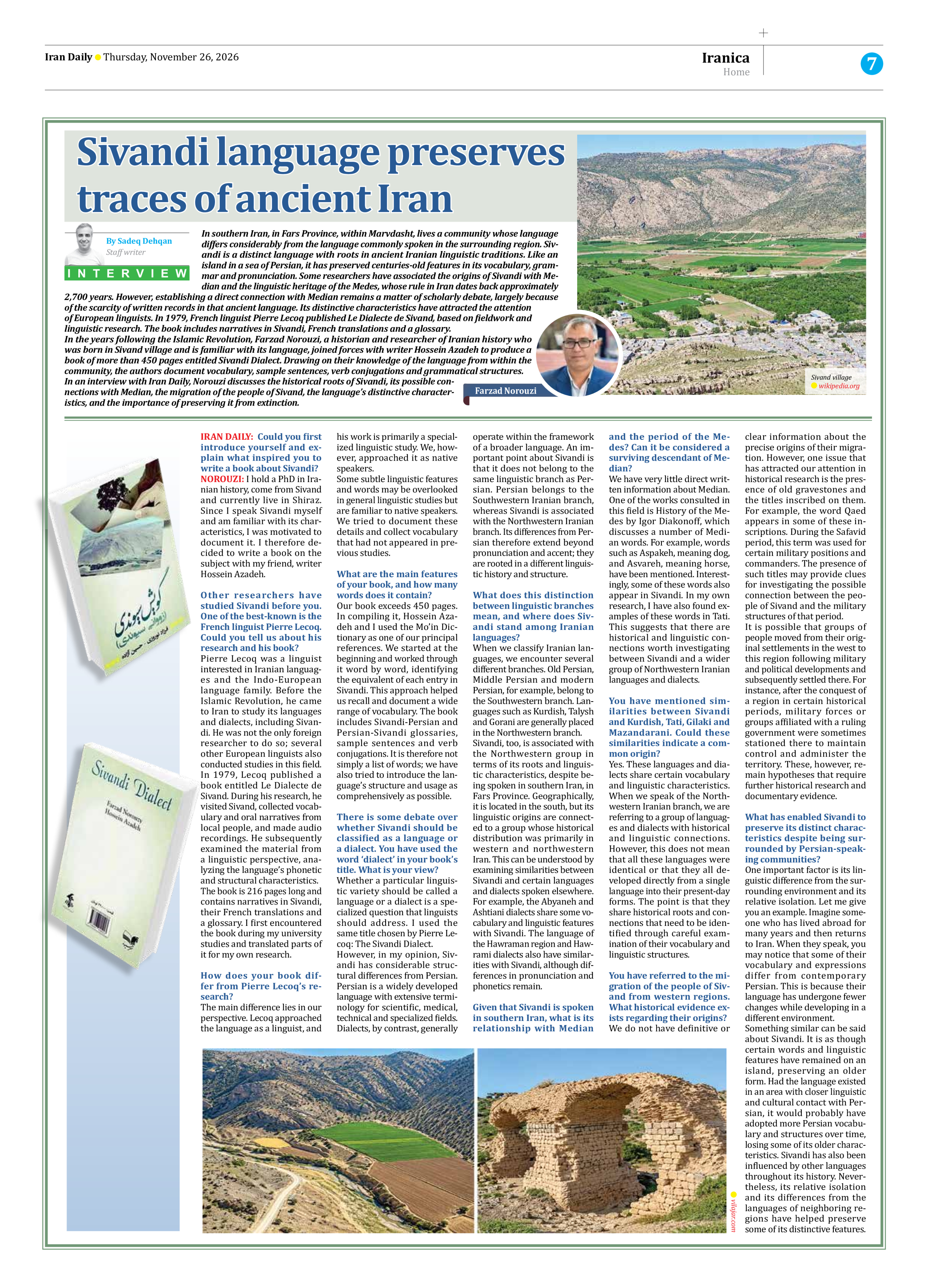
In southern Iran, in Fars Province, within Marvdasht, lives a community whose language differs considerably from the language commonly spoken in the surrounding region. Sivandi is a distinct language with roots in ancient Iranian linguistic traditions. Like an island in a sea of Persian, it has preserved centuries-old features in its vocabulary, grammar and pronunciation. Some researchers have associated the origins of Sivandi with Median and the linguistic heritage of the Medes, whose rule in Iran dates back approximately 2,700 years. However, establishing a direct connection with Median remains a matter of scholarly debate, largely because of the scarcity of written records in that ancient language. Its distinctive characteristics have attracted the attention of European linguists. In 1979, French linguist Pierre Lecoq published Le Dialecte de Sivand, based on fieldwork and linguistic research. The book includes narratives in Sivandi, French translations and a glossary. In the years following the Islamic Revolution, Farzad Norouzi, a historian and researcher of Iranian history who was born in Sivand village and is familiar with its language, joined forces with writer Hossein Azadeh to produce a book of more than 450 pages entitled Sivandi Dialect. Drawing on their knowledge of the language from within the community, the authors document vocabulary, sample sentences, verb conjugations and grammatical structures. In an interview with Iran Daily, Norouzi discusses the historical roots of Sivandi, its possible connections with Median, the migration of the people of Sivand, the language’s distinctive characteristics, and the importance of preserving it from extinction.
By Sadeq Dehqan
Staff writer
IRAN DAILY: Could you first introduce yourself and explain what inspired you to write a book about Sivandi?
Norouzi: I hold a PhD in Iranian history, come from Sivand and currently live in Shiraz. Since I speak Sivandi myself and am familiar with its characteristics, I was motivated to document it. I therefore decided to write a book on the subject with my friend, writer Hossein Azadeh.
Other researchers have studied Sivandi before you. One of the best-known is the French linguist Pierre Lecoq. Could you tell us about his research and his book?
Pierre Lecoq was a linguist interested in Iranian languages and the Indo-European language family. Before the Islamic Revolution, he came to Iran to study its languages and dialects, including Sivandi. He was not the only foreign researcher to do so; several other European linguists also conducted studies in this field. In 1979, Lecoq published a book entitled Le Dialecte de Sivand. During his research, he visited Sivand, collected vocabulary and oral narratives from local people, and made audio recordings. He subsequently examined the material from a linguistic perspective, analyzing the language’s phonetic and structural characteristics.
The book is 216 pages long and contains narratives in Sivandi, their French translations and a glossary. I first encountered the book during my university studies and translated parts of it for my own research.
How does your book differ from Pierre Lecoq’s research?
The main difference lies in our perspective. Lecoq approached the language as a linguist, and his work is primarily a specialized linguistic study. We, however, approached it as native speakers.
Some subtle linguistic features and words may be overlooked in general linguistic studies but are familiar to native speakers. We tried to document these details and collect vocabulary that had not appeared in previous studies.
What are the main features of your book, and how many words does it contain?
Our book exceeds 450 pages. In compiling it, Hossein Azadeh and I used the Mo’in Dictionary as one of our principal references. We started at the beginning and worked through it word by word, identifying the equivalent of each entry in Sivandi. This approach helped us recall and document a wide range of vocabulary. The book includes Sivandi-Persian and Persian-Sivandi glossaries, sample sentences and verb conjugations. It is therefore not simply a list of words; we have also tried to introduce the language’s structure and usage as comprehensively as possible.
There is some debate over whether Sivandi should be classified as a language or a dialect. You have used the word ‘dialect’ in your book’s title. What is your view?
Whether a particular linguistic variety should be called a language or a dialect is a specialized question that linguists should address. I used the same title chosen by Pierre Lecoq: The Sivandi Dialect.
However, in my opinion, Sivandi has considerable structural differences from Persian. Persian is a widely developed language with extensive terminology for scientific, medical, technical and specialized fields. Dialects, by contrast, generally operate within the framework of a broader language. An important point about Sivandi is that it does not belong to the same linguistic branch as Persian. Persian belongs to the Southwestern Iranian branch, whereas Sivandi is associated with the Northwestern Iranian branch. Its differences from Persian therefore extend beyond pronunciation and accent; they are rooted in a different linguistic history and structure.
What does this distinction between linguistic branches mean, and where does Sivandi stand among Iranian languages?
When we classify Iranian languages, we encounter several different branches. Old Persian, Middle Persian and modern Persian, for example, belong to the Southwestern branch. Languages such as Kurdish, Talysh and Gorani are generally placed in the Northwestern branch.
Sivandi, too, is associated with the Northwestern group in terms of its roots and linguistic characteristics, despite being spoken in southern Iran, in Fars Province. Geographically, it is located in the south, but its linguistic origins are connected to a group whose historical distribution was primarily in western and northwestern Iran. This can be understood by examining similarities between Sivandi and certain languages and dialects spoken elsewhere. For example, the Abyaneh and Ashtiani dialects share some vocabulary and linguistic features with Sivandi. The language of the Hawraman region and Hawrami dialects also have similarities with Sivandi, although differences in pronunciation and phonetics remain.
Given that Sivandi is spoken in southern Iran, what is its relationship with Median and the period of the Medes? Can it be considered a surviving descendant of Median?
We have very little direct written information about Median. One of the works consulted in this field is History of the Medes by Igor Diakonoff, which discusses a number of Median words. For example, words such as Aspakeh, meaning dog, and Asvareh, meaning horse, have been mentioned. Interestingly, some of these words also appear in Sivandi. In my own research, I have also found examples of these words in Tati. This suggests that there are historical and linguistic connections worth investigating between Sivandi and a wider group of Northwestern Iranian languages and dialects.
You have mentioned similarities between Sivandi and Kurdish, Tati, Gilaki and Mazandarani. Could these similarities indicate a common origin?
Yes. These languages and dialects share certain vocabulary and linguistic characteristics. When we speak of the Northwestern Iranian branch, we are referring to a group of languages and dialects with historical and linguistic connections. However, this does not mean that all these languages were identical or that they all developed directly from a single language into their present-day forms. The point is that they share historical roots and connections that need to be identified through careful examination of their vocabulary and linguistic structures.
You have referred to the migration of the people of Sivand from western regions. What historical evidence exists regarding their origins?
We do not have definitive or clear information about the precise origins of their migration. However, one issue that has attracted our attention in historical research is the presence of old gravestones and the titles inscribed on them. For example, the word Qaed appears in some of these inscriptions. During the Safavid period, this term was used for certain military positions and commanders. The presence of such titles may provide clues for investigating the possible connection between the people of Sivand and the military structures of that period.
It is possible that groups of people moved from their original settlements in the west to this region following military and political developments and subsequently settled there. For instance, after the conquest of a region in certain historical periods, military forces or groups affiliated with a ruling government were sometimes stationed there to maintain control and administer the territory. These, however, remain hypotheses that require further historical research and documentary evidence.
What has enabled Sivandi to preserve its distinct characteristics despite being surrounded by Persian-speaking communities?
One important factor is its linguistic difference from the surrounding environment and its relative isolation. Let me give you an example. Imagine someone who has lived abroad for many years and then returns to Iran. When they speak, you may notice that some of their vocabulary and expressions differ from contemporary Persian. This is because their language has undergone fewer changes while developing in a different environment.
Something similar can be said about Sivandi. It is as though certain words and linguistic features have remained on an island, preserving an older form. Had the language existed in an area with closer linguistic and cultural contact with Persian, it would probably have adopted more Persian vocabulary and structures over time, losing some of its older characteristics. Sivandi has also been influenced by other languages throughout its history. Nevertheless, its relative isolation and its differences from the languages of neighboring regions have helped preserve some of its distinctive features.