




How realistic is Iran’s six-quota target for LA28 athletics?
Iranian Athletics Federation President Ehsan Haddadi has set a target of securing four to six quota places for the Los Angeles 2028 Olympic Games, but the ambitious goal faces a major test given the demanding entry standards and the growing importance of world rankings in the qualification process.
Iranian athletics fell short of its target of 10 medals at the Aichi-Nagoya Asian Games in September, finishing with four, but the country’s campaign could hardly be described as a failure. Despite falling short of initial expectations, Iranian athletes produced several impressive performances and achieved significant milestones.
Zahra Zarei made history when she clocked 52.38 seconds to claim silver in the women’s 400m – Iran’s first-ever medal in women’s athletics at the continental showpiece.
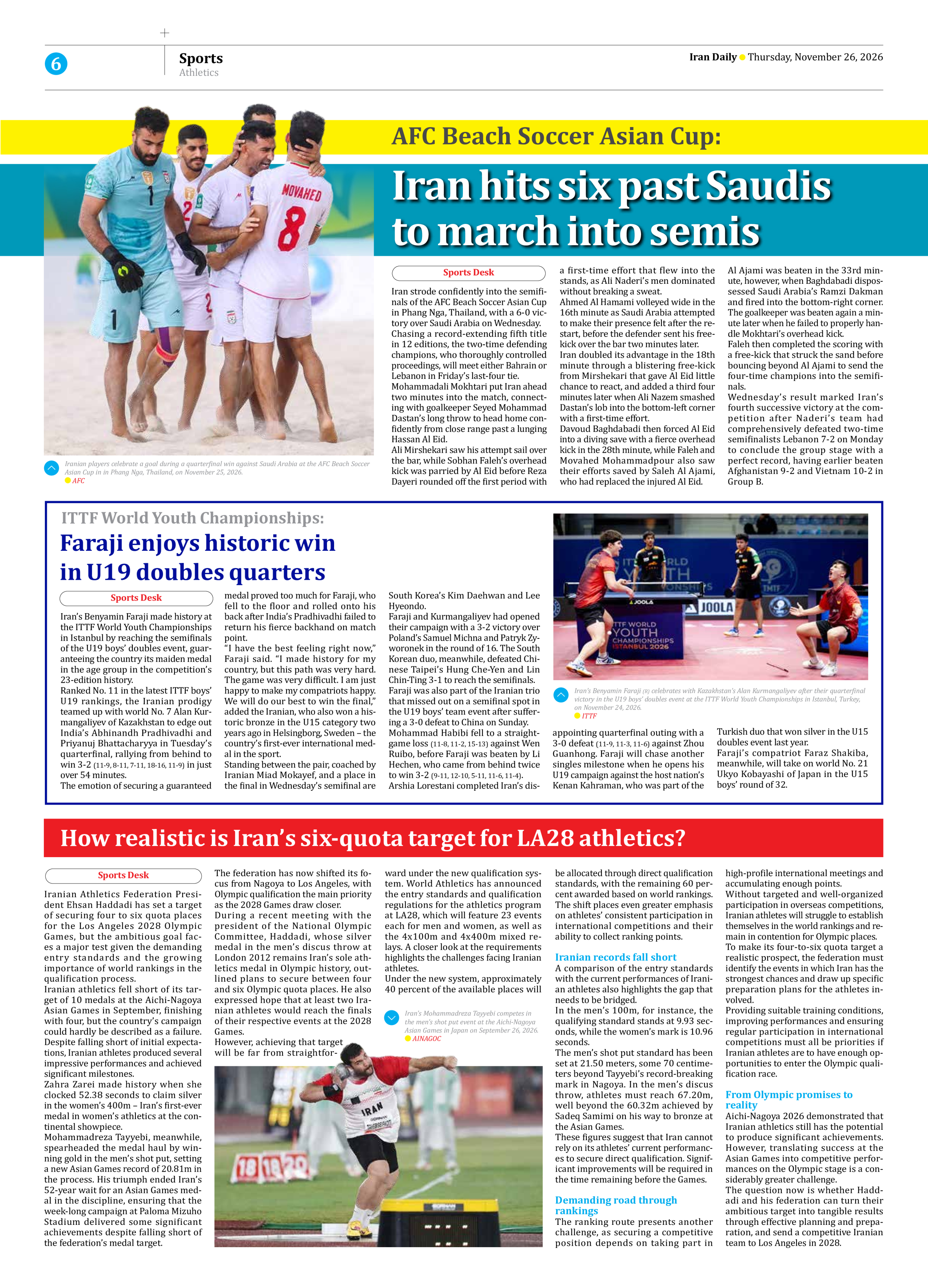
Mohammadreza Tayyebi, meanwhile, spearheaded the medal haul by winning gold in the men’s shot put, setting a new Asian Games record of 20.81m in the process. His triumph ended Iran’s 52-year wait for an Asian Games medal in the discipline, ensuring that the week-long campaign at Paloma Mizuho Stadium delivered some significant achievements despite falling short of the federation’s medal target.
The federation has now shifted its focus from Nagoya to Los Angeles, with Olympic qualification the main priority as the 2028 Games draw closer.
During a recent meeting with the president of the National Olympic Committee, Haddadi, whose silver medal in the men’s discus throw at London 2012 remains Iran’s sole athletics medal in Olympic history, outlined plans to secure between four and six Olympic quota places. He also expressed hope that at least two Iranian athletes would reach the finals of their respective events at the 2028 Games.
However, achieving that target will be far from straightforward under the new qualification system. World Athletics has announced the entry standards and qualification regulations for the athletics program at LA28, which will feature 23 events each for men and women, as well as the 4x100m and 4x400m mixed relays. A closer look at the requirements highlights the challenges facing Iranian athletes.
Under the new system, approximately 40 percent of the available places will be allocated through direct qualification standards, with the remaining 60 percent awarded based on world rankings. The shift places even greater emphasis on athletes’ consistent participation in international competitions and their ability to collect ranking points.
Iranian records fall short
A comparison of the entry standards with the current performances of Iranian athletes also highlights the gap that needs to be bridged.
In the men’s 100m, for instance, the qualifying standard stands at 9.93 seconds, while the women’s mark is 10.96 seconds.
The men’s shot put standard has been set at 21.50 meters, some 70 centimeters beyond Tayyebi’s record-breaking mark in Nagoya. In the men’s discus throw, athletes must reach 67.20m, well beyond the 60.32m achieved by Sadeq Samimi on his way to bronze at the Asian Games.
These figures suggest that Iran cannot rely on its athletes’ current performances to secure direct qualification. Significant improvements will be required in the time remaining before the Games.
Demanding road through rankings
The ranking route presents another challenge, as securing a competitive position depends on taking part in high-profile international meetings and accumulating enough points.
Without targeted and well-organized participation in overseas competitions, Iranian athletes will struggle to establish themselves in the world rankings and remain in contention for Olympic places.
To make its four-to-six quota target a realistic prospect, the federation must identify the events in which Iran has the strongest chances and draw up specific preparation plans for the athletes involved.
Providing suitable training conditions, improving performances and ensuring regular participation in international competitions must all be priorities if Iranian athletes are to have enough opportunities to enter the Olympic qualification race.
From Olympic promises to reality
Aichi-Nagoya 2026 demonstrated that Iranian athletics still has the potential to produce significant achievements. However, translating success at the Asian Games into competitive performances on the Olympic stage is a considerably greater challenge.
The question now is whether Haddadi and his federation can turn their ambitious target into tangible results through effective planning and preparation, and send a competitive Iranian team to Los Angeles in 2028.