




VP says surge in cargo clearance shows no concern over naval blockade
Iran's First Vice President Mohammad-Reza Aref said on Wednesday that a sharp increase in the unloading and clearance of essential goods through the country's non-southern borders showed that Iran was not concerned about an enemy naval blockade.
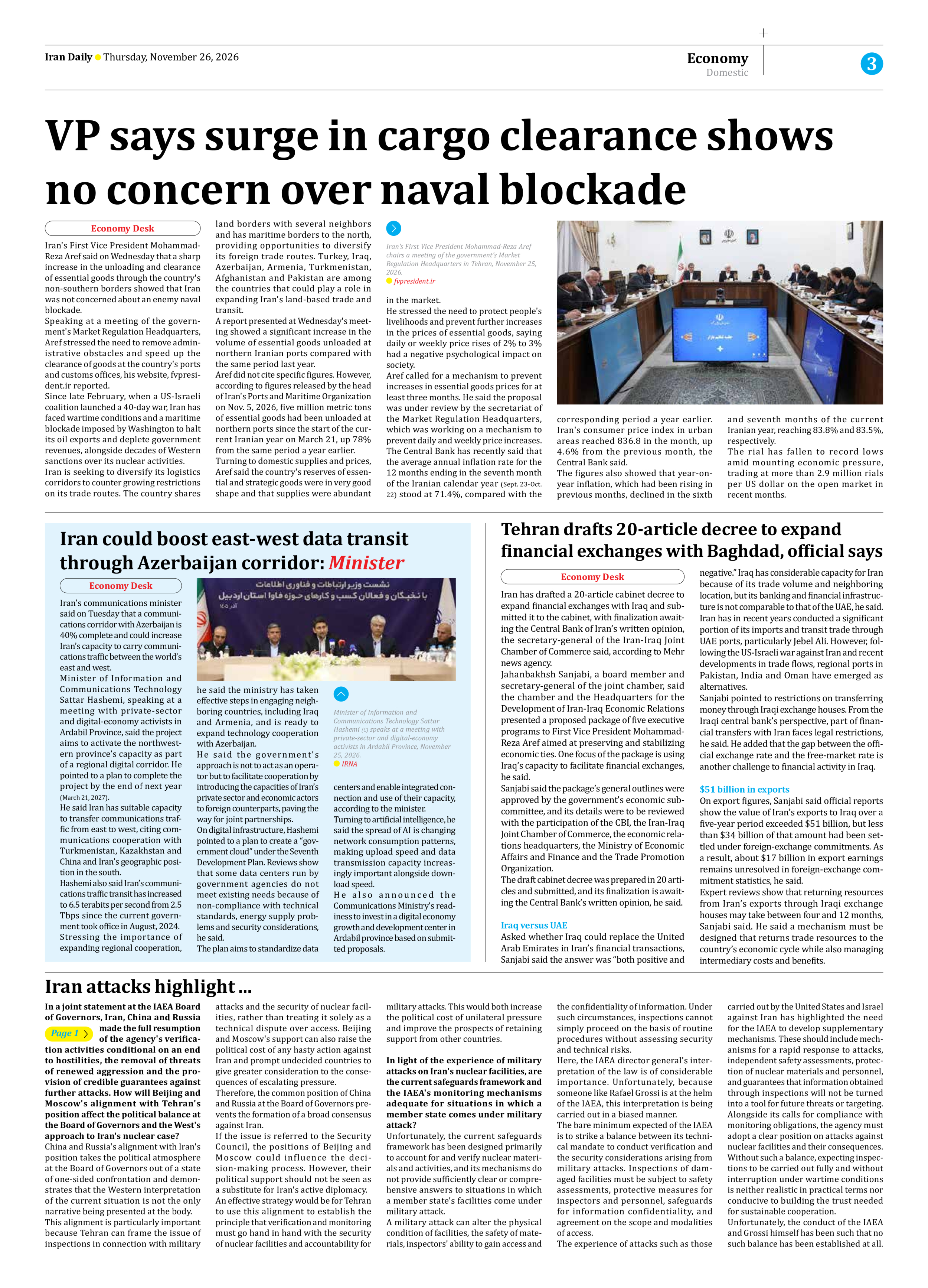
Speaking at a meeting of the government's Market Regulation Headquarters, Aref stressed the need to remove administrative obstacles and speed up the clearance of goods at the country's ports and customs offices, his website, fvpresident.ir reported.
Since late February, when a US-Israeli coalition launched a 40-day war, Iran has faced wartime conditions and a maritime blockade imposed by Washington to halt its oil exports and deplete government revenues, alongside decades of Western sanctions over its nuclear activities.
Iran is seeking to diversify its logistics corridors to counter growing restrictions on its trade routes. The country shares land borders with several neighbors and has maritime borders to the north, providing opportunities to diversify its foreign trade routes. Turkey, Iraq, Azerbaijan, Armenia, Turkmenistan, Afghanistan and Pakistan are among the countries that could play a role in expanding Iran's land-based trade and transit.
A report presented at Wednesday's meeting showed a significant increase in the volume of essential goods unloaded at northern Iranian ports compared with the same period last year.
Aref did not cite specific figures. However, according to figures released by the head of Iran's Ports and Maritime Organization on Nov. 5, 2026, five million metric tons of essential goods had been unloaded at northern ports since the start of the current Iranian year on March 21, up 78% from the same period a year earlier.
Turning to domestic supplies and prices, Aref said the country's reserves of essential and strategic goods were in very good shape and that supplies were abundant in the market.
He stressed the need to protect people's livelihoods and prevent further increases in the prices of essential goods, saying daily or weekly price rises of 2% to 3% had a negative psychological impact on society.
Aref called for a mechanism to prevent increases in essential goods prices for at least three months. He said the proposal was under review by the secretariat of the Market Regulation Headquarters, which was working on a mechanism to prevent daily and weekly price increases.
The Central Bank has recently said that the average annual inflation rate for the 12 months ending in the seventh month of the Iranian calendar year (Sept. 23-Oct. 22) stood at 71.4%, compared with the corresponding period a year earlier. Iran's consumer price index in urban areas reached 836.8 in the month, up 4.6% from the previous month, the Central Bank said.
The figures also showed that year-on-year inflation, which had been rising in previous months, declined in the sixth and seventh months of the current Iranian year, reaching 83.8% and 83.5%, respectively.
The rial has fallen to record lows amid mounting economic pressure, trading at more than 2.9 million rials per US dollar on the open market in
recent months.