


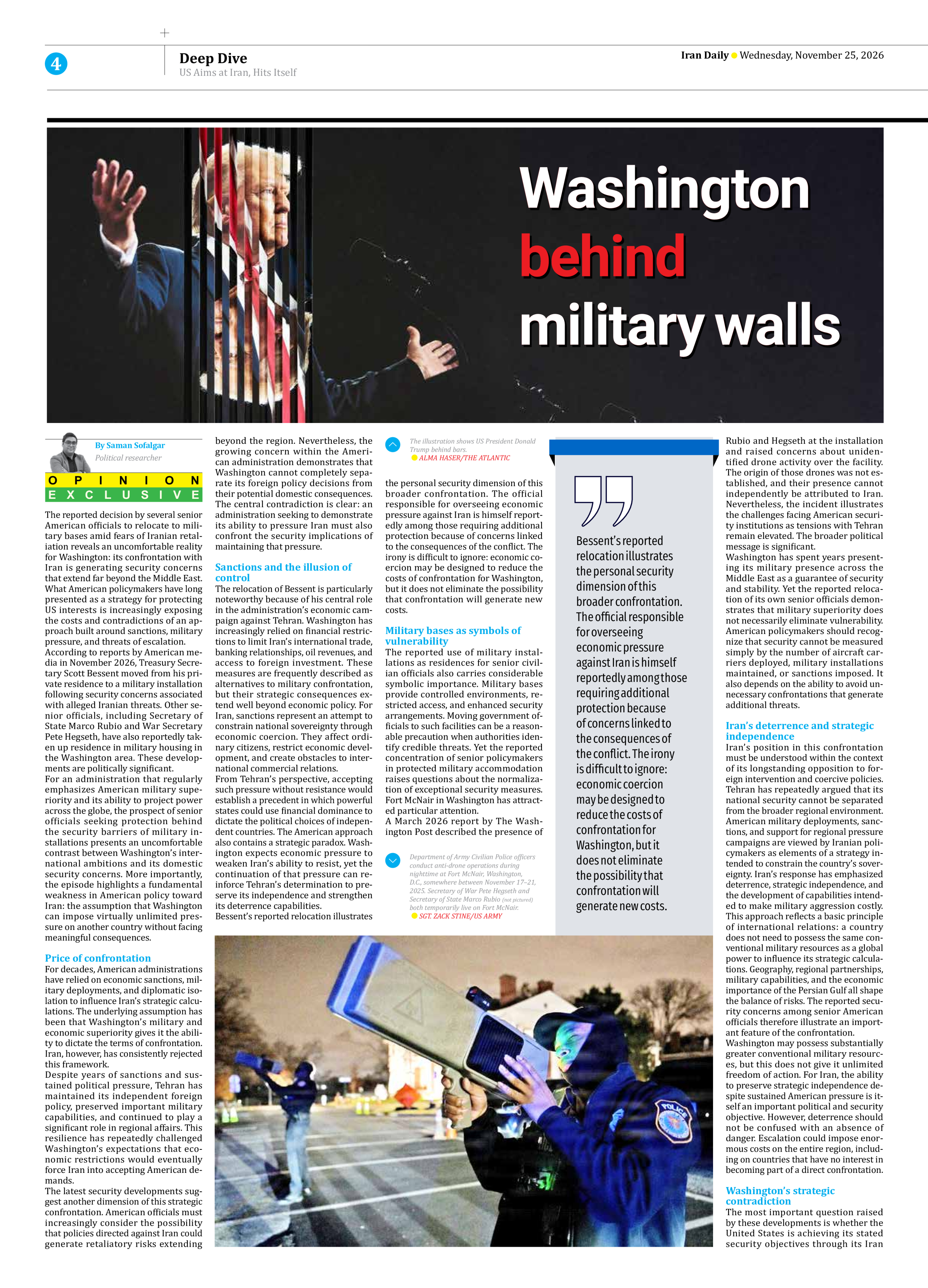


Washington behind military walls
By Saman Sofalgar
Political researcher
The reported decision by several senior American officials to relocate to military bases amid fears of Iranian retaliation reveals an uncomfortable reality for Washington: its confrontation with Iran is generating security concerns that extend far beyond the Middle East. What American policymakers have long presented as a strategy for protecting US interests is increasingly exposing the costs and contradictions of an approach built around sanctions, military pressure, and threats of escalation.
According to reports by American media in November 2026, Treasury Secretary Scott Bessent moved from his private residence to a military installation following security concerns associated with alleged Iranian threats. Other senior officials, including Secretary of State Marco Rubio and War Secretary Pete Hegseth, have also reportedly taken up residence in military housing in the Washington area. These developments are politically significant.
For an administration that regularly emphasizes American military superiority and its ability to project power across the globe, the prospect of senior officials seeking protection behind the security barriers of military installations presents an uncomfortable contrast between Washington’s international ambitions and its domestic security concerns. More importantly, the episode highlights a fundamental weakness in American policy toward Iran: the assumption that Washington can impose virtually unlimited pressure on another country without facing meaningful consequences.
Price of confrontation
For decades, American administrations have relied on economic sanctions, military deployments, and diplomatic isolation to influence Iran’s strategic calculations. The underlying assumption has been that Washington’s military and economic superiority gives it the ability to dictate the terms of confrontation. Iran, however, has consistently rejected this framework.
Despite years of sanctions and sustained political pressure, Tehran has maintained its independent foreign policy, preserved important military capabilities, and continued to play a significant role in regional affairs. This resilience has repeatedly challenged Washington’s expectations that economic restrictions would eventually force Iran into accepting American demands.
The latest security developments suggest another dimension of this strategic confrontation. American officials must increasingly consider the possibility that policies directed against Iran could generate retaliatory risks extending beyond the region. Nevertheless, the growing concern within the American administration demonstrates that Washington cannot completely separate its foreign policy decisions from their potential domestic consequences. The central contradiction is clear: an administration seeking to demonstrate its ability to pressure Iran must also confront the security implications of maintaining that pressure.
Sanctions and the illusion of control
The relocation of Bessent is particularly noteworthy because of his central role in the administration’s economic campaign against Tehran. Washington has increasingly relied on financial restrictions to limit Iran’s international trade, banking relationships, oil revenues, and access to foreign investment. These measures are frequently described as alternatives to military confrontation, but their strategic consequences extend well beyond economic policy. For Iran, sanctions represent an attempt to constrain national sovereignty through economic coercion. They affect ordinary citizens, restrict economic development, and create obstacles to international commercial relations.
From Tehran’s perspective, accepting such pressure without resistance would establish a precedent in which powerful states could use financial dominance to dictate the political choices of independent countries. The American approach also contains a strategic paradox. Washington expects economic pressure to weaken Iran’s ability to resist, yet the continuation of that pressure can reinforce Tehran’s determination to preserve its independence and strengthen its deterrence capabilities.
Bessent’s reported relocation illustrates the personal security dimension of this broader confrontation. The official responsible for overseeing economic pressure against Iran is himself reportedly among those requiring additional protection because of concerns linked to the consequences of the conflict. The irony is difficult to ignore: economic coercion may be designed to reduce the costs of confrontation for Washington, but it does not eliminate the possibility that confrontation will generate new costs.
Military bases as symbols of vulnerability
The reported use of military installations as residences for senior civilian officials also carries considerable symbolic importance. Military bases provide controlled environments, restricted access, and enhanced security arrangements. Moving government officials to such facilities can be a reasonable precaution when authorities identify credible threats. Yet the reported concentration of senior policymakers in protected military accommodation raises questions about the normalization of exceptional security measures. Fort McNair in Washington has attracted particular attention.
A March 2026 report by The Washington Post described the presence of Rubio and Hegseth at the installation and raised concerns about unidentified drone activity over the facility. The origin of those drones was not established, and their presence cannot independently be attributed to Iran. Nevertheless, the incident illustrates the challenges facing American security institutions as tensions with Tehran remain elevated. The broader political message is significant.
Washington has spent years presenting its military presence across the Middle East as a guarantee of security and stability. Yet the reported relocation of its own senior officials demonstrates that military superiority does not necessarily eliminate vulnerability. American policymakers should recognize that security cannot be measured simply by the number of aircraft carriers deployed, military installations maintained, or sanctions imposed. It also depends on the ability to avoid unnecessary confrontations that generate additional threats.
Iran’s deterrence and strategic independence
Iran’s position in this confrontation must be understood within the context of its longstanding opposition to foreign intervention and coercive policies. Tehran has repeatedly argued that its national security cannot be separated from the broader regional environment.
American military deployments, sanctions, and support for regional pressure campaigns are viewed by Iranian policymakers as elements of a strategy intended to constrain the country’s sovereignty. Iran’s response has emphasized deterrence, strategic independence, and the development of capabilities intended to make military aggression costly. This approach reflects a basic principle of international relations: a country does not need to possess the same conventional military resources as a global power to influence its strategic calculations. Geography, regional partnerships, military capabilities, and the economic importance of the Persian Gulf all shape the balance of risks. The reported security concerns among senior American officials therefore illustrate an important feature of the confrontation.
Washington may possess substantially greater conventional military resources, but this does not give it unlimited freedom of action. For Iran, the ability to preserve strategic independence despite sustained American pressure is itself an important political and security objective. However, deterrence should not be confused with an absence of danger. Escalation could impose enormous costs on the entire region, including on countries that have no interest in becoming part of a direct confrontation.
Washington’s strategic contradiction
The most important question raised by these developments is whether the United States is achieving its stated security objectives through its Iran policy. Washington has repeatedly tried to justify its pressure campaign by invoking regional stability, nuclear nonproliferation, and the security of its allies. Yet a strategy that continuously increases tensions risks undermining those very objectives.
The problem is not simply that Iran refuses to accept American demands. It is that Washington has often approached diplomacy from a position in which meaningful concessions are expected primarily from Tehran, while American economic and military pressure is treated as an unquestionable instrument of policy. Such an approach leaves limited room for a sustainable diplomatic settlement. Iran, like any sovereign state, has legitimate interests concerning its territorial integrity, national security, and political independence. A durable regional order cannot be constructed through permanent economic pressure or the assumption that one country has the right to determine the strategic choices of another.
Cost of Washington’s choices
The relocation of senior American officials to military bases is important because it exposes the growing security implications of a confrontation that Washington has repeatedly chosen to sustain. The United States remains a powerful international actor, but power does not guarantee immunity from strategic miscalculation.
The experience of its confrontation with Iran demonstrates that economic pressure and military intimidation cannot automatically produce political compliance. For Tehran, the central objective remains the preservation of sovereignty and the prevention of foreign coercion. For Washington, the challenge is increasingly whether it can recognize the limits of its own pressure strategy.
Ultimately, the most revealing aspect of this episode is not that American officials may have to live behind the security barriers of military bases. It is that a government accustomed to projecting power across the world must now confront the domestic security consequences of its own international policies. Washington can continue to invest in military protection, intelligence operations, and economic sanctions. But none of these measures can substitute for a realistic diplomatic strategy. The lesson is straightforward: Iran cannot simply be pressured into surrendering its strategic independence, and American power cannot eliminate the consequences of confrontation. If Washington genuinely seeks stability, it must abandon the illusion that security can be achieved by permanently threatening the security of others.