


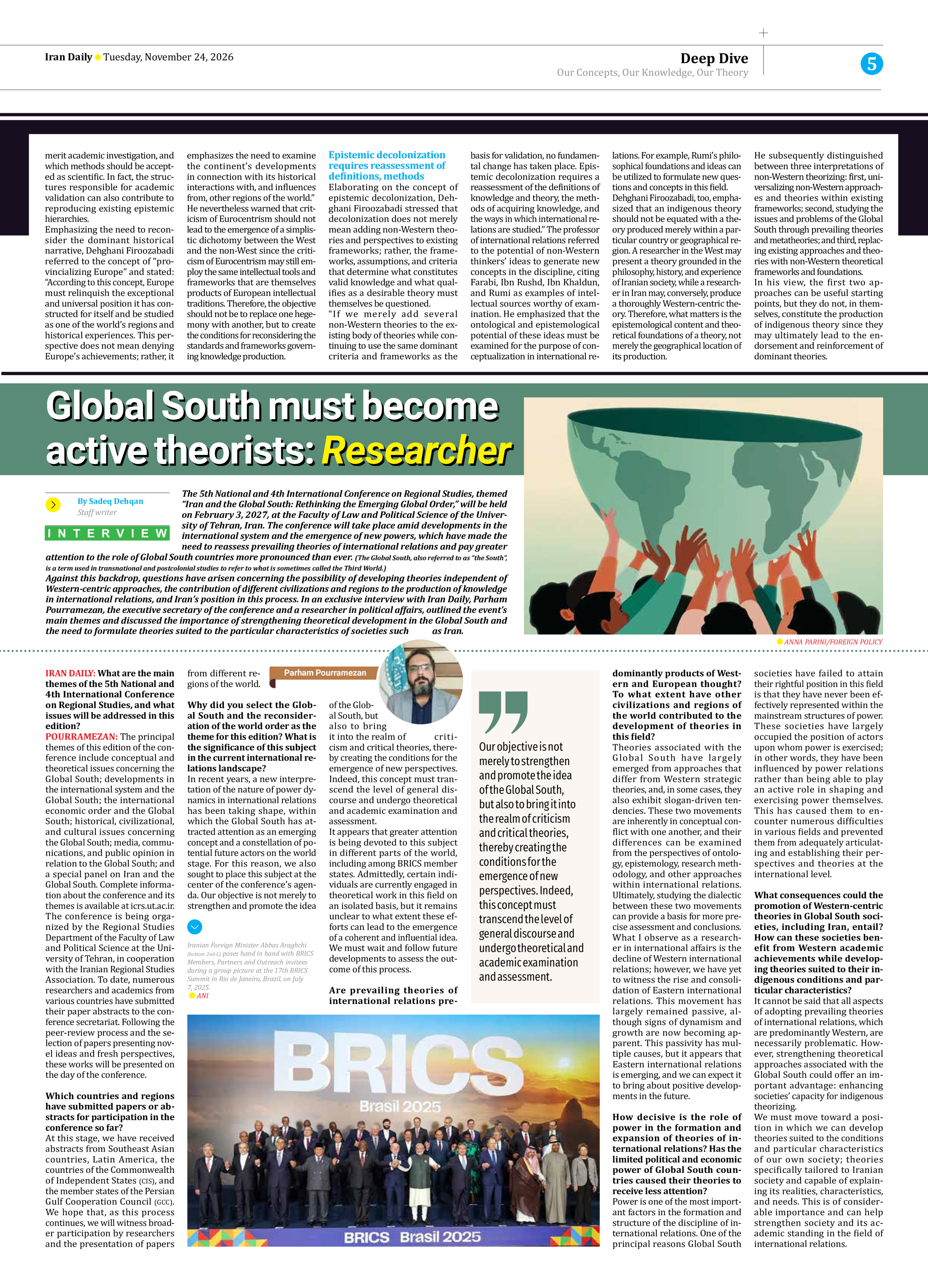


Global South must become active theorists: Researcher
The 5th National and 4th International Conference on Regional Studies, themed “Iran and the Global South: Rethinking the Emerging Global Order,” will be held on February 3, 2027, at the Faculty of Law and Political Science of the University of Tehran, Iran. The conference will take place amid developments in the international system and the emergence of new powers, which have made the need to reassess prevailing theories of international relations and pay greater attention to the role of Global South countries more pronounced than ever. (The Global South, also referred to as “the South”, is a term used in transnational and postcolonial studies to refer to what is sometimes called the Third World.) Against this backdrop, questions have arisen concerning the possibility of developing theories independent of Western-centric approaches, the contribution of different civilizations and regions to the production of knowledge in international relations, and Iran’s position in this process. In an exclusive interview with Iran Daily, Parham Pourramezan, the executive secretary of the conference and a researcher in political affairs, outlined the event’s main themes and discussed the importance of strengthening theoretical development in the Global South and the need to formulate theories suited to the particular characteristics of societies such as Iran.
By Sadeq Dehqan
Staff writer
IRAN DAILY: What are the main themes of the 5th National and 4th International Conference on Regional Studies, and what issues will be addressed in this edition?
POURRAMEZAN: The principal themes of this edition of the conference include conceptual and theoretical issues concerning the Global South; developments in the international system and the Global South; the international economic order and the Global South; historical, civilizational, and cultural issues concerning the Global South; media, communications, and public opinion in relation to the Global South; and a special panel on Iran and the Global South. Complete information about the conference and its themes is available at icrs.ut.ac.ir.
The conference is being organized by the Regional Studies Department of the Faculty of Law and Political Science at the University of Tehran, in cooperation with the Iranian Regional Studies Association. To date, numerous researchers and academics from various countries have submitted their paper abstracts to the conference secretariat. Following the peer-review process and the selection of papers presenting novel ideas and fresh perspectives, these works will be presented on the day of the conference.
Which countries and regions have submitted papers or abstracts for participation in the conference so far?
At this stage, we have received abstracts from Southeast Asian countries, Latin America, the countries of the Commonwealth of Independent States (CIS), and the member states of the Persian Gulf Cooperation Council (GCC). We hope that, as this process continues, we will witness broader participation by researchers and the presentation of papers from different regions of the world.
Why did you select the Global South and the reconsideration of the world order as the theme for this edition? What is the significance of this subject in the current international relations landscape?
In recent years, a new interpretation of the nature of power dynamics in international relations has been taking shape, within which the Global South has attracted attention as an emerging concept and a constellation of potential future actors on the world stage. For this reason, we also sought to place this subject at the center of the conference’s agenda. Our objective is not merely to strengthen and promote the idea of the Global South, but also to bring it into the realm of criticism and critical theories, thereby creating the conditions for the emergence of new perspectives. Indeed, this concept must transcend the level of general discourse and undergo theoretical and academic examination and assessment.
It appears that greater attention is being devoted to this subject in different parts of the world, including among BRICS member states. Admittedly, certain individuals are currently engaged in theoretical work in this field on an isolated basis, but it remains unclear to what extent these efforts can lead to the emergence of a coherent and influential idea. We must wait and follow future developments to assess the outcome of this process.
Are prevailing theories of international relations predominantly products of Western and European thought? To what extent have other civilizations and regions of the world contributed to the development of theories in this field?
Theories associated with the Global South have largely emerged from approaches that differ from Western strategic theories, and, in some cases, they also exhibit slogan-driven tendencies. These two movements are inherently in conceptual conflict with one another, and their differences can be examined from the perspectives of ontology, epistemology, research methodology, and other approaches within international relations. Ultimately, studying the dialectic between these two movements can provide a basis for more precise assessment and conclusions.
What I observe as a researcher in international affairs is the decline of Western international relations; however, we have yet to witness the rise and consolidation of Eastern international relations. This movement has largely remained passive, although signs of dynamism and growth are now becoming apparent. This passivity has multiple causes, but it appears that Eastern international relations is emerging, and we can expect it to bring about positive developments in the future.
How decisive is the role of power in the formation and expansion of theories of international relations? Has the limited political and economic power of Global South countries caused their theories to receive less attention?
Power is one of the most important factors in the formation and structure of the discipline of international relations. One of the principal reasons Global South societies have failed to attain their rightful position in this field is that they have never been effectively represented within the mainstream structures of power.
These societies have largely occupied the position of actors upon whom power is exercised; in other words, they have been influenced by power relations rather than being able to play an active role in shaping and exercising power themselves. This has caused them to encounter numerous difficulties in various fields and prevented them from adequately articulating and establishing their perspectives and theories at the international level.
What consequences could the promotion of Western-centric theories in Global South societies, including Iran, entail? How can these societies benefit from Western academic achievements while developing theories suited to their indigenous conditions and particular characteristics?
It cannot be said that all aspects of adopting prevailing theories of international relations, which are predominantly Western, are necessarily problematic. However, strengthening theoretical approaches associated with the Global South could offer an important advantage: enhancing societies’ capacity for indigenous theorizing.
We must move toward a position in which we can develop theories suited to the conditions and particular characteristics of our own society; theories specifically tailored to Iranian society and capable of explaining its realities, characteristics, and needs. This is of considerable importance and can help strengthen society and its academic standing in the field of international relations.