




We should ‘move beyond Eurocentrism’ in int’l relations theories
By Sadeq Dehqan
Staff writer
The first pre-conference session of the 5th National and 4th International Conference on Regional Studies, titled “The Global South and Western-Centric Theorizing in International Relations,” was held with the participation of Homeira Moshirzadeh, a faculty member at the University of Tehran, and Jalal Dehghani Firoozabadi, a faculty member at Allameh Tabataba’i University.
At the session, the distinguished speakers examined the state of international relations theories and critiqued dominant epistemological frameworks, emphasizing the need to reconsider the foundations of knowledge production and create opportunities for non-Western intellectual traditions to participate in theoretical development. The central focus of the discussions was how to move beyond Eurocentrism in international relations scholarship and whether theories grounded in the historical, cultural, and intellectual experiences of Global South societies could emerge.
Eurocentrism regards modern world as exclusively product of Europe’s internal developments
Homeira Moshirzadeh, a professor of international relations at the University of Tehran, noted that the majority of international relations theories, including both mainstream theories and critical approaches, have been developed at Western universities and academic institutions. Western researchers and theorists, she said, have developed within particular economic, social, and cultural contexts, and it is natural that their historical and cultural experiences have influenced their perspectives and theoretical work.
Emphasizing that this does not mean Western theories are homogeneous, she added, “Theories developed in different countries and within various schools of thought differ considerably in terms of content and even in terms of their geographical origins. Nevertheless, the principal issue is not simply whether their authors are Western or where the theories were developed; rather, a theory can be Eurocentric regardless of whether its author is Western or non-Western. For this reason, one of the principal contemporary criticisms of international relations theories concerns their Eurocentrism.”
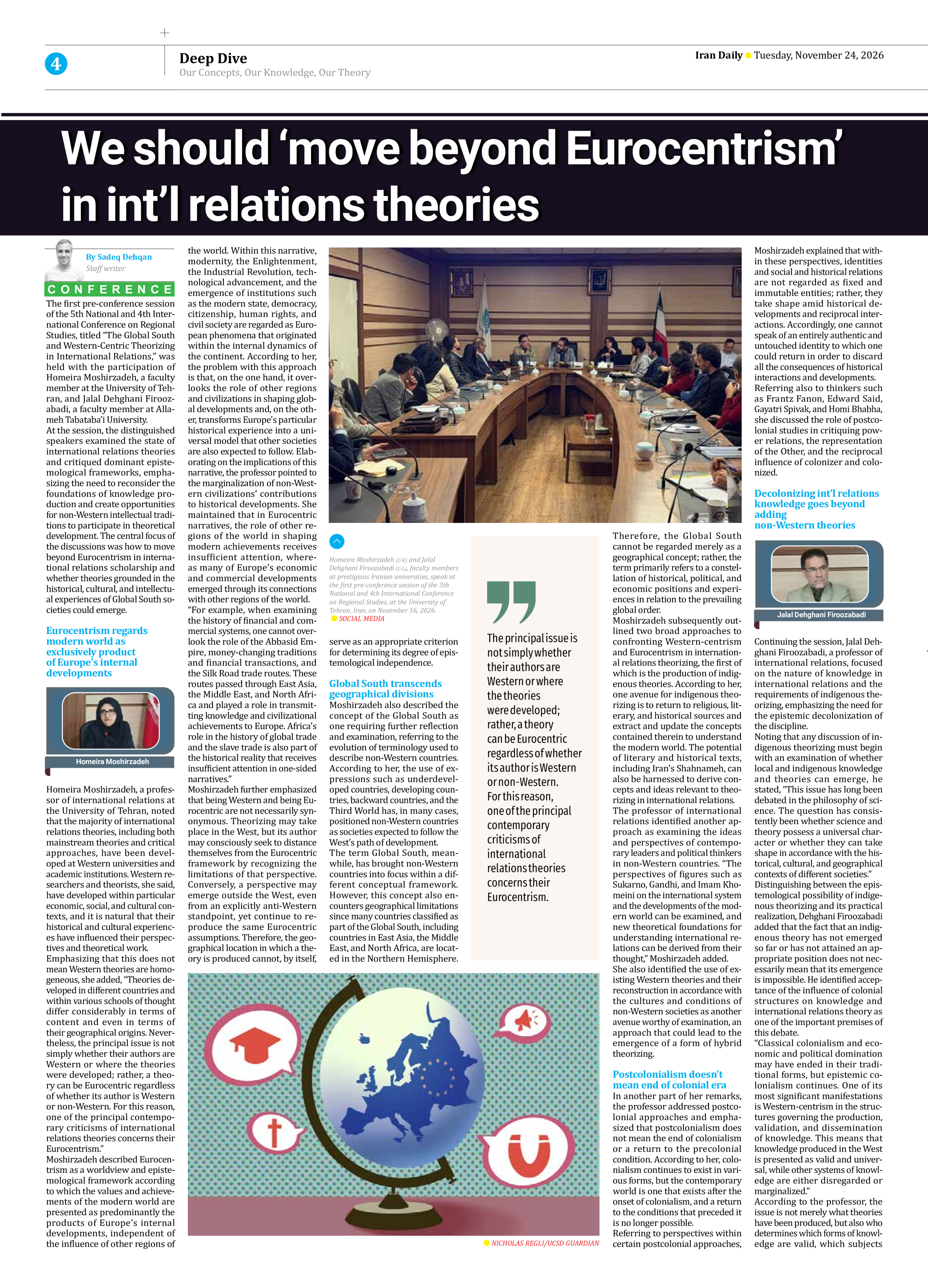
Moshirzadeh described Eurocentrism as a worldview and epistemological framework according to which the values and achievements of the modern world are presented as predominantly the products of Europe’s internal developments, independent of the influence of other regions of the world. Within this narrative, modernity, the Enlightenment, the Industrial Revolution, technological advancement, and the emergence of institutions such as the modern state, democracy, citizenship, human rights, and civil society are regarded as European phenomena that originated within the internal dynamics of the continent. According to her, the problem with this approach is that, on the one hand, it overlooks the role of other regions and civilizations in shaping global developments and, on the other, transforms Europe’s particular historical experience into a universal model that other societies are also expected to follow. Elaborating on the implications of this narrative, the professor pointed to the marginalization of non-Western civilizations’ contributions to historical developments. She maintained that in Eurocentric narratives, the role of other regions of the world in shaping modern achievements receives insufficient attention, whereas many of Europe’s economic and commercial developments emerged through its connections with other regions of the world.
“For example, when examining the history of financial and commercial systems, one cannot overlook the role of the Abbasid Empire, money-changing traditions and financial transactions, and the Silk Road trade routes. These routes passed through East Asia, the Middle East, and North Africa and played a role in transmitting knowledge and civilizational achievements to Europe. Africa’s role in the history of global trade and the slave trade is also part of the historical reality that receives insufficient attention in one-sided narratives.”
Moshirzadeh further emphasized that being Western and being Eurocentric are not necessarily synonymous. Theorizing may take place in the West, but its author may consciously seek to distance themselves from the Eurocentric framework by recognizing the limitations of that perspective. Conversely, a perspective may emerge outside the West, even from an explicitly anti-Western standpoint, yet continue to reproduce the same Eurocentric assumptions. Therefore, the geographical location in which a theory is produced cannot, by itself, serve as an appropriate criterion for determining its degree of epistemological independence.
Global South transcends geographical divisions
Moshirzadeh also described the concept of the Global South as one requiring further reflection and examination, referring to the evolution of terminology used to describe non-Western countries. According to her, the use of expressions such as underdeveloped countries, developing countries, backward countries, and the Third World has, in many cases, positioned non-Western countries as societies expected to follow the West’s path of development.
The term Global South, meanwhile, has brought non-Western countries into focus within a different conceptual framework. However, this concept also encounters geographical limitations since many countries classified as part of the Global South, including countries in East Asia, the Middle East, and North Africa, are located in the Northern Hemisphere. Therefore, the Global South cannot be regarded merely as a geographical concept; rather, the term primarily refers to a constellation of historical, political, and economic positions and experiences in relation to the prevailing global order.
Moshirzadeh subsequently outlined two broad approaches to confronting Western-centrism and Eurocentrism in international relations theorizing, the first of which is the production of indigenous theories. According to her, one avenue for indigenous theorizing is to return to religious, literary, and historical sources and extract and update the concepts contained therein to understand the modern world. The potential of literary and historical texts, including Iran’s Shahnameh, can also be harnessed to derive concepts and ideas relevant to theorizing in international relations.
The professor of international relations identified another approach as examining the ideas and perspectives of contemporary leaders and political thinkers in non-Western countries. “The perspectives of figures such as Sukarno, Gandhi, and Imam Khomeini on the international system and the developments of the modern world can be examined, and new theoretical foundations for understanding international relations can be derived from their thought,” Moshirzadeh added.
She also identified the use of existing Western theories and their reconstruction in accordance with the cultures and conditions of non-Western societies as another avenue worthy of examination, an approach that could lead to the emergence of a form of hybrid theorizing.
Postcolonialism doesn’t mean end of colonial era
In another part of her remarks, the professor addressed postcolonial approaches and emphasized that postcolonialism does not mean the end of colonialism or a return to the precolonial condition. According to her, colonialism continues to exist in various forms, but the contemporary world is one that exists after the onset of colonialism, and a return to the conditions that preceded it is no longer possible.
Referring to perspectives within certain postcolonial approaches, Moshirzadeh explained that within these perspectives, identities and social and historical relations are not regarded as fixed and immutable entities; rather, they take shape amid historical developments and reciprocal interactions. Accordingly, one cannot speak of an entirely authentic and untouched identity to which one could return in order to discard all the consequences of historical interactions and developments.
Referring also to thinkers such as Frantz Fanon, Edward Said, Gayatri Spivak, and Homi Bhabha, she discussed the role of postcolonial studies in critiquing power relations, the representation of the Other, and the reciprocal influence of colonizer and colonized.
Decolonizing int’l relations knowledge goes beyond adding
non-Western theories
Continuing the session, Jalal Dehghani Firoozabadi, a professor of international relations, focused on the nature of knowledge in international relations and the requirements of indigenous theorizing, emphasizing the need for the epistemic decolonization of the discipline.
Noting that any discussion of indigenous theorizing must begin with an examination of whether local and indigenous knowledge and theories can emerge, he stated, “This issue has long been debated in the philosophy of science. The question has consistently been whether science and theory possess a universal character or whether they can take shape in accordance with the historical, cultural, and geographical contexts of different societies.”
Distinguishing between the epistemological possibility of indigenous theorizing and its practical realization, Dehghani Firoozabadi added that the fact that an indigenous theory has not emerged so far or has not attained an appropriate position does not necessarily mean that its emergence is impossible. He identified acceptance of the influence of colonial structures on knowledge and international relations theory as one of the important premises of this debate.
“Classical colonialism and economic and political domination may have ended in their traditional forms, but epistemic colonialism continues. One of its most significant manifestations is Western-centrism in the structures governing the production, validation, and dissemination of knowledge. This means that knowledge produced in the West is presented as valid and universal, while other systems of knowledge are either disregarded or marginalized.”
According to the professor, the issue is not merely what theories have been produced, but also who determines which forms of knowledge are valid, which subjects merit academic investigation, and which methods should be accepted as scientific. In fact, the structures responsible for academic validation can also contribute to reproducing existing epistemic hierarchies.
Emphasizing the need to reconsider the dominant historical narrative, Dehghani Firoozabadi referred to the concept of “provincializing Europe” and stated: “According to this concept, Europe must relinquish the exceptional and universal position it has constructed for itself and be studied as one of the world’s regions and historical experiences. This perspective does not mean denying Europe’s achievements; rather, it emphasizes the need to examine the continent’s developments in connection with its historical interactions with, and influences from, other regions of the world.”
He nevertheless warned that criticism of Eurocentrism should not lead to the emergence of a simplistic dichotomy between the West and the non-West since the criticism of Eurocentrism may still employ the same intellectual tools and frameworks that are themselves products of European intellectual traditions. Therefore, the objective should not be to replace one hegemony with another, but to create the conditions for reconsidering the standards and frameworks governing knowledge production.
Epistemic decolonization requires reassessment of definitions, methods
Elaborating on the concept of epistemic decolonization, Dehghani Firoozabadi stressed that decolonization does not merely mean adding non-Western theories and perspectives to existing frameworks; rather, the frameworks, assumptions, and criteria that determine what constitutes valid knowledge and what qualifies as a desirable theory must themselves be questioned.
“If we merely add several non-Western theories to the existing body of theories while continuing to use the same dominant criteria and frameworks as the basis for validation, no fundamental change has taken place. Epistemic decolonization requires a reassessment of the definitions of knowledge and theory, the methods of acquiring knowledge, and the ways in which international relations are studied.” The professor of international relations referred to the potential of non-Western thinkers’ ideas to generate new concepts in the discipline, citing Farabi, Ibn Rushd, Ibn Khaldun, and Rumi as examples of intellectual sources worthy of examination. He emphasized that the ontological and epistemological potential of these ideas must be examined for the purpose of conceptualization in international relations. For example, Rumi’s philosophical foundations and ideas can be utilized to formulate new questions and concepts in this field.
Dehghani Firoozabadi, too, emphasized that an indigenous theory should not be equated with a theory produced merely within a particular country or geographical region. A researcher in the West may present a theory grounded in the philosophy, history, and experience of Iranian society, while a researcher in Iran may, conversely, produce a thoroughly Western-centric theory. Therefore, what matters is the epistemological content and theoretical foundations of a theory, not merely the geographical location of its production.
He subsequently distinguished between three interpretations of non-Western theorizing: first, universalizing non-Western approaches and theories within existing frameworks; second, studying the issues and problems of the Global South through prevailing theories and metatheories; and third, replacing existing approaches and theories with non-Western theoretical frameworks and foundations.
In his view, the first two approaches can be useful starting points, but they do not, in themselves, constitute the production of indigenous theory since they may ultimately lead to the endorsement and reinforcement of dominant theories.