


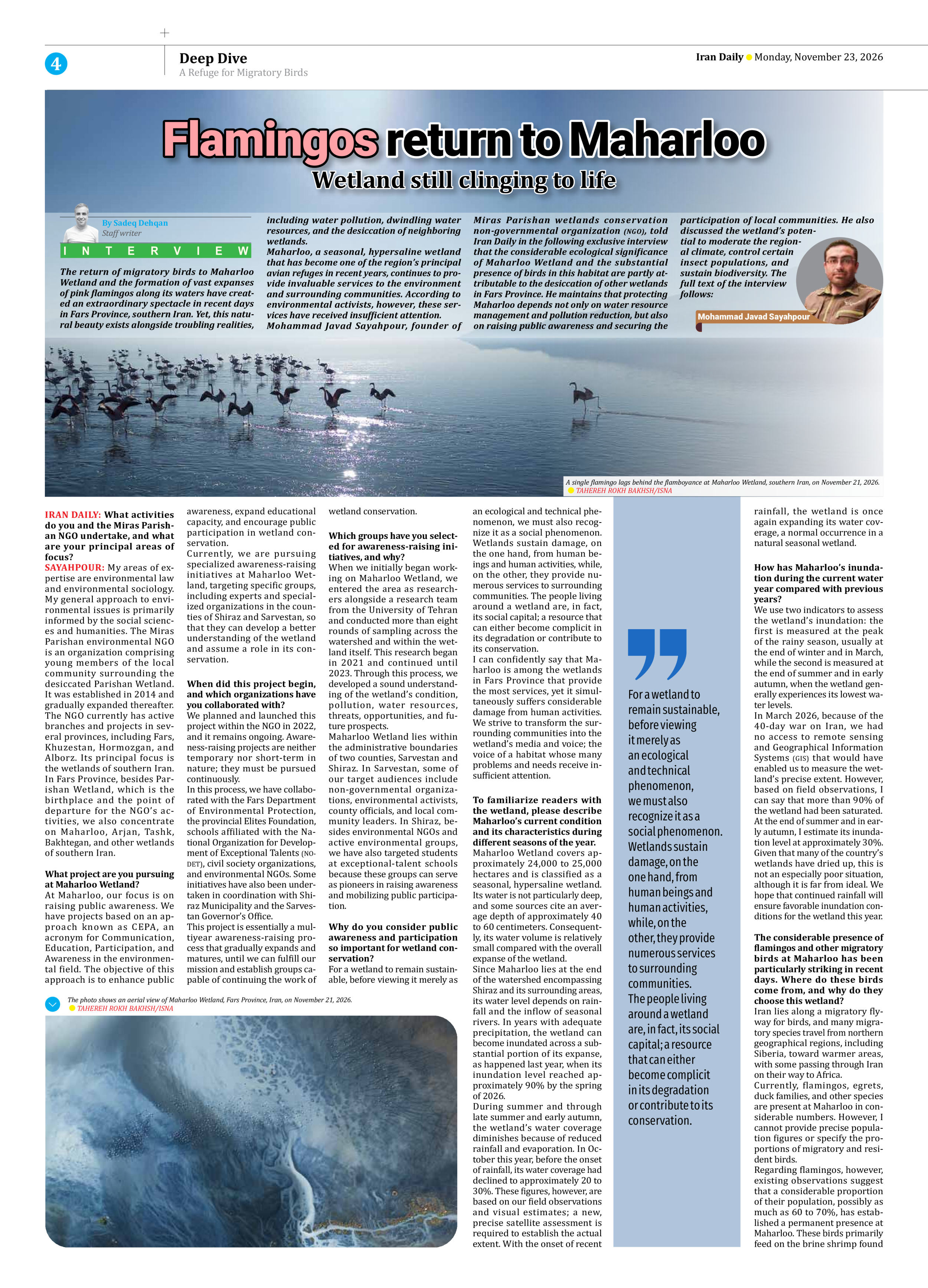


Flamingos return to Maharloo
Wetland still clinging to life
The return of migratory birds to Maharloo Wetland and the formation of vast expanses of pink flamingos along its waters have created an extraordinary spectacle in recent days in Fars Province, southern Iran. Yet, this natural beauty exists alongside troubling realities, including water pollution, dwindling water resources, and the desiccation of neighboring wetlands. Maharloo, a seasonal, hypersaline wetland that has become one of the region’s principal avian refuges in recent years, continues to provide invaluable services to the environment and surrounding communities. According to environmental activists, however, these services have received insufficient attention. Mohammad Javad Sayahpour, founder of Miras Parishan wetlands conservation non-governmental organization (NGO), told Iran Daily in the following exclusive interview that the considerable ecological significance of Maharloo Wetland and the substantial presence of birds in this habitat are partly attributable to the desiccation of other wetlands in Fars Province. He maintains that protecting Maharloo depends not only on water resource management and pollution reduction, but also on raising public awareness and securing the participation of local communities. He also discussed the wetland’s potential to moderate the regional climate, control certain insect populations, and sustain biodiversity. The full text of the interview follows:
By Sadeq Dehqan
Staff writer
IRAN DAILY: What activities do you and the Miras Parishan NGO undertake, and what are your principal areas of focus?
SAYAHPOUR: My areas of expertise are environmental law and environmental sociology. My general approach to environmental issues is primarily informed by the social sciences and humanities. The Miras Parishan environmental NGO is an organization comprising young members of the local community surrounding the desiccated Parishan Wetland. It was established in 2014 and gradually expanded thereafter.
The NGO currently has active branches and projects in several provinces, including Fars, Khuzestan, Hormozgan, and Alborz. Its principal focus is the wetlands of southern Iran. In Fars Province, besides Parishan Wetland, which is the birthplace and the point of departure for the NGO’s activities, we also concentrate on Maharloo, Arjan, Tashk, Bakhtegan, and other wetlands of southern Iran.
What project are you pursuing at Maharloo Wetland?
At Maharloo, our focus is on raising public awareness. We have projects based on an approach known as CEPA, an acronym for Communication, Education, Participation, and Awareness in the environmental field. The objective of this approach is to enhance public awareness, expand educational capacity, and encourage public participation in wetland conservation.
Currently, we are pursuing specialized awareness-raising initiatives at Maharloo Wetland, targeting specific groups, including experts and specialized organizations in the counties of Shiraz and Sarvestan, so that they can develop a better understanding of the wetland and assume a role in its conservation.
When did this project begin, and which organizations have you collaborated with?
We planned and launched this project within the NGO in 2022, and it remains ongoing. Awareness-raising projects are neither temporary nor short-term in nature; they must be pursued continuously.
In this process, we have collaborated with the Fars Department of Environmental Protection, the provincial Elites Foundation, schools affiliated with the National Organization for Development of Exceptional Talents (NODET), civil society organizations, and environmental NGOs. Some initiatives have also been undertaken in coordination with Shiraz Municipality and the Sarvestan Governor’s Office.
This project is essentially a multiyear awareness-raising process that gradually expands and matures, until we can fulfill our mission and establish groups capable of continuing the work of wetland conservation.
Which groups have you selected for awareness-raising initiatives, and why?
When we initially began working on Maharloo Wetland, we entered the area as researchers alongside a research team from the University of Tehran and conducted more than eight rounds of sampling across the watershed and within the wetland itself. This research began in 2021 and continued until 2023. Through this process, we developed a sound understanding of the wetland’s condition, pollution, water resources, threats, opportunities, and future prospects.
Maharloo Wetland lies within the administrative boundaries of two counties, Sarvestan and Shiraz. In Sarvestan, some of our target audiences include non-governmental organizations, environmental activists, county officials, and local community leaders. In Shiraz, besides environmental NGOs and active environmental groups, we have also targeted students at exceptional-talent schools because these groups can serve as pioneers in raising awareness and mobilizing public participation.
Why do you consider public awareness and participation so important for wetland conservation?
For a wetland to remain sustainable, before viewing it merely as an ecological and technical phenomenon, we must also recognize it as a social phenomenon. Wetlands sustain damage, on the one hand, from human beings and human activities, while, on the other, they provide numerous services to surrounding communities. The people living around a wetland are, in fact, its social capital; a resource that can either become complicit in its degradation or contribute to its conservation.
I can confidently say that Maharloo is among the wetlands in Fars Province that provide the most services, yet it simultaneously suffers considerable damage from human activities. We strive to transform the surrounding communities into the wetland’s media and voice; the voice of a habitat whose many problems and needs receive insufficient attention.
To familiarize readers with the wetland, please describe Maharloo’s current condition and its characteristics during different seasons of the year.
Maharloo Wetland covers approximately 24,000 to 25,000 hectares and is classified as a seasonal, hypersaline wetland. Its water is not particularly deep, and some sources cite an average depth of approximately 40 to 60 centimeters. Consequently, its water volume is relatively small compared with the overall expanse of the wetland.
Since Maharloo lies at the end of the watershed encompassing Shiraz and its surrounding areas, its water level depends on rainfall and the inflow of seasonal rivers. In years with adequate precipitation, the wetland can become inundated across a substantial portion of its expanse, as happened last year, when its inundation level reached approximately 90% by the spring of 2026.
During summer and through late summer and early autumn, the wetland’s water coverage diminishes because of reduced rainfall and evaporation. In October this year, before the onset of rainfall, its water coverage had declined to approximately 20 to 30%. These figures, however, are based on our field observations and visual estimates; a new, precise satellite assessment is required to establish the actual extent. With the onset of recent rainfall, the wetland is once again expanding its water coverage, a normal occurrence in a natural seasonal wetland.
How has Maharloo’s inundation during the current water year compared with previous years?
We use two indicators to assess the wetland’s inundation: the first is measured at the peak of the rainy season, usually at the end of winter and in March, while the second is measured at the end of summer and in early autumn, when the wetland generally experiences its lowest water levels.
In March 2026, because of the 40-day war on Iran, we had no access to remote sensing and Geographical Information Systems (GIS) that would have enabled us to measure the wetland’s precise extent. However, based on field observations, I can say that more than 90% of the wetland had been saturated.
At the end of summer and in early autumn, I estimate its inundation level at approximately 30%. Given that many of the country’s wetlands have dried up, this is not an especially poor situation, although it is far from ideal. We hope that continued rainfall will ensure favorable inundation conditions for the wetland this year.
The considerable presence of flamingos and other migratory birds at Maharloo has been particularly striking in recent days. Where do these birds come from, and why do they choose this wetland?
Iran lies along a migratory flyway for birds, and many migratory species travel from northern geographical regions, including Siberia, toward warmer areas, with some passing through Iran on their way to Africa.
Currently, flamingos, egrets, duck families, and other species are present at Maharloo in considerable numbers. However, I cannot provide precise population figures or specify the proportions of migratory and resident birds.
Regarding flamingos, however, existing observations suggest that a considerable proportion of their population, possibly as much as 60 to 70%, has established a permanent presence at Maharloo. These birds primarily feed on the brine shrimp found in the wetland. Artemia is the only organism capable of surviving in the wetland’s saline waters. Besides using the wetland as a migratory destination, these birds also reproduce there, and their chicks can be observed during certain seasons.
Has the increase in Maharloo’s bird population in recent years resulted from the wetland’s favorable conditions?
One of the principal reasons for the increase in Maharloo’s bird population is the desiccation of other wetlands in Fars Province, including Parishan and Bakhtegan. When other wetlands dry up, birds lose their suitable habitats and are compelled to relocate. Consequently, the bird population at Maharloo has now increased.
However, not all these birds enjoy favorable conditions. Certain species that depend on specific food resources, such as fish, encounter limitations in Maharloo’s saline waters and may have been compelled to inhabit this area because of the loss of their primary habitats.
Migratory birds generally arrive in the region in early autumn, and some remain at the wetland until late winter and early spring, before resuming their migratory journeys. However, certain species move in and out throughout the winter, while others have established a permanent presence at Maharloo.
What services does Maharloo Wetland provide to the environment and surrounding communities that have received insufficient attention?
One of the wetland’s most important services is precisely its provision of habitats for birds. The presence of migratory birds and their species diversity constitute a major contribution to biodiversity, a service valuable not only to Iran but also to the global ecosystem.
A substantial portion of the diet of certain wetland birds consists of insects, and these birds can help regulate populations of certain insects, including pest species.
Another important service provided by the wetland is regional climate moderation. Maharloo Wetland, particularly when it has an adequate water expanse, can help reduce ambient heat during summer and moderate temperatures in neighboring cities, including Shiraz and Sarvestan. This water expanse functions as a natural temperature regulator.
Furthermore, the wetland plays a role in absorbing and controlling regional floods, contributes to the replenishment of groundwater resources, and, by generating humidity in the area, helps create favorable conditions for vegetation across the surrounding mountainous watershed.
These are the services the wetland provides to the area, and we benefit from them as long as it remains alive. However, if the wetland dries up, we will face consequences such as dust emissions and the displacement of sediment from its bed. Given the accumulation of pollutants, this sediment can pose a serious threat to human health.
What causes the pink and red coloration of Maharloo Wetland? Is this phenomenon an indication of the wetland’s favorable condition?
The wetland’s red and pink coloration is primarily associated with algal growth and algal blooms in saline water. When nutrient concentrations, such as nitrates and phosphates, entering the wetland through agricultural, industrial, and urban wastewater increase, conditions become conducive to algal proliferation.
If the concentration of these substances remains within the wetland’s natural assimilative capacity, the ecosystem can absorb and filter them. However, when nutrient inflows exceed the wetland’s capacity, it moves toward nutrient enrichment, or eutrophication.
In freshwater wetlands, this eutrophic condition may be accompanied by increased growth of plants such as reeds and reed beds. In saline wetlands, however, it can trigger algal blooms that produce red or pink coloration.
This phenomenon is exceptionally beautiful from a visual perspective, but at Maharloo, it can indicate increasing nutrient concentrations and pollution. Tourists visiting the wetland may be unaware of this, and may enter the water or come into contact with it, even though the water quality is not such that contact can be recommended without concern.
What tourism potential does Maharloo Wetland possess, and can this potential be harnessed for the region’s economic development?
I am an unequivocal advocate of tourism, particularly sustainable tourism. Maharloo possesses considerable tourism potential, but its tourism infrastructure remains relatively underdeveloped.
A limited number of pedal boats operate around the wetland during seasons when water levels are high. However, this capacity falls considerably short of the wetland’s actual potential.
On the other hand, caution is necessary when developing tourism because of water pollution. Tourism can be a positive development, provided that it is accompanied by an understanding of the wetland’s environmental conditions, adequate public information, and standardized infrastructure.
What are the most significant threats currently facing Maharloo Wetland?
One of the most significant threats is the influx of pollutants into the wetland. Some pollution originates from surrounding agricultural lands, while another substantial portion is conveyed through the Chenar-Rahdar River, which flows toward the wetland from the southern and western parts of Shiraz.
Along this river, some wastewater from the Shiraz Industrial Town also enters the wetland. This is an extremely alarming environmental issue, and serious measures must be considered for wastewater management and treatment.
Another major threat is the depletion of the wetland’s water resources and the restriction of river inflows. The construction of the Tang-e Sorkh Dam upstream of Shiraz, to its west, could affect the volume of water entering through the Chenar-Rahdar River and, consequently, Maharloo’s water resources.
What measures should be undertaken to improve the wetland’s condition and reduce its pollution?
The first measure is to reduce pollution sources and prevent pollutants from entering the wetland. Agricultural, urban, and industrial wastewater must be properly managed, and pollutant inflows must be prevented to the greatest extent possible.
At the same time, the wetland’s water resources must not be restricted. Rivers flowing into the wetland must be allowed to maintain their natural flow, and barriers to water inflows, particularly rainwater and seasonal floodwaters, must be studied.
Wastewater management is also a complex issue. On the one hand, wastewater must be treated to prevent threats to human health and the environment. On the other, treated water resources must be managed in a manner that does not disregard the wetland’s water allocation rights and environmental requirements. Therefore, protecting Maharloo requires comprehensive planning for water management, pollution control, and due consideration of the wetland’s environmental water requirements.
Finally, what would you like to say about Maharloo Wetland’s future and the necessity of protecting it?
Maharloo Wetland may be one of the last hopes for the wetlands of Fars Province. Because of its saline waters, encroachment upon its lands has been less extensive than at certain other wetlands, and opportunities for its conservation still remain.
I hope that, through preventive planning, we can prevent the wetland’s condition from deteriorating further. The most important measures are reducing pollutant inflows and raising public awareness. Maharloo provides significant environmental services and is important even at the international level, particularly for migratory birds and migratory flyways.
This wetland possesses the potential for international registration and recognition, and the Department of Environmental Protection is also pursuing initiatives in this regard. Ultimately, if we can make people aware of the wetland’s value and encourage them to participate in its conservation, we can have greater hope for Maharloo’s future.