


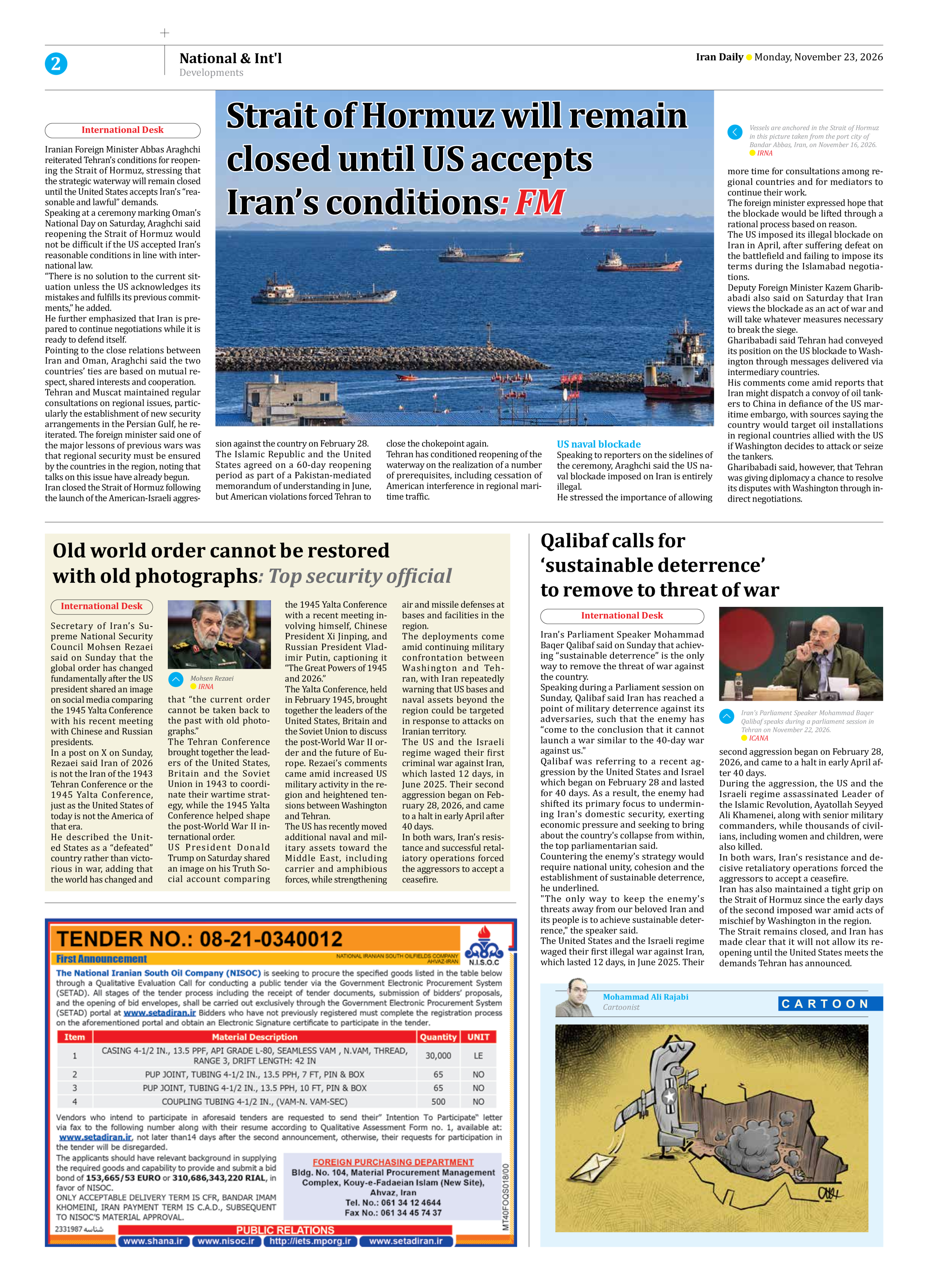


Strait of Hormuz will remain closed until US accepts Iran’s conditions: FM
Iranian Foreign Minister Abbas Araghchi reiterated Tehran’s conditions for reopening the Strait of Hormuz, stressing that the strategic waterway will remain closed until the United States accepts Iran’s “reasonable and lawful” demands.
Speaking at a ceremony marking Oman’s National Day on Saturday, Araghchi said reopening the Strait of Hormuz would not be difficult if the US accepted Iran’s reasonable conditions in line with international law.
“There is no solution to the current situation unless the US acknowledges its mistakes and fulfills its previous commitments,” he added.
He further emphasized that Iran is prepared to continue negotiations while it is ready to defend itself.
Pointing to the close relations between Iran and Oman, Araghchi said the two countries’ ties are based on mutual respect, shared interests and cooperation.
Tehran and Muscat maintained regular consultations on regional issues, particularly the establishment of new security arrangements in the Persian Gulf, he reiterated. The foreign minister said one of the major lessons of previous wars was that regional security must be ensured by the countries in the region, noting that talks on this issue have already begun.
Iran closed the Strait of Hormuz following the launch of the American-Israeli aggression against the country on February 28.
The Islamic Republic and the United States agreed on a 60-day reopening period as part of a Pakistan-mediated memorandum of understanding in June, but American violations forced Tehran to close the chokepoint again.
Tehran has conditioned reopening of the waterway on the realization of a number of prerequisites, including cessation of American interference in regional maritime traffic.
US naval blockade
Speaking to reporters on the sidelines of the ceremony, Araghchi said the US naval blockade imposed on Iran is entirely illegal.
He stressed the importance of allowing more time for consultations among regional countries and for mediators to continue their work.
The foreign minister expressed hope that the blockade would be lifted through a rational process based on reason.
The US imposed its illegal blockade on Iran in April, after suffering defeat on the battlefield and failing to impose its terms during the Islamabad negotiations.
Deputy Foreign Minister Kazem Gharibabadi also said on Saturday that Iran views the blockade as an act of war and will take whatever measures necessary to break the siege.
Gharibabadi said Tehran had conveyed its position on the US blockade to Washington through messages delivered via intermediary countries.
His comments come amid reports that Iran might dispatch a convoy of oil tankers to China in defiance of the US maritime embargo, with sources saying the country would target oil installations in regional countries allied with the US if Washington decides to attack or seize the tankers.
Gharibabadi said, however, that Tehran was giving diplomacy a chance to resolve its disputes with Washington through indirect negotiations.