




Hosseini tips Iranian women weightlifters to vie for global glory
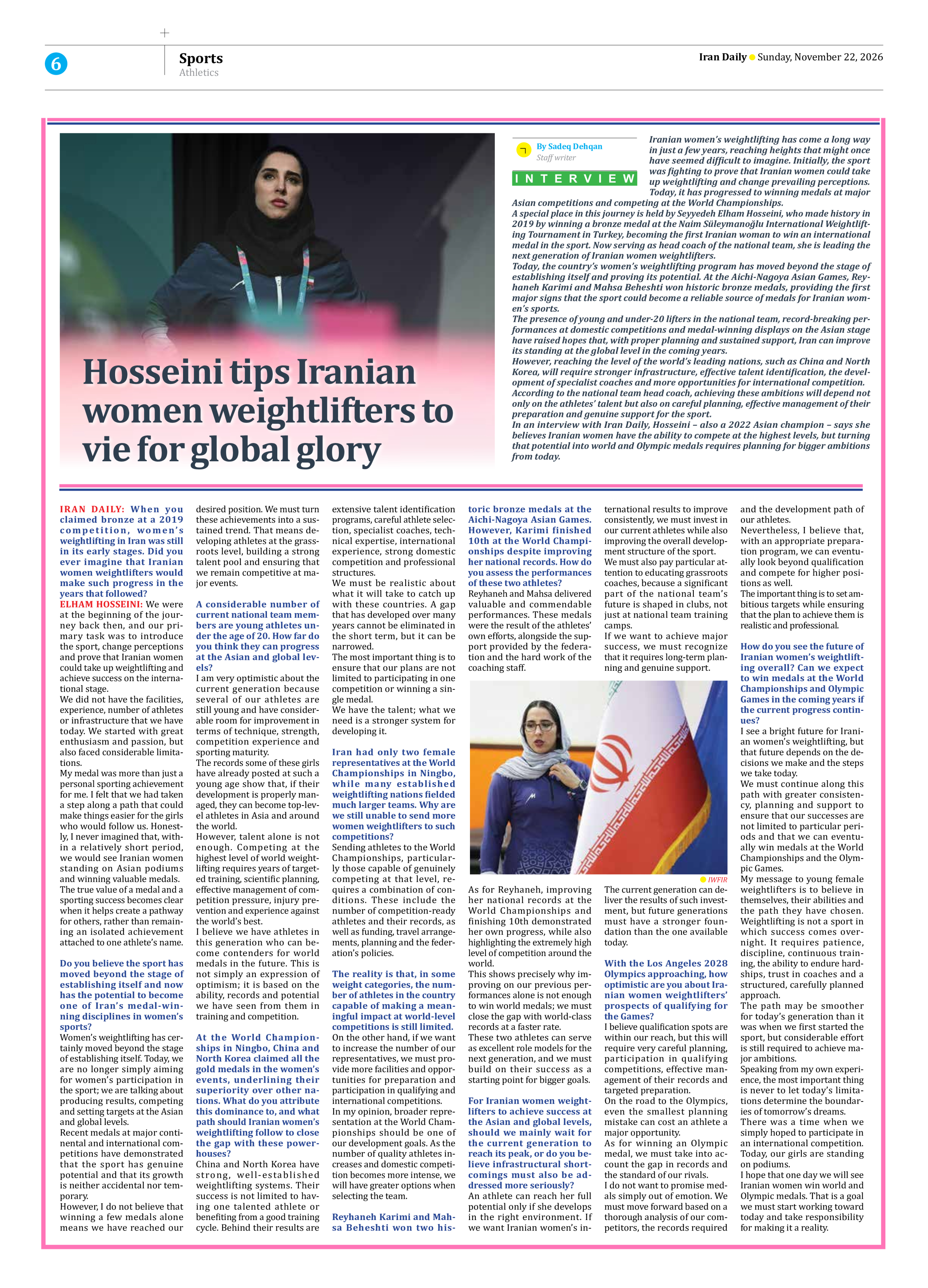
Iranian women’s weightlifting has come a long way in just a few years, reaching heights that might once have seemed difficult to imagine. Initially, the sport was fighting to prove that Iranian women could take up weightlifting and change prevailing perceptions. Today, it has progressed to winning medals at major Asian competitions and competing at the World Championships. A special place in this journey is held by Seyyedeh Elham Hosseini, who made history in 2019 by winning a bronze medal at the Naim Süleymanoğlu International Weightlifting Tournament in Turkey, becoming the first Iranian woman to win an international medal in the sport. Now serving as head coach of the national team, she is leading the next generation of Iranian women weightlifters. Today, the country’s women’s weightlifting program has moved beyond the stage of establishing itself and proving its potential. At the Aichi-Nagoya Asian Games, Reyhaneh Karimi and Mahsa Beheshti won historic bronze medals, providing the first major signs that the sport could become a reliable source of medals for Iranian women’s sports. The presence of young and under-20 lifters in the national team, record-breaking performances at domestic competitions and medal-winning displays on the Asian stage have raised hopes that, with proper planning and sustained support, Iran can improve its standing at the global level in the coming years. However, reaching the level of the world’s leading nations, such as China and North Korea, will require stronger infrastructure, effective talent identification, the development of specialist coaches and more opportunities for international competition. According to the national team head coach, achieving these ambitions will depend not only on the athletes’ talent but also on careful planning, effective management of their preparation and genuine support for the sport. In an interview with Iran Daily, Hosseini – also a 2022 Asian champion – says she believes Iranian women have the ability to compete at the highest levels, but turning that potential into world and Olympic medals requires planning for bigger ambitions from today.
By Sadeq Dehqan
Staff writer
IRAN DAILY: When you claimed bronze at a 2019 competition, women’s weightlifting in Iran was still in its early stages. Did you ever imagine that Iranian women weightlifters would make such progress in the years that followed?
ELHAM HOSSEINI: We were at the beginning of the journey back then, and our primary task was to introduce the sport, change perceptions and prove that Iranian women could take up weightlifting and achieve success on the international stage.
We did not have the facilities, experience, number of athletes or infrastructure that we have today. We started with great enthusiasm and passion, but also faced considerable limitations.
My medal was more than just a personal sporting achievement for me. I felt that we had taken a step along a path that could make things easier for the girls who would follow us. Honestly, I never imagined that, within a relatively short period, we would see Iranian women standing on Asian podiums and winning valuable medals.
The true value of a medal and a sporting success becomes clear when it helps create a pathway for others, rather than remaining an isolated achievement attached to one athlete’s name.
Do you believe the sport has moved beyond the stage of establishing itself and now has the potential to become one of Iran’s medal-winning disciplines in women’s sports?
Women’s weightlifting has certainly moved beyond the stage of establishing itself. Today, we are no longer simply aiming for women’s participation in the sport; we are talking about producing results, competing and setting targets at the Asian and global levels.
Recent medals at major continental and international competitions have demonstrated that the sport has genuine potential and that its growth is neither accidental nor temporary.
However, I do not believe that winning a few medals alone means we have reached our desired position. We must turn these achievements into a sustained trend. That means developing athletes at the grassroots level, building a strong talent pool and ensuring that we remain competitive at major events.
A considerable number of current national team members are young athletes under the age of 20. How far do you think they can progress at the Asian and global levels?
I am very optimistic about the current generation because several of our athletes are still young and have considerable room for improvement in terms of technique, strength, competition experience and sporting maturity.
The records some of these girls have already posted at such a young age show that, if their development is properly managed, they can become top-level athletes in Asia and around the world.
However, talent alone is not enough. Competing at the highest level of world weightlifting requires years of targeted training, scientific planning, effective management of competition pressure, injury prevention and experience against the world’s best.
I believe we have athletes in this generation who can become contenders for world medals in the future. This is not simply an expression of optimism; it is based on the ability, records and potential we have seen from them in training and competition.
At the World Championships in Ningbo, China and North Korea claimed all the gold medals in the women’s events, underlining their superiority over other nations. What do you attribute this dominance to, and what path should Iranian women’s weightlifting follow to close the gap with these powerhouses?
China and North Korea have strong, well-established weightlifting systems. Their success is not limited to having one talented athlete or benefiting from a good training cycle. Behind their results are extensive talent identification programs, careful athlete selection, specialist coaches, technical expertise, international experience, strong domestic competition and professional structures.
We must be realistic about what it will take to catch up with these countries. A gap that has developed over many years cannot be eliminated in the short term, but it can be narrowed.
The most important thing is to ensure that our plans are not limited to participating in one competition or winning a single medal.
We have the talent; what we need is a stronger system for developing it.
Iran had only two female representatives at the World Championships in Ningbo, while many established weightlifting nations fielded much larger teams. Why are we still unable to send more women weightlifters to such competitions?
Sending athletes to the World Championships, particularly those capable of genuinely competing at that level, requires a combination of conditions. These include the number of competition-ready athletes and their records, as well as funding, travel arrangements, planning and the federation’s policies.
The reality is that, in some weight categories, the number of athletes in the country capable of making a meaningful impact at world-level competitions is still limited.
On the other hand, if we want to increase the number of our representatives, we must provide more facilities and opportunities for preparation and participation in qualifying and international competitions.
In my opinion, broader representation at the World Championships should be one of our development goals. As the number of quality athletes increases and domestic competition becomes more intense, we will have greater options when selecting the team.
Reyhaneh Karimi and Mahsa Beheshti won two historic bronze medals at the Aichi-Nagoya Asian Games. However, Karimi finished 10th at the World Championships despite improving her national records. How do you assess the performances of these two athletes?
Reyhaneh and Mahsa delivered valuable and commendable performances. These medals were the result of the athletes’ own efforts, alongside the support provided by the federation and the hard work of the coaching staff.
As for Reyhaneh, improving her national records at the World Championships and finishing 10th demonstrated her own progress, while also highlighting the extremely high level of competition around the world.
This shows precisely why improving on our previous performances alone is not enough to win world medals; we must close the gap with world-class records at a faster rate.
These two athletes can serve as excellent role models for the next generation, and we must build on their success as a starting point for bigger goals.
For Iranian women weightlifters to achieve success at the Asian and global levels, should we mainly wait for the current generation to reach its peak, or do you believe infrastructural shortcomings must also be addressed more seriously?
An athlete can reach her full potential only if she develops in the right environment. If we want Iranian women’s international results to improve consistently, we must invest in our current athletes while also improving the overall development structure of the sport.
We must also pay particular attention to educating grassroots coaches, because a significant part of the national team’s future is shaped in clubs, not just at national team training camps.
If we want to achieve major success, we must recognize that it requires long-term planning and genuine support.
The current generation can deliver the results of such investment, but future generations must have a stronger foundation than the one available today.
With the Los Angeles 2028 Olympics approaching, how optimistic are you about Iranian women weightlifters’ prospects of qualifying for the Games?
I believe qualification spots are within our reach, but this will require very careful planning, participation in qualifying competitions, effective management of their records and targeted preparation.
On the road to the Olympics, even the smallest planning mistake can cost an athlete a major opportunity.
As for winning an Olympic medal, we must take into account the gap in records and the standard of our rivals.
I do not want to promise medals simply out of emotion. We must move forward based on a thorough analysis of our competitors, the records required and the development path of our athletes.
Nevertheless, I believe that, with an appropriate preparation program, we can eventually look beyond qualification and compete for higher positions as well.
The important thing is to set ambitious targets while ensuring that the plan to achieve them is realistic and professional.
How do you see the future of Iranian women’s weightlifting overall? Can we expect to win medals at the World Championships and Olympic Games in the coming years if the current progress continues?
I see a bright future for Iranian women’s weightlifting, but that future depends on the decisions we make and the steps we take today.
We must continue along this path with greater consistency, planning and support to ensure that our successes are not limited to particular periods and that we can eventually win medals at the World Championships and the Olympic Games.
My message to young female weightlifters is to believe in themselves, their abilities and the path they have chosen. Weightlifting is not a sport in which success comes overnight. It requires patience, discipline, continuous training, the ability to endure hardships, trust in coaches and a structured, carefully planned approach.
The path may be smoother for today’s generation than it was when we first started the sport, but considerable effort is still required to achieve major ambitions.
Speaking from my own experience, the most important thing is never to let today’s limitations determine the boundaries of tomorrow’s dreams.
There was a time when we simply hoped to participate in an international competition. Today, our girls are standing on podiums.
I hope that one day we will see Iranian women win world and Olympic medals. That is a goal we must start working toward today and take responsibility for making it a reality.