




Lake Urmia’s water area quadrupled in a year
Let’s not forfeit opportunity for revitalization
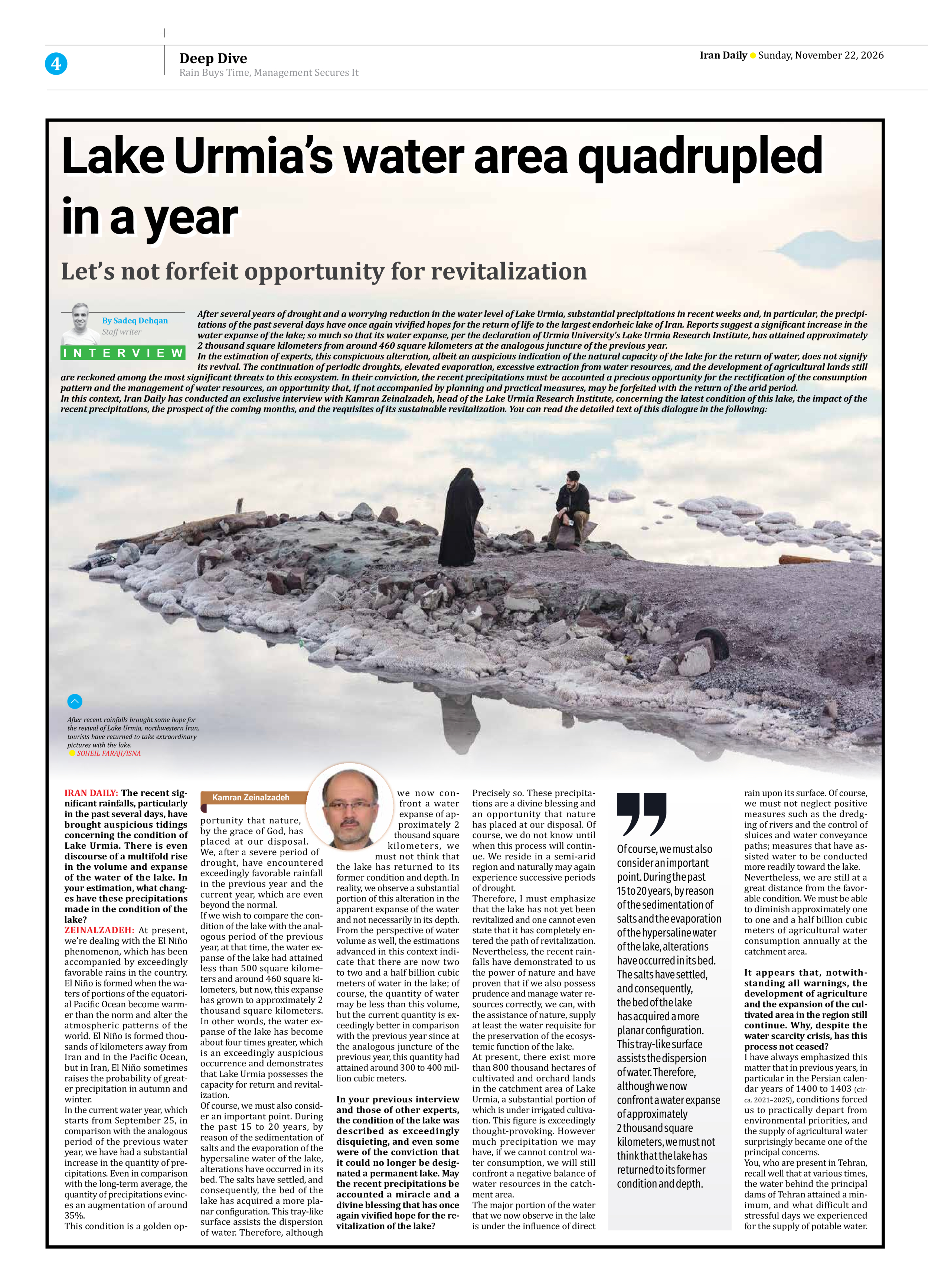
After several years of drought and a worrying reduction in the water level of Lake Urmia, substantial precipitations in recent weeks and, in particular, the precipitations of the past several days have once again vivified hopes for the return of life to the largest endorheic lake of Iran. Reports suggest a significant increase in the water expanse of the lake; so much so that its water expanse, per the declaration of Urmia University’s Lake Urmia Research Institute, has attained approximately 2 thousand square kilometers from around 460 square kilometers at the analogous juncture of the previous year. In the estimation of experts, this conspicuous alteration, albeit an auspicious indication of the natural capacity of the lake for the return of water, does not signify its revival. The continuation of periodic droughts, elevated evaporation, excessive extraction from water resources, and the development of agricultural lands still are reckoned among the most significant threats to this ecosystem. In their conviction, the recent precipitations must be accounted a precious opportunity for the rectification of the consumption pattern and the management of water resources, an opportunity that, if not accompanied by planning and practical measures, may be forfeited with the return of the arid period. In this context, Iran Daily has conducted an exclusive interview with Kamran Zeinalzadeh, head of the Lake Urmia Research Institute, concerning the latest condition of this lake, the impact of the recent precipitations, the prospect of the coming months, and the requisites of its sustainable revitalization. You can read the detailed text of this dialogue in the following:
By Sadeq Dehqan
Staff writer
IRAN DAILY: The recent significant rainfalls, particularly in the past several days, have brought auspicious tidings concerning the condition of Lake Urmia. There is even discourse of a multifold rise in the volume and expanse of the water of the lake. In your estimation, what changes have these precipitations made in the condition of the lake?
ZEINALZADEH: At present, we’re dealing with the El Niño phenomenon, which has been accompanied by exceedingly favorable rains in the country. El Niño is formed when the waters of portions of the equatorial Pacific Ocean become warmer than the norm and alter the atmospheric patterns of the world. El Niño is formed thousands of kilometers away from Iran and in the Pacific Ocean, but in Iran, El Niño sometimes raises the probability of greater precipitation in autumn and winter.
In the current water year, which starts from September 25, in comparison with the analogous period of the previous water year, we have had a substantial increase in the quantity of precipitations. Even in comparison with the long-term average, the quantity of precipitations evinces an augmentation of around 35%.
This condition is a golden opportunity that nature, by the grace of God, has placed at our disposal. We, after a severe period of drought, have encountered exceedingly favorable rainfall in the previous year and the current year, which are even beyond the normal.
If we wish to compare the condition of the lake with the analogous period of the previous year, at that time, the water expanse of the lake had attained less than 500 square kilometers and around 460 square kilometers, but now, this expanse has grown to approximately 2 thousand square kilometers. In other words, the water expanse of the lake has become about four times greater, which is an exceedingly auspicious occurrence and demonstrates that Lake Urmia possesses the capacity for return and revitalization.
Of course, we must also consider an important point. During the past 15 to 20 years, by reason of the sedimentation of salts and the evaporation of the hypersaline water of the lake, alterations have occurred in its bed. The salts have settled, and consequently, the bed of the lake has acquired a more planar configuration. This tray-like surface assists the dispersion of water. Therefore, although we now confront a water expanse of approximately 2 thousand square kilometers, we must not think that the lake has returned to its former condition and depth. In reality, we observe a substantial portion of this alteration in the apparent expanse of the water and not necessarily in its depth.
From the perspective of water volume as well, the estimations advanced in this context indicate that there are now two to two and a half billion cubic meters of water in the lake; of course, the quantity of water may be less than this volume, but the current quantity is exceedingly better in comparison with the previous year since at the analogous juncture of the previous year, this quantity had attained around 300 to 400 million cubic meters.
In your previous interview and those of other experts, the condition of the lake was described as exceedingly disquieting, and even some were of the conviction that it could no longer be designated a permanent lake. May the recent precipitations be accounted a miracle and a divine blessing that has once again vivified hope for the revitalization of the lake?
Precisely so. These precipitations are a divine blessing and an opportunity that nature has placed at our disposal. Of course, we do not know until when this process will continue. We reside in a semi-arid region and naturally may again experience successive periods of drought.
Therefore, I must emphasize that the lake has not yet been revitalized and one cannot even state that it has completely entered the path of revitalization. Nevertheless, the recent rainfalls have demonstrated to us the power of nature and have proven that if we also possess prudence and manage water resources correctly, we can, with the assistance of nature, supply at least the water requisite for the preservation of the ecosystemic function of the lake.
At present, there exist more than 800 thousand hectares of cultivated and orchard lands in the catchment area of Lake Urmia, a substantial portion of which is under irrigated cultivation. This figure is exceedingly thought-provoking. However much precipitation we may have, if we cannot control water consumption, we will still confront a negative balance of water resources in the catchment area.
The major portion of the water that we now observe in the lake is under the influence of direct rain upon its surface. Of course, we must not neglect positive measures such as the dredging of rivers and the control of sluices and water conveyance paths; measures that have assisted water to be conducted more readily toward the lake.
Nevertheless, we are still at a great distance from the favorable condition. We must be able to diminish approximately one to one and a half billion cubic meters of agricultural water consumption annually at the catchment area.
It appears that, notwithstanding all warnings, the development of agriculture and the expansion of the cultivated area in the region still continue. Why, despite the water scarcity crisis, has this process not ceased?
I have always emphasized this matter that in previous years, in particular in the Persian calendar years of 1400 to 1403 (circa. 2021–2025), conditions forced us to practically depart from environmental priorities, and the supply of agricultural water surprisingly became one of the principal concerns.
You, who are present in Tehran, recall well that at various times, the water behind the principal dams of Tehran attained a minimum, and what difficult and stressful days we experienced for the supply of potable water. Similar conditions, of course with differing intensity, existed in the catchment area of Lake Urmia.
Notwithstanding these conditions, when you examine the news pertaining to the region, you observe that the export of products such as apples, sugar beets, fodder, alfalfa, peaches, and other agricultural products still occupies the forefront of the news. This region, in a condition in which it confronted severe water deficiency and water stress, was reckoned one of the major exporters of water-intensive products to other provinces and even abroad, and this process still continues. This contradiction demonstrates that we have not yet seriously apprehended the reality of the water crisis and its dimensions, and this matter has not found its true position in our planning.
We must alter the course. Alternative livelihoods, the creation of new occupational opportunities, the development of service activities, and the utilization of border capacities must be placed on the agenda. One cannot, in a region that confronts a serious water crisis, still emphasize the development of activities that are dependent upon high consumption of water resources.
In spite of all of these matters, we must not neglect the positive occurrence that has now transpired in nature. Today, in comparison with previous years, we observe the lake with a substantial water expanse, and even its islands again experience indications of life. Birds have returned to this habitat, they lay eggs, and beautiful scenes of the return of life in the region have taken form.
Given the international significance of Lake Urmia and that this water expanse is one of the important habitats of migratory birds and diverse animal species, has not the time arrived for international supports for its revitalization to be pursued more seriously?
Precisely so. Lake Urmia is covered by the Ramsar Convention and is reckoned a protected habitat of international significance.
Of course, our country possesses considerable capabilities with respect to scientific capacities, specialized human resources, experience, and hardware facilities. We possess this capacity to accomplish many of the requisite measures within the country. Our principal problem pertains more to the weakness of integrated management and the matter of the governance of water resources.
Yet, the utilization of international capacities, the experiences of other countries, and the facilities of global organizations can accelerate the process of the revitalization of the lake. In previous years as well, collaborations with entities such as the United Nations Development Programme (UNDP) and the Food and Agriculture Organization of the United Nations (FAO) have been undertaken.
One of the successful examples of these collaborations is an activity that the Urmia University’s Lake Urmia Research Institute has commenced during the past four years with the assistance of the FAO. This program is executed with the objective of promoting novel methods and eliciting the participation of beneficiaries in the preservation of water and soil resources.
Within the framework of this scheme, several pilots of smart agriculture and smart irrigation are being executed in the plains of Nazlu and Baranduz and also in the regions of Naghadeh, Mahabad, and Miandoab.
Of course, it is necessary that the Ministry of Agriculture pursue the matter of the promotion of novel methods and soft measures more seriously. Furthermore, the national working group must move toward the creation of a structure that ultimately conduces to the integrated management of water resources.
Until such a structure takes form and the two important ministries, Agriculture and Energy, enter the field seriously, we will still confront difficulties. In sum, movements have commenced and favorable measures are in progress, but the extent of collaborations and international communications is still at a distance from the expected level, and greater effort must be undertaken in this context.
If we return to the precipitations of the past several days, what precisely has been the impact of these precipitations upon the alteration of the condition of the lake? Is the fourfold increase of the expanse of the lake principally the result of these recent rainfalls?
The statistics that I presented to you indicate that the rise in the water expanse of the lake in comparison with the previous year has been substantial. The precipitations of the past several days as well have had a direct impact upon the amelioration of the condition. Of course, one must not attribute all of this augmentation solely to the rainfalls of the past several days because prior to these rainfalls, the lake had already attained a substantial level of water intake by reason of the favorable precipitations of the current water year.
The more important and more auspicious point is that predictions indicate that the major portion of the principal precipitations of the coming water year is still en route. We anticipate a precipitation-rich autumn, and in all probability, winter as well will be accompanied by favorable snowfalls.
If we can, alongside these rains, exercise greater control over the rivers and conduct a greater share of the runoffs toward the lake, in particular in the non-agricultural season, we can create a favorable water reserve in the lake prior to the commencement of the warm season.
This matter is exceedingly important, for summer is reckoned the most difficult season for Lake Urmia. In this season, we practically have no considerable water inflow, and on the other hand, the quantity of evaporation attains its maximum. For this reason, we usually confront the minimum water expanse of the lake at the end of summer.
In previous years, conditions were such that we practically could no longer speak of a lake with a natural character; for a lake that possessed the capacity of about 12 billion cubic meters of water, when only a few hundred million cubic meters of water remain in it, loses a major portion of its ecological character.
Nevertheless, we hope that with the forthcoming precipitations and, in particular, a snow-rich winter, the condition of the lake in the coming year will be far better than in the current year. If the government undertakes the requisite measures and the people also cooperate, we can utilize this opportunity for the storage of greater water in the lake.
If in the coming years as well, we witness rains analogous to the current water year and managerial measures are also pursued with seriousness, may one be hopeful that Lake Urmia will attain the condition of revitalization?
Without doubt, the continuation of rains has a direct impact upon the amelioration of the condition of the lake. But the reality is that we have not been as successful as we ought in the matter of the prevention of the development of agricultural lands and land-use changes, and for this reason, our dependence upon precipitation has become exceedingly great.
The condition at present is such that if precipitation occurs, the condition of the lake ameliorates, and if we do not have favorable precipitation, given the quantity of consumption and extraction of water, the condition will again move toward crisis.
Of course, we must not necessarily think of the precipitations of the previous year and the current year as a sustainable climatic process. Our region possesses a semi-arid climate, and we must not anticipate that henceforth, we will encounter abundant and continuous precipitations every year.
It is possible that climatic changes and novel atmospheric patterns will impact this process, but in this context, the experts of the Meteorological Organization can better pronounce upon the prospect of the coming years.
In sum, we must not imagine that the climate of the region has suddenly transformed and that henceforth, we will always confront favorable precipitations. Therefore, we must, along with hopefulness for the continuation of precipitations, also pursue managerial measures and the rectification of the water consumption pattern so that we can still have Lake Urmia as a living water expanse upon the map.
You have directly followed the condition of Lake Urmia for more than two decades and have conducted research in this context for years. Given the current condition, are you more hopeful concerning the future of the lake in comparison with the past?
I have a good feeling about the fact that the awareness and attention of the people, farmers, and officials has changed a lot within the past two decades. Today, the matter of water and its impact upon the lives of people, and also the consequences of environmental destruction, have become more tangible for society.
We in the Lake Urmia Research Institute have been active in this region for approximately 15 years, and we now observe that the farmers themselves, spontaneously and consciously, seek methods that diminish water consumption without any decline in their yield and quantity of production.
The objective is that even despite lesser water consumption, they get to have greater production, diminish the extent of the utilization of fertilizers and agricultural pesticides, and simultaneously boost their product yield. This alteration of attitude is extremely precious. I hope that relevant officials and organizations as well will work alongside this movement with greater seriousness so that we can, with the collaboration of all sectors, delineate a better prospect for the future of the lake.
Nature has now assisted us and has placed a renewed opportunity at our disposal. I predict that in the coming year as well, we will witness a far greater water expanse in the lake. If the precipitations that are predicted for the continuation of autumn, winter, and early spring materialize, the water expanse of the lake may even attain around two times the current level.
This opportunity permits us, with the favorable storage of water prior to the commencement of the coming summer, to have a lake with a better condition and an acceptable water reserve at the end of the current water year; so much so that the lake can also receive the rainfalls of the following year, and the cycle of desiccation and the loss of its ecological life not be repeated. This process assists the lake to take a breather and to be able to preserve its condition.
You have devoted years to the study and pursuit of the condition of Lake Urmia and naturally have had difficult days upon this path. Seeing this quantity of water and the return of hope to the region in recent days, what sentiment has it engendered in you? Did you imagine that one day the lake would again experience such a condition?
The reality is that, given the experience of the former condition and the desiccation of the lake, and today with the observation of these auspicious precipitations and the water-covered surface of the lake, the hair of my body stands on end from the intensity of emotion. The water-abundance of the lake and the waves that have again taken form in it have engendered a sensation of liveliness and hope not only in me but among the people of the region.
I occasionally encounter Iranians who have traversed kilometers of road and have come to this region from distant locations to see the lake filled with water again. This occurrence truly imparts hope to us.
I hope that these precipitations will continue, that the grace of God will still encompass this region, and that we can correctly utilize the opportunity that has been placed at our disposal. We must endeavor more than in the past and convey a greater share of water resources to the lake.