




Pezeshkian calls for closer regional engagement to boost trade
Iran needs to strengthen cooperation with neighboring countries and move away from confrontational rhetoric to expand regional trade, President Masoud Pezeshkian said on Saturday, calling for the removal of barriers to economic ties and greater engagement with Muslim countries.
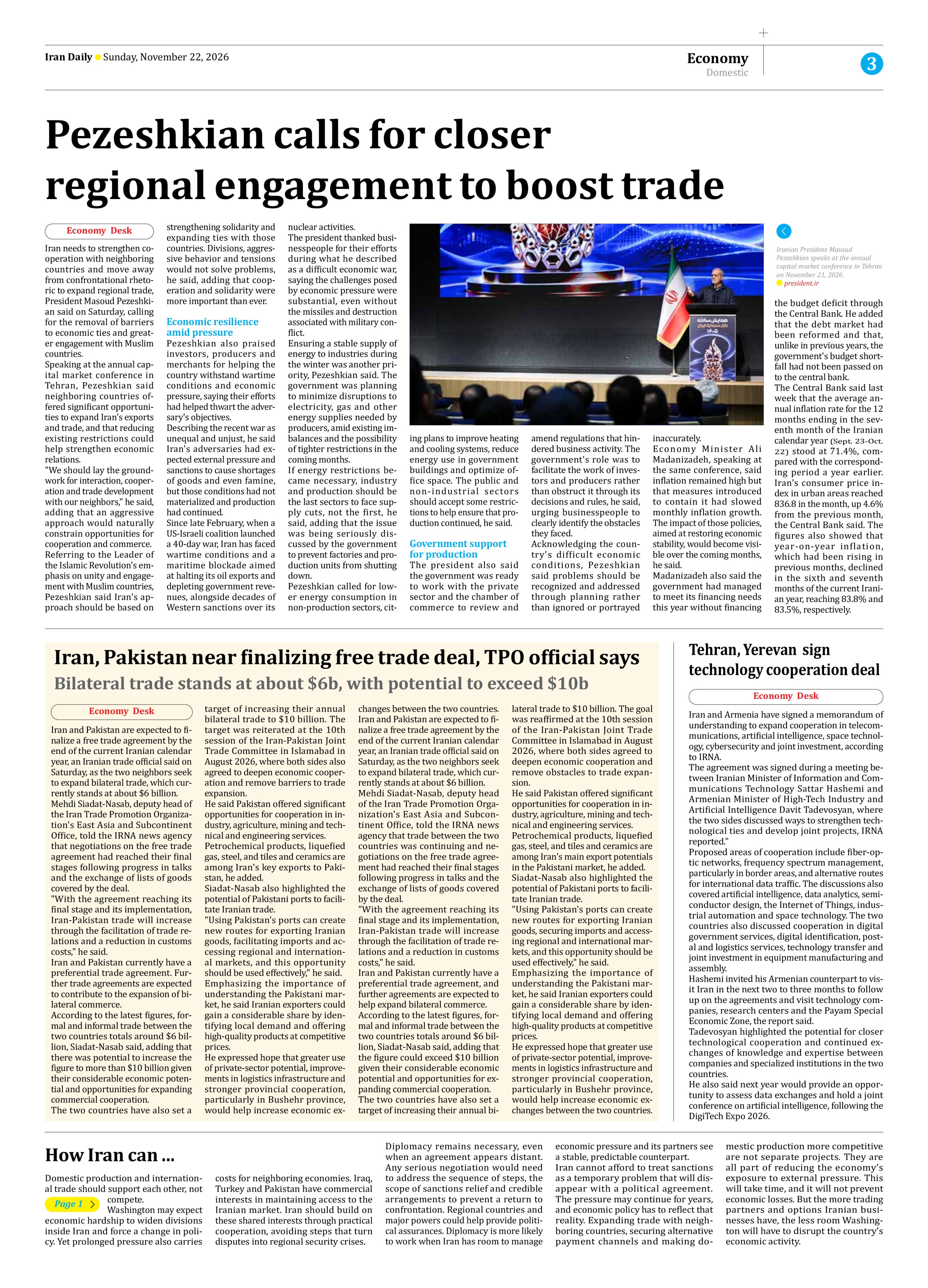
Speaking at the annual capital market conference in Tehran, Pezeshkian said neighboring countries offered significant opportunities to expand Iran's exports and trade, and that reducing existing restrictions could help strengthen economic relations.
"We should lay the groundwork for interaction, cooperation and trade development with our neighbors," he said, adding that an aggressive approach would naturally constrain opportunities for cooperation and commerce.
Referring to the Leader of the Islamic Revolution's emphasis on unity and engagement with Muslim countries, Pezeshkian said Iran's approach should be based on strengthening solidarity and expanding ties with those countries. Divisions, aggressive behavior and tensions would not solve problems, he said, adding that cooperation and solidarity were more important than ever.
Economic resilience amid pressure
Pezeshkian also praised investors, producers and merchants for helping the country withstand wartime conditions and economic pressure, saying their efforts had helped thwart the adversary's objectives.
Describing the recent war as unequal and unjust, he said Iran's adversaries had expected external pressure and sanctions to cause shortages of goods and even famine, but those conditions had not materialized and production had continued.
Since late February, when a US-Israeli coalition launched a 40-day war, Iran has faced wartime conditions and a maritime blockade aimed at halting its oil exports and depleting government revenues, alongside decades of Western sanctions over its nuclear activities.
The president thanked businesspeople for their efforts during what he described as a difficult economic war, saying the challenges posed by economic pressure were substantial, even without the missiles and destruction associated with military conflict.
Ensuring a stable supply of energy to industries during the winter was another priority, Pezeshkian said. The government was planning to minimize disruptions to electricity, gas and other energy supplies needed by producers, amid existing imbalances and the possibility of tighter restrictions in the coming months.
If energy restrictions became necessary, industry and production should be the last sectors to face supply cuts, not the first, he said, adding that the issue was being seriously discussed by the government to prevent factories and production units from shutting down.
Pezeshkian called for lower energy consumption in non-production sectors, citing plans to improve heating and cooling systems, reduce energy use in government buildings and optimize office space. The public and non-industrial sectors should accept some restrictions to help ensure that production continued, he said.
Government support for production
The president also said the government was ready to work with the private sector and the chamber of commerce to review and amend regulations that hindered business activity. The government's role was to facilitate the work of investors and producers rather than obstruct it through its decisions and rules, he said, urging businesspeople to clearly identify the obstacles they faced.
Acknowledging the country's difficult economic conditions, Pezeshkian said problems should be recognized and addressed through planning rather than ignored or portrayed inaccurately.
Economy Minister Ali Madanizadeh, speaking at the same conference, said inflation remained high but that measures introduced to contain it had slowed monthly inflation growth. The impact of those policies, aimed at restoring economic stability, would become visible over the coming months, he said.
Madanizadeh also said the government had managed to meet its financing needs this year without financing the budget deficit through the Central Bank. He added that the debt market had been reformed and that, unlike in previous years, the government's budget shortfall had not been passed on to the central bank.
The Central Bank said last week that the average annual inflation rate for the 12 months ending in the seventh month of the Iranian calendar year (Sept. 23-Oct. 22) stood at 71.4%, compared with the corresponding period a year earlier. Iran's consumer price index in urban areas reached 836.8 in the month, up 4.6% from the previous month, the Central Bank said. The figures also showed that year-on-year inflation, which had been rising in previous months, declined in the sixth and seventh months of the current Iranian year, reaching 83.8% and 83.5%, respectively.