


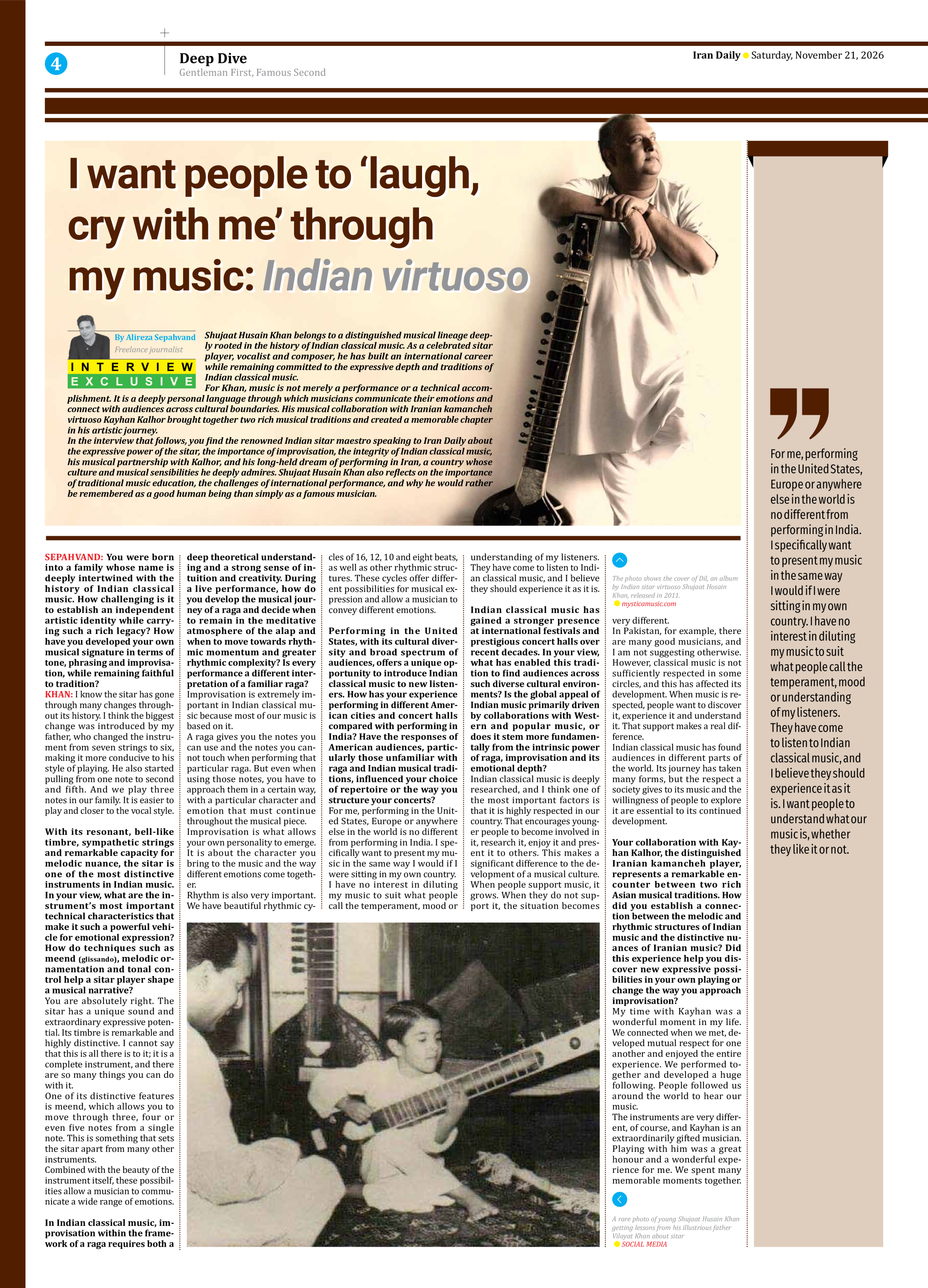


I want people to ‘laugh, cry with me’ through my music: Indian virtuoso
Shujaat Husain Khan belongs to a distinguished musical lineage deeply rooted in the history of Indian classical music. As a celebrated sitar player, vocalist and composer, he has built an international career while remaining committed to the expressive depth and traditions of Indian classical music. For Khan, music is not merely a performance or a technical accomplishment. It is a deeply personal language through which musicians communicate their emotions and connect with audiences across cultural boundaries. His musical collaboration with Iranian kamancheh virtuoso Kayhan Kalhor brought together two rich musical traditions and created a memorable chapter in his artistic journey. In the interview that follows, you find the renowned Indian sitar maestro speaking to Iran Daily about the expressive power of the sitar, the importance of improvisation, the integrity of Indian classical music, his musical partnership with Kalhor, and his long-held dream of performing in Iran, a country whose culture and musical sensibilities he deeply admires. Shujaat Husain Khan also reflects on the importance of traditional music education, the challenges of international performance, and why he would rather be remembered as a good human being than simply as a famous musician.
Freelance journalist
SEPAHVAND: You were born into a family whose name is deeply intertwined with the history of Indian classical music. How challenging is it to establish an independent artistic identity while carrying such a rich legacy? How have you developed your own musical signature in terms of tone, phrasing and improvisation, while remaining faithful to tradition?
KHAN: I know the sitar has gone through many changes throughout its history. I think the biggest change was introduced by my father, who changed the instrument from seven strings to six, making it more conducive to his style of playing. He also started pulling from one note to second and fifth. And we play three notes in our family. It is easier to play and closer to the vocal style.
With its resonant, bell-like timbre, sympathetic strings and remarkable capacity for melodic nuance, the sitar is one of the most distinctive instruments in Indian music. In your view, what are the instrument’s most important technical characteristics that make it such a powerful vehicle for emotional expression? How do techniques such as meend (glissando), melodic ornamentation and tonal control help a sitar player shape a musical narrative?
You are absolutely right. The sitar has a unique sound and extraordinary expressive potential. Its timbre is remarkable and highly distinctive. I cannot say that this is all there is to it; it is a complete instrument, and there are so many things you can do with it.
One of its distinctive features is meend, which allows you to move through three, four or even five notes from a single note. This is something that sets the sitar apart from many other instruments.
Combined with the beauty of the instrument itself, these possibilities allow a musician to communicate a wide range of emotions.
In Indian classical music, improvisation within the framework of a raga requires both a deep theoretical understanding and a strong sense of intuition and creativity. During a live performance, how do you develop the musical journey of a raga and decide when to remain in the meditative atmosphere of the alap and when to move towards rhythmic momentum and greater rhythmic complexity? Is every performance a different interpretation of a familiar raga?
Improvisation is extremely important in Indian classical music because most of our music is based on it.
A raga gives you the notes you can use and the notes you cannot touch when performing that particular raga. But even when using those notes, you have to approach them in a certain way, with a particular character and emotion that must continue throughout the musical piece.
Improvisation is what allows your own personality to emerge. It is about the character you bring to the music and the way different emotions come together.
Rhythm is also very important. We have beautiful rhythmic cycles of 16, 12, 10 and eight beats, as well as other rhythmic structures. These cycles offer different possibilities for musical expression and allow a musician to convey different emotions.
Performing in the United States, with its cultural diversity and broad spectrum of audiences, offers a unique opportunity to introduce Indian classical music to new listeners. How has your experience performing in different American cities and concert halls compared with performing in India? Have the responses of American audiences, particularly those unfamiliar with raga and Indian musical traditions, influenced your choice of repertoire or the way you structure your concerts?
For me, performing in the United States, Europe or anywhere else in the world is no different from performing in India. I specifically want to present my music in the same way I would if I were sitting in my own country.
I have no interest in diluting my music to suit what people call the temperament, mood or understanding of my listeners. They have come to listen to Indian classical music, and I believe they should experience it as it is.
Indian classical music has gained a stronger presence at international festivals and prestigious concert halls over recent decades. In your view, what has enabled this tradition to find audiences across such diverse cultural environments? Is the global appeal of Indian music primarily driven by collaborations with Western and popular music, or does it stem more fundamentally from the intrinsic power of raga, improvisation and its emotional depth?
Indian classical music is deeply researched, and I think one of the most important factors is that it is highly respected in our country. That encourages younger people to become involved in it, research it, enjoy it and present it to others. This makes a significant difference to the development of a musical culture. When people support music, it grows. When they do not support it, the situation becomes very different.
In Pakistan, for example, there are many good musicians, and I am not suggesting otherwise. However, classical music is not sufficiently respected in some circles, and this has affected its development. When music is respected, people want to discover it, experience it and understand it. That support makes a real difference.
Indian classical music has found audiences in different parts of the world. Its journey has taken many forms, but the respect a society gives to its music and the willingness of people to explore it are essential to its continued development.
Your collaboration with Kayhan Kalhor, the distinguished Iranian kamancheh player, represents a remarkable encounter between two rich Asian musical traditions. How did you establish a connection between the melodic and rhythmic structures of Indian music and the distinctive nuances of Iranian music? Did this experience help you discover new expressive possibilities in your own playing or change the way you approach improvisation?
My time with Kayhan was a wonderful moment in my life. We connected when we met, developed mutual respect for one another and enjoyed the entire experience. We performed together and developed a huge following. People followed us around the world to hear our music.
The instruments are very different, of course, and Kayhan is an extraordinarily gifted musician. Playing with him was a great honour and a wonderful experience for me. We spent many memorable moments together. It was one of the most rewarding and beautiful periods of my musical life.
Some believe that classical music should remain faithful to its historical frameworks, while others argue that innovation and collaboration with different musical styles are essential to keeping it alive. Where do you stand in this debate? Have your international collaborations, including those with Western musicians, influenced your personal musical language, or do you prefer to explore the sitar’s identity primarily within its own traditional context?
I have seen many musicians use computer-generated loops, keyboards and big drums in their performances. On rare occasions, I have performed with a very respected and interesting classical guitarist who accompanies me with some chords and provides a musical background. But it is not a duet or anything of that kind.
I want people to understand what our music is, whether they like it or not. It is their choice to enjoy it or not, but they should at least have the opportunity to experience the tradition in its authentic form. Diluting music to suit what we think other people might like is not something I do. Other musicians may choose to do that, but it is not my interest.
Today, young musicians can access an enormous wealth of music through the internet, historical recordings and online tutorials. Yet Indian classical music education has traditionally relied on a close teacher–student relationship and the direct transmission of practical experience. Can modern technology replace some aspects of this traditional relationship? What is the most important skill a sitar student cannot acquire simply by watching videos or studying written material?
This is a wonderful question. We have so many choices and so much access to information nowadays that people are spoiled by the abundance of material available to them. At the same time, I believe this can make people lazy.
I have particular beliefs in this regard, and I am sorry, but perhaps that is because I am old-fashioned. I live according to what I believe. One of my beliefs is that if you want to learn music or any other fine art, you need to sit with your teacher. Sitting in front of a screen does not work for me. This is only my personal opinion. I have nothing against people who choose a different approach. I am not on social media myself, specifically because of my personal beliefs.
For me, learning face to face is the most important thing in music. You need to be in touch with your teacher and understand their feelings. You need to understand why and when they make certain musical decisions, what is happening in their life, how they compose, and how they put music together. You learn about the teacher’s personality and emotions, whether the teacher is a man or a woman. All these things are part of the learning process.
Watching videos and studying written material cannot replace that experience. In my opinion, technology will never, by itself, make you a musician. Thousands of people watch YouTube, but watching someone perform is not the same as learning music from a teacher.
Given your collaboration with Kayhan Kalhor and the interest Iranian audiences have shown in Indian classical music, there have been discussions in recent years about bringing you to Iran, including a possible performance at the Fajr International Music Festival. However, these plans have not materialised. Are you still interested in performing in Iran? What conditions would help make a concert or collaborative project with Iranian musicians possible?
The simple answer is yes. I would love to perform in Iran. Iran is one of the countries with the most beautiful, wonderful and profound cultures in the world. Your country has given so much to the world, and there is such wonderful emotional depth in the way Iranian people connect with music.
It is my loss that I have not been able to perform in your beautiful country. There have been discussions about my coming to Iran, but for various reasons, these plans have not materialised. Sometimes the obstacle is financial. I do not perform too many concerts, and I am trying to reduce my schedule further. I therefore need to receive a certain fee for my performances, and sometimes that amount is not available.
Another issue is visas. Musicians from our countries need specific visas that allow them to travel internationally without complications. International politics can also become an obstacle, and these circumstances sometimes prevent us from bringing our music and feelings to another country.
Nevertheless, I very much hope that one day I will have the opportunity to come to Iran, perform for all of you and enjoy the experience. It is one of my unfulfilled dreams.
When you look back on your professional journey and your experiences performing in different countries, what would you most like audiences to remember about your music? Is a great musician’s legacy primarily about preserving and passing on the tradition inherited from their teachers, or does it also lie in opening new artistic pathways for future generations?
People often ask me how I would like to be remembered as a musician and what kind of legacy I want to leave behind. To be honest, I do not pay too much attention to these questions. My legacy will happen naturally through what I leave behind: my music, my personality and everything associated with my life.
I have always craved the love and affection of my listeners, and that is the greatest blessing. When I perform somewhere and see people smile and open their hearts to the music, I feel that I have received something truly special.
I would rather people remember me as a good human being than simply as a famous musician. I hope they will remember me as someone who enjoyed life, smiled a lot, laughed a lot and was genuinely happy to live a simple, relaxed life surrounded by friends. That is what I have always strived for.
I believe that my destiny will take care of my professional standing, popularity, position, money and luxuries. All these things will happen as they are meant to happen. What matters most to me is being regarded as a thorough professional in my work and a nice gentleman.
I have never asked anyone for work throughout my professional life. If there is one person who can stand up and say that I have asked them for work during the past 50 years, I would like to know about it. I believe in the grace of God, and the affection and love I have received from people have been far greater than anything I could have expected from my music alone.
I already feel that I have received everything I need. I am simply enjoying a beautiful life and enjoying the people I meet, including people like you who reach out to me. I am extremely grateful.
I am not very good at talking about myself. I am just a simple musician who wants to get up on stage and play. I hope people enjoy my music and laugh and cry with me through it. Explaining my feelings and emotions in words is difficult, but I have tried my best. Ultimately, I want to enjoy my music and my life, and I hope people will enjoy that journey with me.