


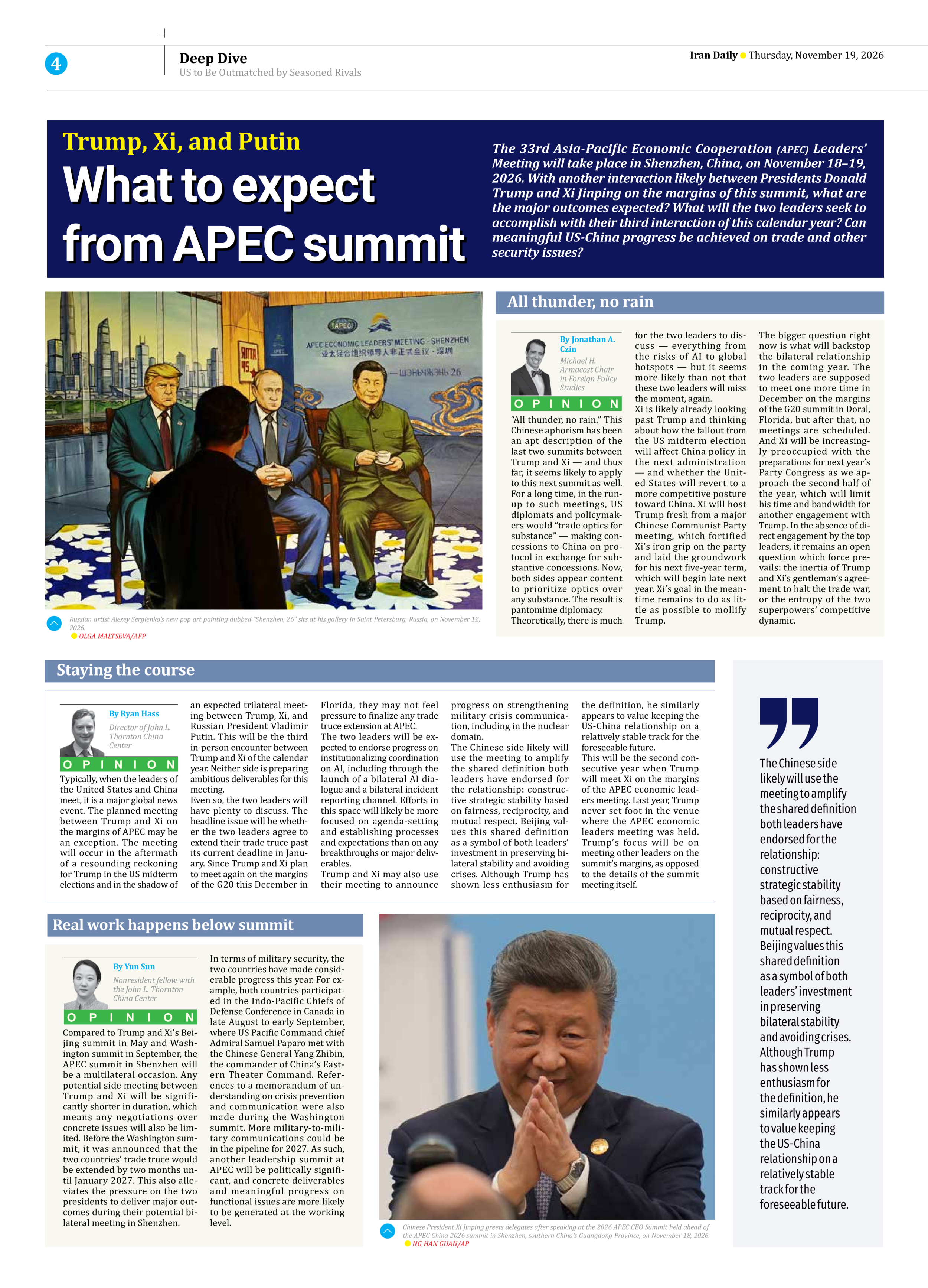


Trump, Xi, and Putin
What to expect from APEC summit
The 33rd Asia-Pacific Economic Cooperation (APEC) Leaders’ Meeting will take place in Shenzhen, China, on November 18–19, 2026. With another interaction likely between Presidents Donald Trump and Xi Jinping on the margins of this summit, what are the major outcomes expected? What will the two leaders seek to accomplish with their third interaction of this calendar year? Can meaningful US-China progress be achieved on trade and other security issues?
All thunder, no rain
By Jonathan A. Czin
Michael H. Armacost Chair in Foreign Policy Studies
“All thunder, no rain.” This Chinese aphorism has been an apt description of the last two summits between Trump and Xi — and thus far, it seems likely to apply to this next summit as well. For a long time, in the run-up to such meetings, US diplomats and policymakers would “trade optics for substance” — making concessions to China on protocol in exchange for substantive concessions. Now, both sides appear content to prioritize optics over any substance. The result is pantomime diplomacy.
Theoretically, there is much for the two leaders to discuss — everything from the risks of AI to global hotspots — but it seems more likely than not that these two leaders will miss the moment, again.
Xi is likely already looking past Trump and thinking about how the fallout from the US midterm election will affect China policy in the next administration — and whether the United States will revert to a more competitive posture toward China. Xi will host Trump fresh from a major Chinese Communist Party meeting, which fortified Xi’s iron grip on the party and laid the groundwork for his next five-year term, which will begin late next year. Xi’s goal in the meantime remains to do as little as possible to mollify Trump.
The bigger question right now is what will backstop the bilateral relationship in the coming year. The two leaders are supposed to meet one more time in December on the margins of the G20 summit in Doral, Florida, but after that, no meetings are scheduled. And Xi will be increasingly preoccupied with the preparations for next year’s Party Congress as we approach the second half of the year, which will limit his time and bandwidth for another engagement with Trump. In the absence of direct engagement by the top leaders, it remains an open question which force prevails: the inertia of Trump and Xi’s gentleman’s agreement to halt the trade war, or the entropy of the two superpowers’ competitive dynamic.
Staying the course
By Ryan Hass
Director of John L. Thornton China Center
Typically, when the leaders of the United States and China meet, it is a major global news event. The planned meeting between Trump and Xi on the margins of APEC may be an exception. The meeting will occur in the aftermath of a resounding reckoning for Trump in the US midterm elections and in the shadow of an expected trilateral meeting between Trump, Xi, and Russian President Vladimir Putin. This will be the third in-person encounter between Trump and Xi of the calendar year. Neither side is preparing ambitious deliverables for this meeting.
Even so, the two leaders will have plenty to discuss. The headline issue will be whether the two leaders agree to extend their trade truce past its current deadline in January. Since Trump and Xi plan to meet again on the margins of the G20 this December in Florida, they may not feel pressure to finalize any trade truce extension at APEC.
The two leaders will be expected to endorse progress on institutionalizing coordination on AI, including through the launch of a bilateral AI dialogue and a bilateral incident reporting channel. Efforts in this space will likely be more focused on agenda-setting and establishing processes and expectations than on any breakthroughs or major deliverables.
Trump and Xi may also use their meeting to announce progress on strengthening military crisis communication, including in the nuclear domain.
The Chinese side likely will use the meeting to amplify the shared definition both leaders have endorsed for the relationship: constructive strategic stability based on fairness, reciprocity, and mutual respect. Beijing values this shared definition as a symbol of both leaders’ investment in preserving bilateral stability and avoiding crises. Although Trump has shown less enthusiasm for the definition, he similarly appears to value keeping the US-China relationship on a relatively stable track for the foreseeable future.
This will be the second consecutive year when Trump will meet Xi on the margins of the APEC economic leaders meeting. Last year, Trump never set foot in the venue where the APEC economic leaders meeting was held. Trump’s focus will be on meeting other leaders on the summit’s margins, as opposed to the details of the summit meeting itself.
Real work happens below summit
By Yun Sun
Nonresident fellow with the John L. Thornton China Center
Compared to Trump and Xi’s Beijing summit in May and Washington summit in September, the APEC summit in Shenzhen will be a multilateral occasion. Any potential side meeting between Trump and Xi will be significantly shorter in duration, which means any negotiations over concrete issues will also be limited. Before the Washington summit, it was announced that the two countries’ trade truce would be extended by two months until January 2027. This also alleviates the pressure on the two presidents to deliver major outcomes during their potential bilateral meeting in Shenzhen.
In terms of military security, the two countries have made considerable progress this year. For example, both countries participated in the Indo-Pacific Chiefs of Defense Conference in Canada in late August to early September, where US Pacific Command chief Admiral Samuel Paparo met with the Chinese General Yang Zhibin, the commander of China’s Eastern Theater Command. References to a memorandum of understanding on crisis prevention and communication were also made during the Washington summit. More military-to-military communications could be in the pipeline for 2027. As such, another leadership summit at APEC will be politically significant, and concrete deliverables and meaningful progress on functional issues are more likely to be generated at the working level.
A three-way meeting with two winners
By Jonathan A. Czin
Michael H. Armacost Chair in Foreign Policy Studies
It is difficult to envisage a scenario in which a meeting among Trump, Xi, and Putin has a happy outcome for the United States and its interests. The visual from such a meeting alone would be an unsettling imitation of the “Big Three” meeting at Yalta in the midst of World War II. Although this meeting will be more photo op than substance, like the original Yalta, this meeting could pave the way for a carving up of Eastern Europe to accommodate Russian interests. That is a worst-case and perhaps unlikely scenario. But if these three men emerge elated from this meeting, it would likely bode ill for Ukraine — and more importantly, for European security. Last century, an America buffered by two oceans had to learn the hard way that its interests are in fact bound up with the security of Europe and East Asia — yet we seem to periodically need a remedial reeducation in the realities of geopolitics.
Alternatively, if each of these men finds himself frustrated, that is also a potentially dangerous outcome. Acrimony among heads of state is no mere spat — a personal contretemps can have enduring and dangerous consequences, inflaming rather than assuaging the many points of tension and divergence between these leaders.
While Xi and Putin are more likely to humor than to humiliate Trump, even that outcome is a poor one for the United States. It will bait Trump further down his current path of trying to conciliate rather than counter these two strongmen. And, ironically, Trump’s very willingness to participate in such a meeting with so little time to prepare will only make his nominal objective of ending the war in Ukraine even more elusive. Trump has already demonstrated that he has little appetite or wherewithal to avail himself of the leverage he might have over either leader if he were to work in tandem with American allies and partners. And both men know Trump’s time is expiring even more quickly than his leverage — and that he will be irrelevant in a mere 26 months. That is a pittance for two leaders who can measure their tenures in decades, not years. Why would either man make a deal with a leader whose time and leverage are waning? They will only do it if they think they can pilfer more from Trump diplomatically than they will be able to gain from the next American president.
More downside risk than upside potential for US
By Ryan Hass
Director of John L. Thornton China Center
The risk/reward calculation for all three leaders is different.
For Russia, this meeting offers major upside. By sitting down with the leaders of the world’s two most powerful countries in a trilateral format, Putin will be recognized as a major player on the world stage rather than a pariah. He will have achieved his return to the top table in global diplomacy without making any significant concessions on Ukraine or elsewhere.
For China, the meeting will be mixed. On the one hand, Xi will bask in the glow of China serving as the convener and agenda-setter for how China, Russia, and the United States will relate to each other. The meeting will highlight Xi’s statesmanship and China’s centrality in the international system. On the other hand, Beijing will bear the burden of setting an agenda, ensuring a productive exchange, and holding some responsibility for follow-through on any outcomes the meeting generates. Xi typically avoids owning responsibility for high-profile diplomatic events with uncertain outcomes, so this event will stretch the Chinese side’s comfort zone.
For Trump, the meeting will pose greater downside risks than upside potential. Trump will face the risk of being outmaneuvered by more prepared and more cunning leaders. In this triangle, the closest and warmest relationship among the three leaders is between Xi and Putin, who have met over 40 times since 2013 and share a desire to diminish American leadership on the world stage. The meeting’s optics will also send a chill to America’s allies and partners, who will fear Trump is prioritizing his relations with Xi and Putin over their interests and concerns. This chill will be felt most acutely in Ukraine and Taiwan.
Ultimately, symbolism may prove more enduring than the substance of this meeting. It is unlikely that there will be any breakthroughs on Ukraine or on launching trilateral arms control efforts, Trump’s putative focus for this meeting. Beijing has long been unwilling to enter arms control negotiations until it is closer to reaching parity in nuclear capabilities with the United States and Russia. Beijing is concerned that doing so could lock China into a permanently subordinate position that could expose China to risk. At best, the three leaders could find common principles to endorse, such as maintaining open sea lines of communication, reaffirming that nuclear wars can never be won and should never be fought, and affirming an interest in an end to war in Ukraine, while leaving the terms of such an end ambiguous.
A once-unthinkable alignment
By Scott M. Moore
Managing Director of Global Initiatives, Research, and Strategy at Penn
Much has been made of Trump’s apparent rapport with the leaders of Russia and China, long regarded as America’s foremost adversaries. But a trilateral summit with Putin and Xi in Shenzhen would go well beyond bonhomie. It would dramatically signal that Washington is prepared to trade away the liberal international order it built after 1945.
The White House has framed the meeting around the legitimate goal of advancing nuclear arms control. But the meeting has broader implications. Holding a three-way meeting with Russia, just as Moscow says it will resume talks with Washington and Kyiv, represents Ukraine’s worst fear: the image of the war being settled among great powers, over Kyiv’s head. Beijing, too, would benefit from being portrayed as a would-be peacemaker, rather than as an enabler for sustaining Russia’s war economy.
The summit may also preview a broader convergence of interests. The Wall Street Journal reports that the Trump administration has encouraged former Hungarian Prime Minister Viktor Orbán to run for UN secretary-general as a joint US-Russia-China candidate. Meanwhile, Beijing reportedly considered a bid to host the 2028 UN climate conference, the annual meeting of parties to the UN Framework Convention on Climate Change, a treaty from which the United States will formally withdraw in February 2027. Washington is not merely leaving a gap in multilateral leadership. In the Orbán case, it appears to be working with Moscow and Beijing to reshape the multilateral system.
For America’s allies, the message is stark. A trilateral meeting in Shenzhen will reinforce European concerns that their security is negotiable. In Asia, partners such as Japan and Taiwan will wonder whether their own US security commitments are up for negotiation. The result could be that many will hedge, toward Beijing, toward strategic autonomy, or both.
If the summit goes ahead, it will symbolize a once-unthinkable alignment between the United States and the world’s foremost powers. It will also speed up the fracturing of Western alliances that Moscow and Beijing have long sought and make it even more difficult to tackle shared challenges and provide global public goods.
China wants spotlight, not arms control
By Yun Sun
Nonresident fellow with the John L. Thornton China Center
Russia has been the primary driver of a potential trilateral summit during APEC, with Moscow circulating the possibility as early as this past summer. The Chinese are not necessarily actively driving such a summit. However, if the United States and Russia clearly call for it, there are few reasons why China would not embrace such an event. In recent weeks, the United States has engaged in active Track 2 diplomacy and dialogue with China and Russia. The Chinese enthusiasm is obvious, despite the struggle over the deliverables and substance of such a summit. Some Chinese officials have suggested that some in China are viewing the trilateral summit as “the most significant meeting in the history of international relations since the end of World War II.” If it happens, China will be presenting itself as the peer of the United States and Russia and playing a pivotal role in US-Russia relations at a historical moment to end the Ukraine war. That is not an opportunity that Beijing would like to miss. In addition, according to Chinese and Russian interlocutors, Russia has made a genuine plea for China to host the trilateral summit. Beijing will have to develop a really strong and convincing argument about why it would refuse to do its Russian partner a solid. Beijing is likely concerned by Trump’s and Secretary of State Marco Rubio’s references to such a summit containing a trilateral dialogue on arms control and nuclear weapons. China has consistently rejected the concept of US-China-Russia trilateral arms control and nuclear dialogue, citing its significantly smaller nuclear arsenal. The Chinese do not seem to see the Ukraine war as coming to an end so soon. By the time of the APEC summit, the US midterm elections will already be over, and Trump will have lost the motivation to use peace in Ukraine to boost the Republican Party’s popularity. Therefore, a trilateral summit will be unlikely to end the war in Ukraine anyway.
The full article was first published by
Brookings.