




Pezeshkian urges fuel savings as Iran reports rise in CNG consumption
Iranian President Masoud Pezeshkian has called for more efficient fuel and energy consumption, saying the country uses at least three times the global average, as government measures to manage fuel demand have boosted daily compressed natural gas (CNG) consumption by 16-17%, an oil official said.
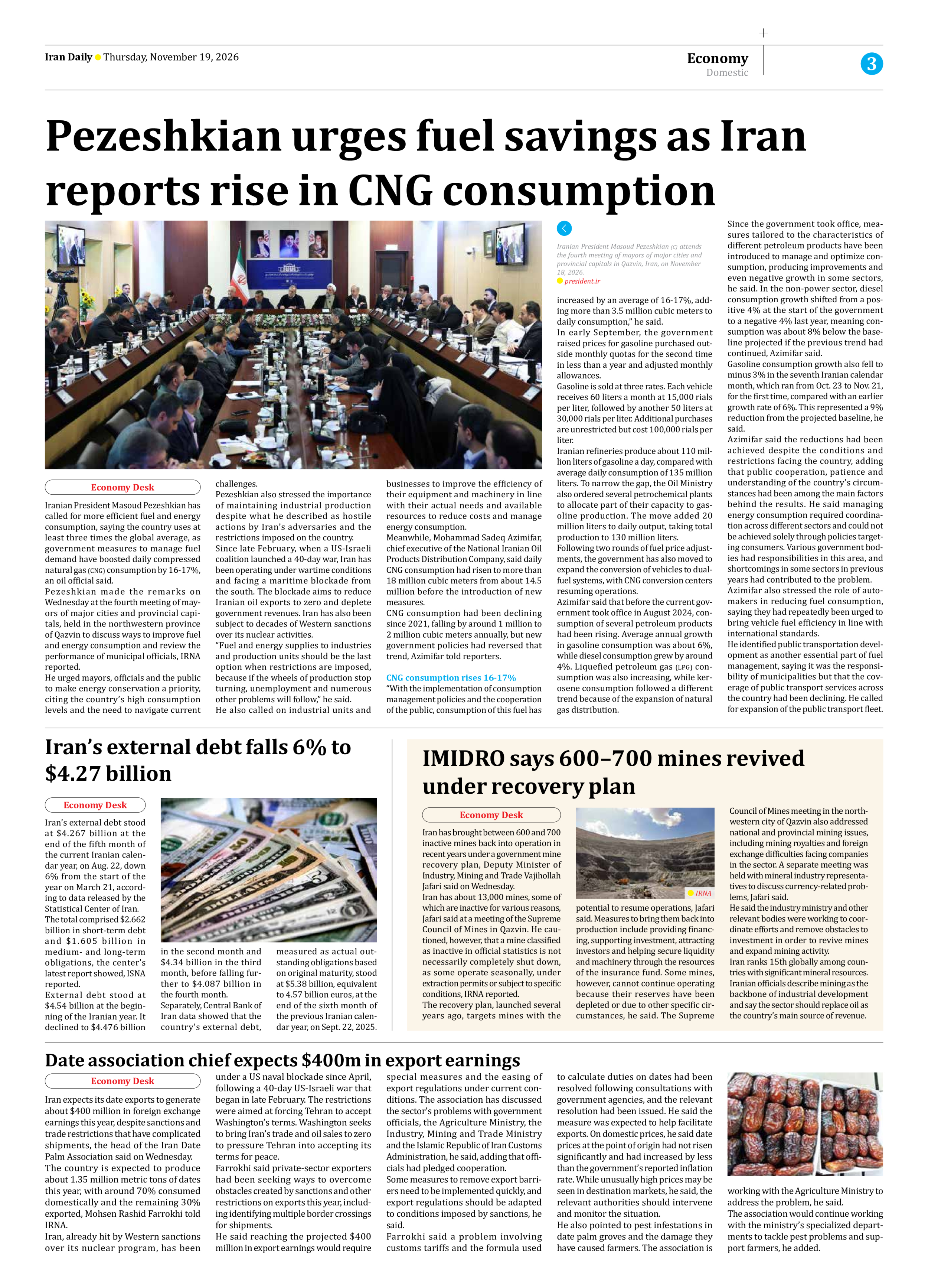
Pezeshkian made the remarks on Wednesday at the fourth meeting of mayors of major cities and provincial capitals, held in the northwestern province of Qazvin to discuss ways to improve fuel and energy consumption and review the performance of municipal officials, IRNA reported.
He urged mayors, officials and the public to make energy conservation a priority, citing the country’s high consumption levels and the need to navigate current challenges.
Pezeshkian also stressed the importance of maintaining industrial production despite what he described as hostile actions by Iran’s adversaries and the restrictions imposed on the country.
Since late February, when a US-Israeli coalition launched a 40-day war, Iran has been operating under wartime conditions and facing a maritime blockade from the south. The blockade aims to reduce Iranian oil exports to zero and deplete government revenues. Iran has also been subject to decades of Western sanctions over its nuclear activities.
“Fuel and energy supplies to industries and production units should be the last option when restrictions are imposed, because if the wheels of production stop turning, unemployment and numerous other problems will follow,” he said.
He also called on industrial units and businesses to improve the efficiency of their equipment and machinery in line with their actual needs and available resources to reduce costs and manage energy consumption.
Meanwhile, Mohammad Sadeq Azimifar, chief executive of the National Iranian Oil Products Distribution Company, said daily CNG consumption had risen to more than 18 million cubic meters from about 14.5 million before the introduction of new measures.
CNG consumption had been declining since 2021, falling by around 1 million to 2 million cubic meters annually, but new government policies had reversed that trend, Azimifar told reporters.
CNG consumption rises 16-17%
“With the implementation of consumption management policies and the cooperation of the public, consumption of this fuel has increased by an average of 16-17%, adding more than 3.5 million cubic meters to daily consumption,” he said.
In early September, the government raised prices for gasoline purchased outside monthly quotas for the second time in less than a year and adjusted monthly allowances.
Gasoline is sold at three rates. Each vehicle receives 60 liters a month at 15,000 rials per liter, followed by another 50 liters at 30,000 rials per liter. Additional purchases are unrestricted but cost 100,000 rials per liter.
Iranian refineries produce about 110 million liters of gasoline a day, compared with average daily consumption of 135 million liters. To narrow the gap, the Oil Ministry also ordered several petrochemical plants to allocate part of their capacity to gasoline production. The move added 20 million liters to daily output, taking total production to 130 million liters.
Following two rounds of fuel price adjustments, the government has also moved to expand the conversion of vehicles to dual-fuel systems, with CNG conversion centers resuming operations.
Azimifar said that before the current government took office in August 2024, consumption of several petroleum products had been rising. Average annual growth in gasoline consumption was about 6%, while diesel consumption grew by around 4%. Liquefied petroleum gas (LPG) consumption was also increasing, while kerosene consumption followed a different trend because of the expansion of natural gas distribution.
Since the government took office, measures tailored to the characteristics of different petroleum products have been introduced to manage and optimize consumption, producing improvements and even negative growth in some sectors, he said. In the non-power sector, diesel consumption growth shifted from a positive 4% at the start of the government to a negative 4% last year, meaning consumption was about 8% below the baseline projected if the previous trend had continued, Azimifar said.
Gasoline consumption growth also fell to minus 3% in the seventh Iranian calendar month, which ran from Oct. 23 to Nov. 21, for the first time, compared with an earlier growth rate of 6%. This represented a 9% reduction from the projected baseline, he said.
Azimifar said the reductions had been achieved despite the conditions and restrictions facing the country, adding that public cooperation, patience and understanding of the country’s circumstances had been among the main factors behind the results. He said managing energy consumption required coordination across different sectors and could not be achieved solely through policies targeting consumers. Various government bodies had responsibilities in this area, and shortcomings in some sectors in previous years had contributed to the problem.
Azimifar also stressed the role of automakers in reducing fuel consumption, saying they had repeatedly been urged to bring vehicle fuel efficiency in line with international standards.
He identified public transportation development as another essential part of fuel management, saying it was the responsibility of municipalities but that the coverage of public transport services across the country had been declining. He called for expansion of the public transport fleet.