




A’alipour sets sights on dethroning Olympic champion Nasar
Iranian weightlifter Ali A’alipour has set his sights on dethroning Bulgarian superstar Karlos Nasar, saying he relishes the prospect of challenging the world and Olympic champion as he targets a gold medal at the Los Angeles 2028 Games.
The 21-year-old has emerged as one of Iran’s brightest prospects in recent years.
A’alipour made his mark on his World Championships debut in 2024, collecting bronze medals in the total and clean & jerk in the 96kg class in Manama, before claiming snatch silver in the newly introduced 94kg division last year in Førde, Norway.
Also a two-time Asian champion, A’alipour enjoyed a memorable campaign at the Aichi-Nagoya 2026 Asian Games in September, claiming gold in the 95kg class at the expense of 2024 world champion Nurgissa Adiletuly of Kazakhstan, who settled for silver.
The Iranian followed his Asian Games triumph, which ended the country’s eight-year wait for a weightlifting gold at the continental showpiece, with another impressive performance at the World Championships in Ningbo, China, earlier this month.
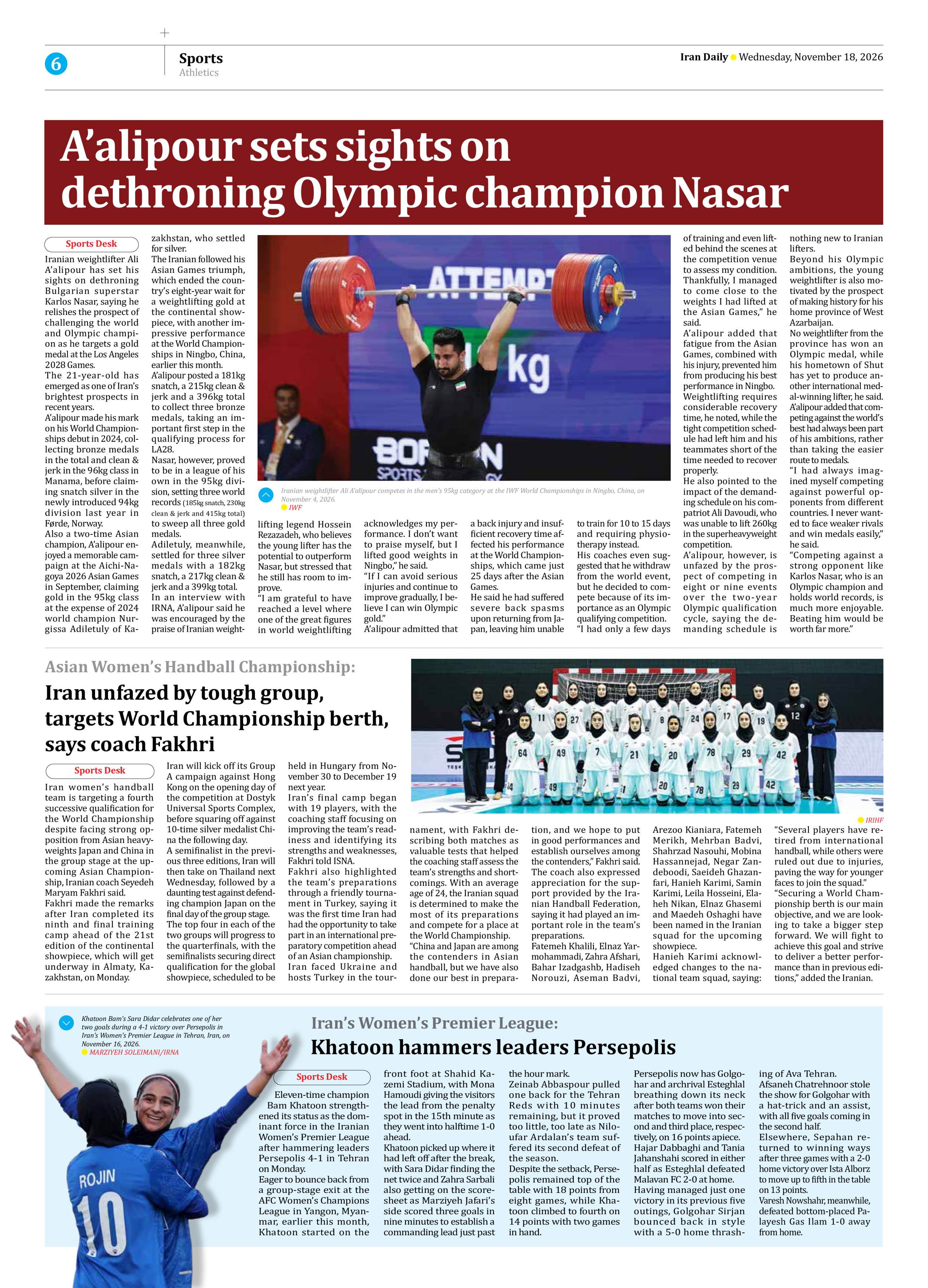
A’alipour posted a 181kg snatch, a 215kg clean & jerk and a 396kg total to collect three bronze medals, taking an important first step in the qualifying process for LA28.
Nasar, however, proved to be in a league of his own in the 95kg division, setting three world records (185kg snatch, 230kg clean & jerk and 415kg total) to sweep all three gold medals.
Adiletuly, meanwhile, settled for three silver medals with a 182kg snatch, a 217kg clean & jerk and a 399kg total.
In an interview with IRNA, A’alipour said he was encouraged by the praise of Iranian weightlifting legend Hossein Rezazadeh, who believes the young lifter has the potential to outperform Nasar, but stressed that he still has room to improve.
“I am grateful to have reached a level where one of the great figures in world weightlifting acknowledges my performance. I don’t want to praise myself, but I lifted good weights in Ningbo,” he said.
“If I can avoid serious injuries and continue to improve gradually, I believe I can win Olympic gold.”
A’alipour admitted that a back injury and insufficient recovery time affected his performance at the World Championships, which came just 25 days after the Asian Games.
He said he had suffered severe back spasms upon returning from Japan, leaving him unable to train for 10 to 15 days and requiring physiotherapy instead.
His coaches even suggested that he withdraw from the world event, but he decided to compete because of its importance as an Olympic qualifying competition.
“I had only a few days of training and even lifted behind the scenes at the competition venue to assess my condition. Thankfully, I managed to come close to the weights I had lifted at the Asian Games,” he said.
A’alipour added that fatigue from the Asian Games, combined with his injury, prevented him from producing his best performance in Ningbo.
Weightlifting requires considerable recovery time, he noted, while the tight competition schedule had left him and his teammates short of the time needed to recover properly.
He also pointed to the impact of the demanding schedule on his compatriot Ali Davoudi, who was unable to lift 260kg in the superheavyweight competition.
A’alipour, however, is unfazed by the prospect of competing in eight or nine events over the two-year Olympic qualification cycle, saying the demanding schedule is nothing new to Iranian lifters.
Beyond his Olympic ambitions, the young weightlifter is also motivated by the prospect of making history for his home province of West Azarbaijan.
No weightlifter from the province has won an Olympic medal, while his hometown of Shut has yet to produce another international medal-winning lifter, he said.
A’alipour added that competing against the world’s best had always been part of his ambitions, rather than taking the easier route to medals.
“I had always imagined myself competing against powerful opponents from different countries. I never wanted to face weaker rivals and win medals easily,” he said.
“Competing against a strong opponent like Karlos Nasar, who is an Olympic champion and holds world records, is much more enjoyable. Beating him would be worth far more.”