


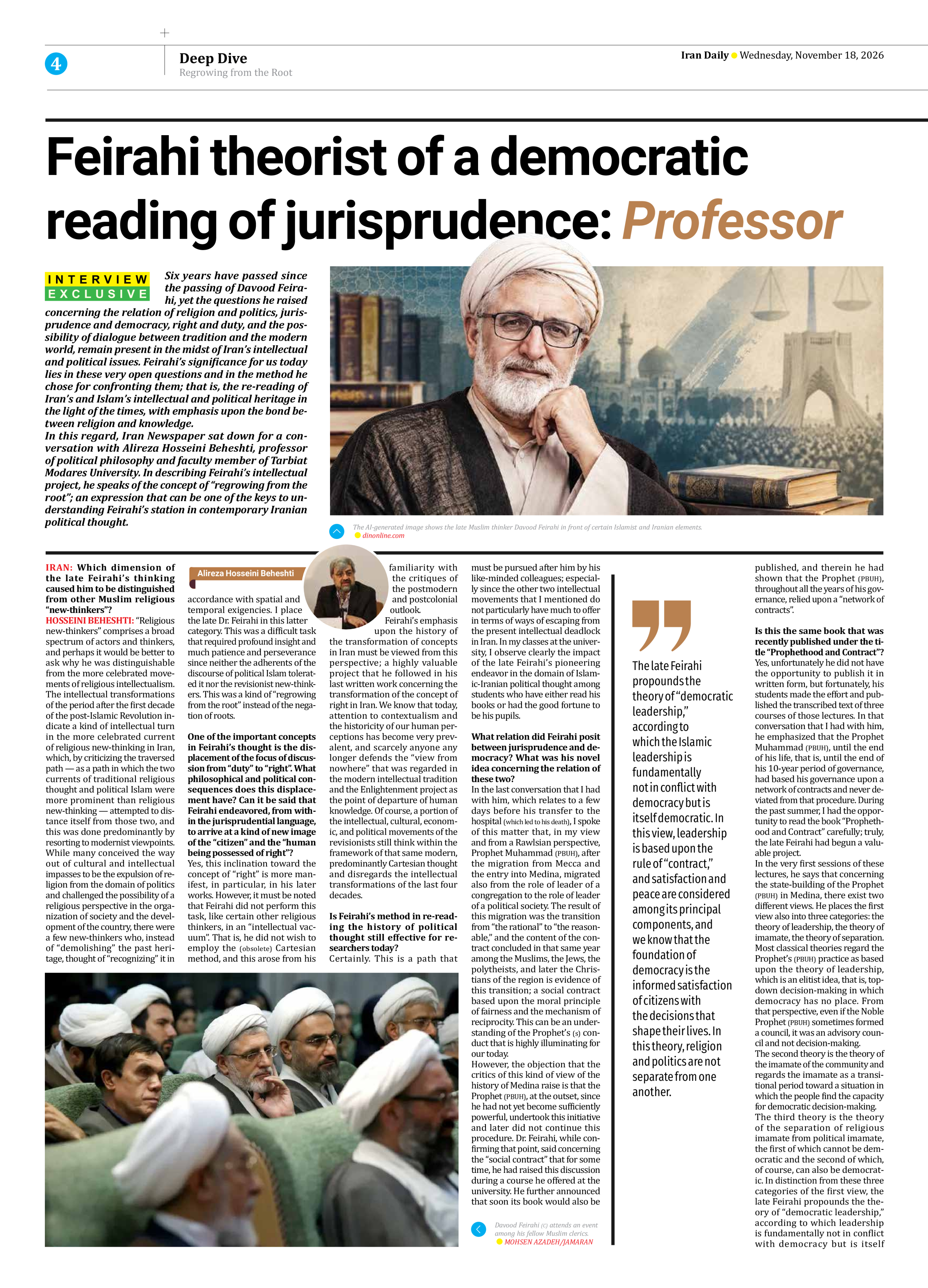


Feirahi theorist of a democratic reading of jurisprudence: Professor
Six years have passed since the passing of Davood Feirahi, yet the questions he raised concerning the relation of religion and politics, jurisprudence and democracy, right and duty, and the possibility of dialogue between tradition and the modern world, remain present in the midst of Iran’s intellectual and political issues. Feirahi’s significance for us today lies in these very open questions and in the method he chose for confronting them; that is, the re-reading of Iran’s and Islam’s intellectual and political heritage in the light of the times, with emphasis upon the bond between religion and knowledge. In this regard, Iran Newspaper sat down for a conversation with Alireza Hosseini Beheshti, professor of political philosophy and faculty member of Tarbiat Modares University. In describing Feirahi’s intellectual project, he speaks of the concept of “regrowing from the root”; an expression that can be one of the keys to understanding Feirahi’s station in contemporary Iranian political thought.
IRAN: Which dimension of the late Feirahi’s thinking caused him to be distinguished from other Muslim religious “new-thinkers”?
HOSSEINI BEHESHTI: “Religious new-thinkers” comprises a broad spectrum of actors and thinkers, and perhaps it would be better to ask why he was distinguishable from the more celebrated movements of religious intellectualism. The intellectual transformations of the period after the first decade of the post-Islamic Revolution indicate a kind of intellectual turn in the more celebrated current of religious new-thinking in Iran, which, by criticizing the traversed path — as a path in which the two currents of traditional religious thought and political Islam were more prominent than religious new-thinking — attempted to distance itself from those two, and this was done predominantly by resorting to modernist viewpoints.
While many conceived the way out of cultural and intellectual impasses to be the expulsion of religion from the domain of politics and challenged the possibility of a religious perspective in the organization of society and the development of the country, there were a few new-thinkers who, instead of “demolishing” the past heritage, thought of “recognizing” it in accordance with spatial and temporal exigencies. I place the late Dr. Feirahi in this latter category. This was a difficult task that required profound insight and much patience and perseverance since neither the adherents of the discourse of political Islam tolerated it nor the revisionist new-thinkers. This was a kind of “regrowing from the root” instead of the negation of roots.
One of the important concepts in Feirahi’s thought is the displacement of the focus of discussion from “duty” to “right”. What philosophical and political consequences does this displacement have? Can it be said that Feirahi endeavored, from within the jurisprudential language, to arrive at a kind of new image of the “citizen” and the “human being possessed of right”?
Yes, this inclination toward the concept of “right” is more manifest, in particular, in his later works. However, it must be noted that Feirahi did not perform this task, like certain other religious thinkers, in an “intellectual vacuum”. That is, he did not wish to employ the (obsolete) Cartesian method, and this arose from his familiarity with the critiques of the postmodern and postcolonial outlook.
Feirahi’s emphasis upon the history of the transformation of concepts in Iran must be viewed from this perspective; a highly valuable project that he followed in his last written work concerning the transformation of the concept of right in Iran. We know that today, attention to contextualism and the historicity of our human perceptions has become very prevalent, and scarcely anyone any longer defends the “view from nowhere” that was regarded in the modern intellectual tradition and the Enlightenment project as the point of departure of human knowledge. Of course, a portion of the intellectual, cultural, economic, and political movements of the revisionists still think within the framework of that same modern, predominantly Cartesian thought and disregards the intellectual transformations of the last four decades.
Is Feirahi’s method in re-reading the history of political thought still effective for researchers today?
Certainly. This is a path that must be pursued after him by his like-minded colleagues; especially since the other two intellectual movements that I mentioned do not particularly have much to offer in terms of ways of escaping from the present intellectual deadlock in Iran. In my classes at the university, I observe clearly the impact of the late Feirahi’s pioneering endeavor in the domain of Islamic-Iranian political thought among students who have either read his books or had the good fortune to be his pupils.
What relation did Feirahi posit between jurisprudence and democracy? What was his novel idea concerning the relation of these two?
In the last conversation that I had with him, which relates to a few days before his transfer to the hospital (which led to his death), I spoke of this matter that, in my view and from a Rawlsian perspective, Prophet Muhammad (PBUH), after the migration from Mecca and the entry into Medina, migrated also from the role of leader of a congregation to the role of leader of a political society. The result of this migration was the transition from “the rational” to “the reasonable,” and the content of the contract concluded in that same year among the Muslims, the Jews, the polytheists, and later the Christians of the region is evidence of this transition; a social contract based upon the moral principle of fairness and the mechanism of reciprocity. This can be an understanding of the Prophet’s (s) conduct that is highly illuminating for our today.
However, the objection that the critics of this kind of view of the history of Medina raise is that the Prophet (PBUH), at the outset, since he had not yet become sufficiently powerful, undertook this initiative and later did not continue this procedure. Dr. Feirahi, while confirming that point, said concerning the “social contract” that for some time, he had raised this discussion during a course he offered at the university. He further announced that soon its book would also be published, and therein he had shown that the Prophet (PBUH), throughout all the years of his governance, relied upon a “network of contracts”.
Is this the same book that was recently published under the title “Prophethood and Contract”?
Yes, unfortunately he did not have the opportunity to publish it in written form, but fortunately, his students made the effort and published the transcribed text of three courses of those lectures. In that conversation that I had with him, he emphasized that the Prophet Muhammad (PBUH), until the end of his life, that is, until the end of his 10-year period of governance, had based his governance upon a network of contracts and never deviated from that procedure. During the past summer, I had the opportunity to read the book “Prophethood and Contract” carefully; truly, the late Feirahi had begun a valuable project.
In the very first sessions of these lectures, he says that concerning the state-building of the Prophet (PBUH) in Medina, there exist two different views. He places the first view also into three categories: the theory of leadership, the theory of imamate, the theory of separation. Most classical theories regard the Prophet’s (PBUH) practice as based upon the theory of leadership, which is an elitist idea, that is, top-down decision-making in which democracy has no place. From that perspective, even if the Noble Prophet (PBUH) sometimes formed a council, it was an advisory council and not decision-making.
The second theory is the theory of the imamate of the community and regards the imamate as a transitional period toward a situation in which the people find the capacity for democratic decision-making.
The third theory is the theory of the separation of religious imamate from political imamate, the first of which cannot be democratic and the second of which, of course, can also be democratic. In distinction from these three categories of the first view, the late Feirahi propounds the theory of “democratic leadership,” according to which leadership is fundamentally not in conflict with democracy but is itself
democratic. In this view, leadership is based upon the rule of “contract,” and satisfaction and peace are considered among its principal components, and we know that the foundation of democracy is the informed satisfaction of citizens with the decisions that shape their lives. In this theory, religion and politics are not separate from one another, but the community is of two kinds: the religious community and the political community. The religious community is based upon equality in faith, and the political community upon order and political commitment despite the different religions and denominations of the citizens.
This is a good path that the late Feirahi opened. I think that if this is conjoined with that very precise separation between “the rational” and “the reasonable,” it would be highly useful for delineating the framework of a governance that, by recognizing equal respect for the different religions and denominations in which citizens believe, can establish a kind of political solidarity based upon the satisfaction of all; this means “unity in plurality”.
This is a project that I began 30 years ago under the title “the coexistence of union and separation” and have authored a trilogy of which two volumes have thus far been published; they explore the separation of “politics based upon rationality,” which is suitable and specific to within cultural communities (religious, philosophical, ethnic, etc.), and “politics based upon reasonableness,” which is suitable and specific to the regulation of relations among different cultural communities living in a single political society. I personally have derived much benefit from the late Feirahi’s intellectual project in explicating my view, and I think many others likewise evaluate it as an auspicious beginning.
Why do you think Feirahi returned to political jurisprudence and placed it at the center of his research?
Political jurisprudence is a part of the heritage of our political thought that we cannot disregard. But we can, and indeed must, subject it to our review, our recognition, and expose it to time-awareness. This is the task that the late Feirahi prepared himself to perform. There are other experts as well who undertake this difficult task. The road is long, but, in my view, bright and illuminating horizons are also observable. On this path, if continuous intellectual dialogue and interaction between religious new-thinkers in the university and the seminary takes shape, it will certainly bring many fruits.
This is the same reconciliation between religion and knowledge that for more than a century has lit a fire under our religion-oriented reformers. The element of religion is one of the wellsprings of the formation of Iranian identity which, alongside Iranian culture, tradition, and modernity, constitutes the four elements that, in the words of Dr. Farhang Rajaee, without the establishment of a balance among them, comprehensive and sustainable development will not be realized.
Some still imagine that the sciences possess only universal aspects and are heedless of the particularity of important aspects of present-day knowledge. Therefore, they think that the shortcut and tried solution is recourse to secular political knowledge. If there were time, I would explain why recourse to secularism does not solve our problem. In Rawls’s expression, secularism is itself a comprehensive and encompassing doctrine that cannot serve as the basis of an overlapping consensus and the social contract arising therefrom. Recent literature in the field of understanding secularism, such as Charles Taylor’s magnificent work, also shows why secularism does not become prevalent among Muslim societies.
In your view, what is Professor Feirahi’s most important legacy for the discipline of political science in Iran?
Dr. Hossein Bashiriyeh, to whom the science of politics in Iran owes a great debt, in recent years and after a revision in his approach, which previously was more firmly based upon political sociology, draws our attention to the “return to political thought”. If we regard political governance as based upon structure and agent, we are necessarily in need of the design of the former and the cultivation of the latter in a manner compatible with the Iranian model of development.
For this purpose, we are in need of knowledge-based public policymaking. Political science is an important foundation for this domain, and the important and principal foundation of political science is “political philosophy”. In political philosophy, for us Iranians, both the recognition of the intellectual achievements of the West and the recognition of our own intellectual roots — whether Iranian or Islamic — are important. Perhaps this is the very thing to which the late Feirahi continually invited us under the title “return to the wellspring.”
May God have mercy upon him, for the wound of losing him is still fresh. We must also remember his devoted wife, who likewise, unfortunately, bade farewell to the mortal realm a short while after him. The bearing of that heavy scientific burden by the late Feirahi would not have been possible without the patient companionship of his wife and family. May their memory be honored.
The interview first appeared in the Persian-language
newspaper Iran.