




Iran played key role in shaping Islamic civilization: Khatami
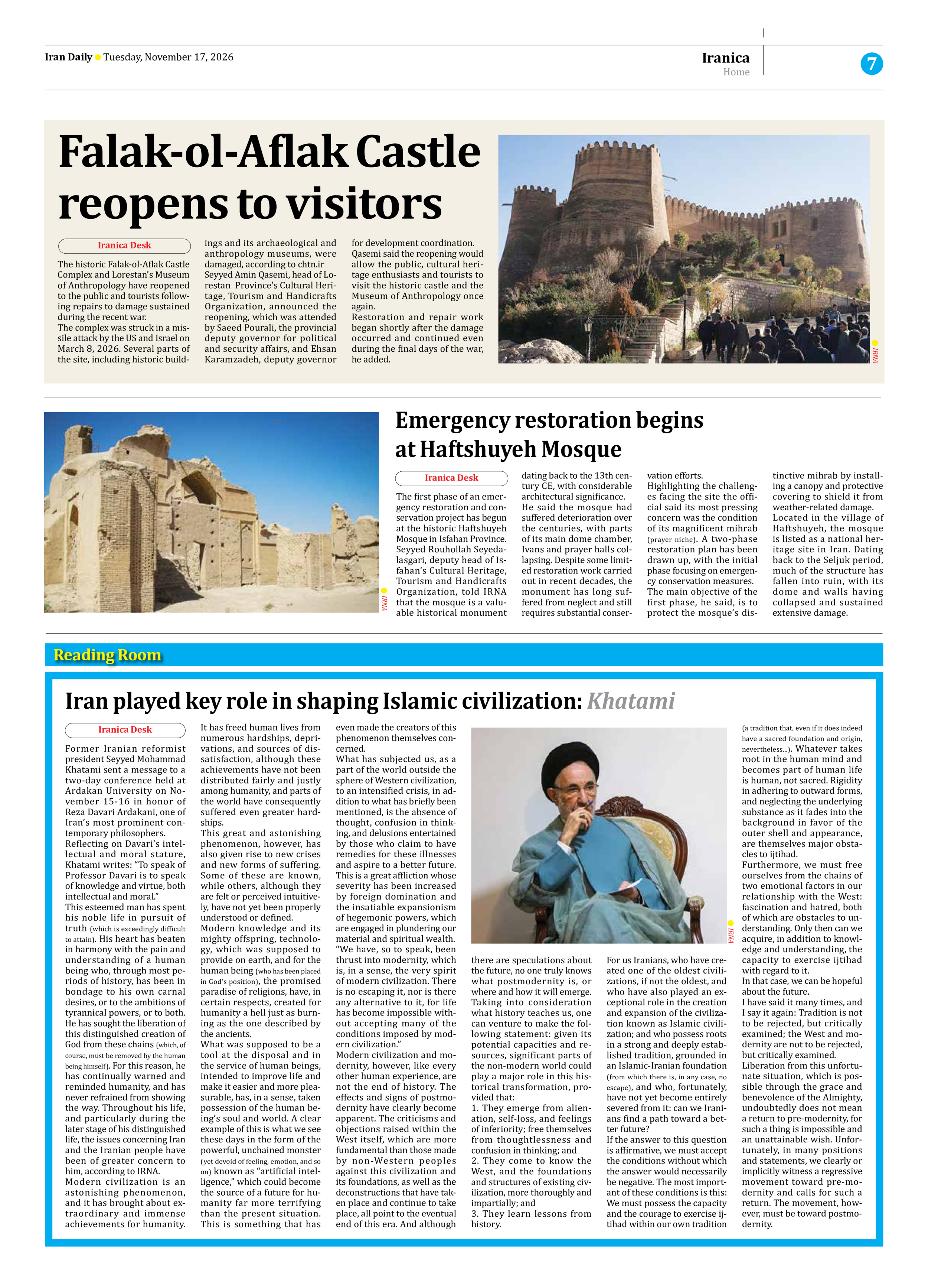
Former Iranian reformist president Seyyed Mohammad Khatami sent a message to a two-day conference held at Ardakan University on November 15-16 in honor of Reza Davari Ardakani, one of Iran’s most prominent contemporary philosophers.
Reflecting on Davari’s intellectual and moral stature, Khatami writes: “To speak of Professor Davari is to speak of knowledge and virtue, both intellectual and moral.”
This esteemed man has spent his noble life in pursuit of truth (which is exceedingly difficult to attain). His heart has beaten in harmony with the pain and understanding of a human being who, through most periods of history, has been in bondage to his own carnal desires, or to the ambitions of tyrannical powers, or to both. He has sought the liberation of this distinguished creation of God from these chains (which, of course, must be removed by the human being himself). For this reason, he has continually warned and reminded humanity, and has never refrained from showing the way. Throughout his life, and particularly during the later stage of his distinguished life, the issues concerning Iran and the Iranian people have been of greater concern to him, according to IRNA.
Modern civilization is an astonishing phenomenon, and it has brought about extraordinary and immense achievements for humanity. It has freed human lives from numerous hardships, deprivations, and sources of dissatisfaction, although these achievements have not been distributed fairly and justly among humanity, and parts of the world have consequently suffered even greater hardships.
This great and astonishing phenomenon, however, has also given rise to new crises and new forms of suffering. Some of these are known, while others, although they are felt or perceived intuitively, have not yet been properly understood or defined.
Modern knowledge and its mighty offspring, technology, which was supposed to provide on earth, and for the human being (who has been placed in God’s position), the promised paradise of religions, have, in certain respects, created for humanity a hell just as burning as the one described by the ancients.
What was supposed to be a tool at the disposal and in the service of human beings, intended to improve life and make it easier and more pleasurable, has, in a sense, taken possession of the human being’s soul and world. A clear example of this is what we see these days in the form of the powerful, unchained monster (yet devoid of feeling, emotion, and so on) known as “artificial intelligence,” which could become the source of a future for humanity far more terrifying than the present situation. This is something that has even made the creators of this phenomenon themselves concerned.
What has subjected us, as a part of the world outside the sphere of Western civilization, to an intensified crisis, in addition to what has briefly been mentioned, is the absence of thought, confusion in thinking, and delusions entertained by those who claim to have remedies for these illnesses and aspire to a better future. This is a great affliction whose severity has been increased by foreign domination and the insatiable expansionism of hegemonic powers, which are engaged in plundering our material and spiritual wealth.
“We have, so to speak, been thrust into modernity, which is, in a sense, the very spirit of modern civilization. There is no escaping it, nor is there any alternative to it, for life has become impossible without accepting many of the conditions imposed by modern civilization.”
Modern civilization and modernity, however, like every other human experience, are not the end of history. The effects and signs of postmodernity have clearly become apparent. The criticisms and objections raised within the West itself, which are more fundamental than those made by non-Western peoples against this civilization and its foundations, as well as the deconstructions that have taken place and continue to take place, all point to the eventual end of this era. And although there are speculations about the future, no one truly knows what postmodernity is, or where and how it will emerge.
Taking into consideration what history teaches us, one can venture to make the following statement: given its potential capacities and resources, significant parts of the non-modern world could play a major role in this historical transformation, provided that:
1. They emerge from alienation, self-loss, and feelings of inferiority; free themselves from thoughtlessness and confusion in thinking; and
2. They come to know the West, and the foundations and structures of existing civilization, more thoroughly and impartially; and
3. They learn lessons from history.
For us Iranians, who have created one of the oldest civilizations, if not the oldest, and who have also played an exceptional role in the creation and expansion of the civilization known as Islamic civilization; and who possess roots in a strong and deeply established tradition, grounded in an Islamic-Iranian foundation (from which there is, in any case, no escape), and who, fortunately, have not yet become entirely severed from it: can we Iranians find a path toward a better future?
If the answer to this question is affirmative, we must accept the conditions without which the answer would necessarily be negative. The most important of these conditions is this:
We must possess the capacity and the courage to exercise ijtihad within our own tradition (a tradition that, even if it does indeed have a sacred foundation and origin, nevertheless...). Whatever takes root in the human mind and becomes part of human life is human, not sacred. Rigidity in adhering to outward forms, and neglecting the underlying substance as it fades into the background in favor of the outer shell and appearance, are themselves major obstacles to ijtihad.
Furthermore, we must free ourselves from the chains of two emotional factors in our relationship with the West: fascination and hatred, both of which are obstacles to understanding. Only then can we acquire, in addition to knowledge and understanding, the capacity to exercise ijtihad with regard to it.
In that case, we can be hopeful about the future.
I have said it many times, and I say it again: Tradition is not to be rejected, but critically examined; the West and modernity are not to be rejected, but critically examined.
Liberation from this unfortunate situation, which is possible through the grace and benevolence of the Almighty, undoubtedly does not mean a return to pre-modernity, for such a thing is impossible and an unattainable wish. Unfortunately, in many positions and statements, we clearly or implicitly witness a regressive movement toward pre-modernity and calls for such a return. The movement, however, must be toward postmodernity.