




2026 Summer Youth Olympics:
Dakar delivers damning verdict on youth development in Iranian sport
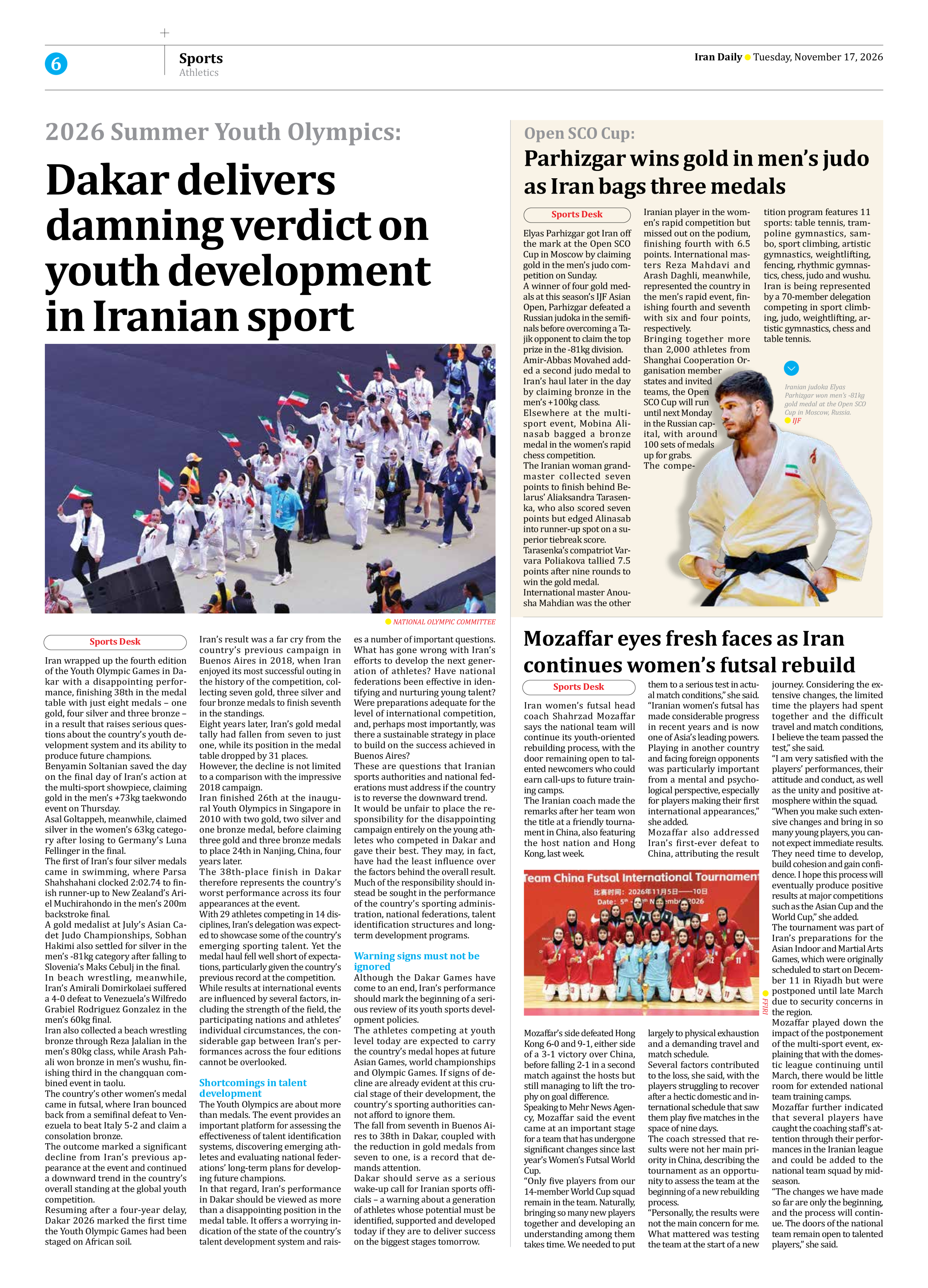
Iran wrapped up the fourth edition of the Youth Olympic Games in Dakar with a disappointing performance, finishing 38th in the medal table with just eight medals – one gold, four silver and three bronze – in a result that raises serious questions about the country’s youth development system and its ability to produce future champions.
Benyamin Soltanian saved the day on the final day of Iran’s action at the multi-sport showpiece, claiming gold in the men’s +73kg taekwondo event on Thursday.
Asal Goltappeh, meanwhile, claimed silver in the women’s 63kg category after losing to Germany’s Luna Fellinger in the final.
The first of Iran’s four silver medals came in swimming, where Parsa Shahshahani clocked 2:02.74 to finish runner-up to New Zealand’s Ariel Muchirahondo in the men’s 200m backstroke final.
A gold medalist at July’s Asian Cadet Judo Championships, Sobhan Hakimi also settled for silver in the men’s -81kg category after falling to Slovenia’s Maks Cebulj in the final.
In beach wrestling, meanwhile, Iran’s Amirali Domirkolaei suffered a 4-0 defeat to Venezuela’s Wilfredo Grabiel Rodriguez Gonzalez in the men’s 60kg final.
Iran also collected a beach wrestling bronze through Reza Jalalian in the men’s 80kg class, while Arash Pahali won bronze in men’s wushu, finishing third in the changquan combined event in taolu.
The country’s other women’s medal came in futsal, where Iran bounced back from a semifinal defeat to Venezuela to beat Italy 5-2 and claim a consolation bronze.
The outcome marked a significant decline from Iran’s previous appearance at the event and continued a downward trend in the country’s overall standing at the global youth competition.
Resuming after a four-year delay, Dakar 2026 marked the first time the Youth Olympic Games had been staged on African soil.
Iran’s result was a far cry from the country’s previous campaign in Buenos Aires in 2018, when Iran enjoyed its most successful outing in the history of the competition, collecting seven gold, three silver and four bronze medals to finish seventh in the standings.
Eight years later, Iran’s gold medal tally had fallen from seven to just one, while its position in the medal table dropped by 31 places.
However, the decline is not limited to a comparison with the impressive 2018 campaign.
Iran finished 26th at the inaugural Youth Olympics in Singapore in 2010 with two gold, two silver and one bronze medal, before claiming three gold and three bronze medals to place 24th in Nanjing, China, four years later.
The 38th-place finish in Dakar therefore represents the country’s worst performance across its four appearances at the event.
With 29 athletes competing in 14 disciplines, Iran’s delegation was expected to showcase some of the country’s emerging sporting talent. Yet the medal haul fell well short of expectations, particularly given the country’s previous record at the competition.
While results at international events are influenced by several factors, including the strength of the field, the participating nations and athletes’ individual circumstances, the considerable gap between Iran’s performances across the four editions cannot be overlooked.
Shortcomings in talent development
The Youth Olympics are about more than medals. The event provides an important platform for assessing the effectiveness of talent identification systems, discovering emerging athletes and evaluating national federations’ long-term plans for developing future champions.
In that regard, Iran’s performance in Dakar should be viewed as more than a disappointing position in the medal table. It offers a worrying indication of the state of the country’s talent development system and raises a number of important questions.
What has gone wrong with Iran’s efforts to develop the next generation of athletes? Have national federations been effective in identifying and nurturing young talent? Were preparations adequate for the level of international competition, and, perhaps most importantly, was there a sustainable strategy in place to build on the success achieved in Buenos Aires?
These are questions that Iranian sports authorities and national federations must address if the country is to reverse the downward trend.
It would be unfair to place the responsibility for the disappointing campaign entirely on the young athletes who competed in Dakar and gave their best. They may, in fact, have had the least influence over the factors behind the overall result.
Much of the responsibility should instead be sought in the performance of the country’s sporting administration, national federations, talent identification structures and long-term development programs.
Warning signs must not be ignored
Although the Dakar Games have come to an end, Iran’s performance should mark the beginning of a serious review of its youth sports development policies.
The athletes competing at youth level today are expected to carry the country’s medal hopes at future Asian Games, world championships and Olympic Games. If signs of decline are already evident at this crucial stage of their development, the country’s sporting authorities cannot afford to ignore them.
The fall from seventh in Buenos Aires to 38th in Dakar, coupled with the reduction in gold medals from seven to one, is a record that demands attention.
Dakar should serve as a serious wake-up call for Iranian sports officials – a warning about a generation of athletes whose potential must be identified, supported and developed today if they are to deliver success on the biggest stages tomorrow.