


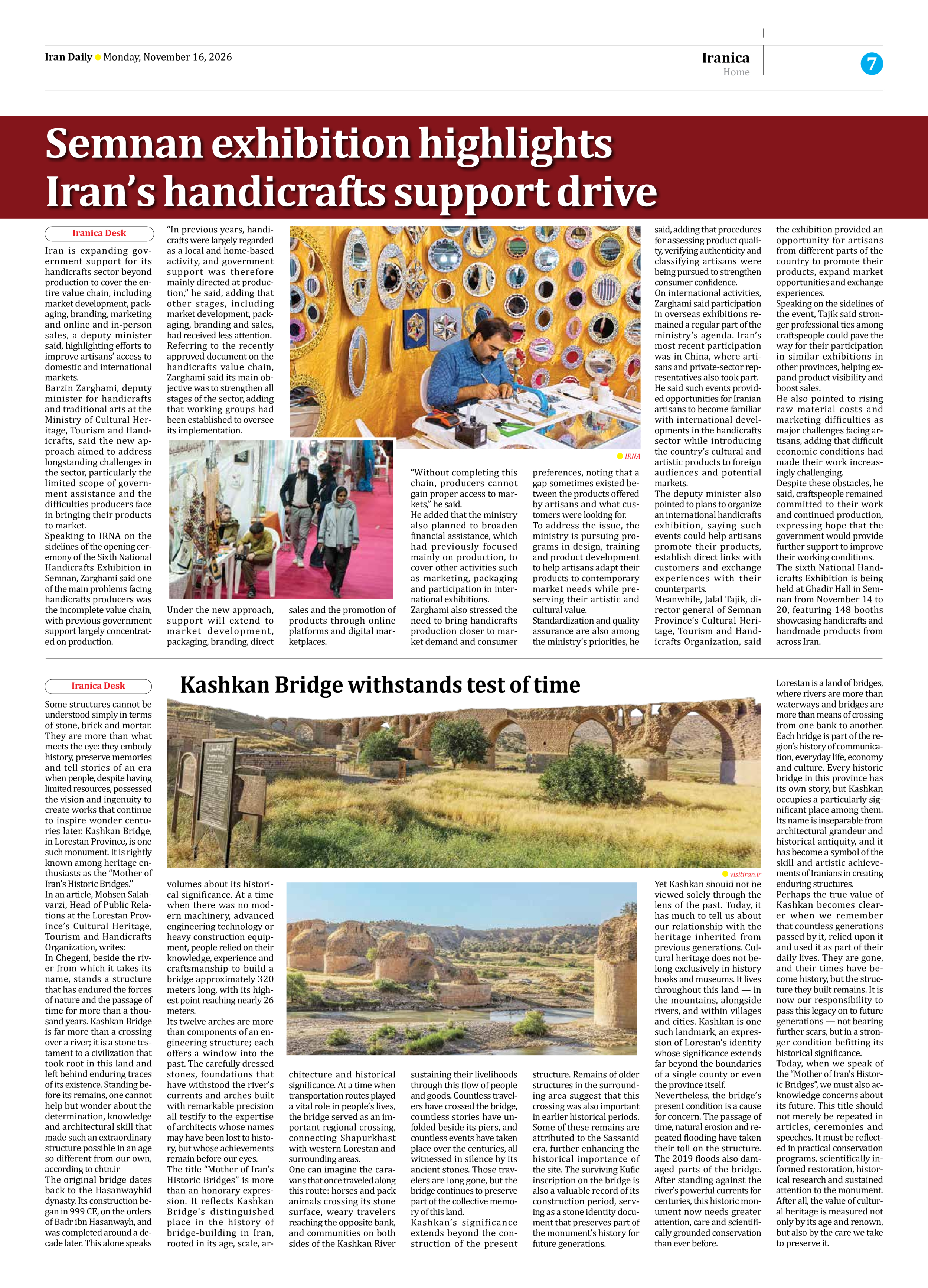


Kashkan Bridge withstands test of time
Some structures cannot be understood simply in terms of stone, brick and mortar. They are more than what meets the eye: they embody history, preserve memories and tell stories of an era when people, despite having limited resources, possessed the vision and ingenuity to create works that continue to inspire wonder centuries later. Kashkan Bridge, in Lorestan Province, is one such monument. It is rightly known among heritage enthusiasts as the “Mother of Iran’s Historic Bridges.”
In an article, Mohsen Salahvarzi, Head of Public Relations at the Lorestan Province’s Cultural Heritage, Tourism and Handicrafts Organization, writes:
In Chegeni, beside the river from which it takes its name, stands a structure that has endured the forces of nature and the passage of time for more than a thousand years. Kashkan Bridge is far more than a crossing over a river; it is a stone testament to a civilization that took root in this land and left behind enduring traces of its existence. Standing before its remains, one cannot help but wonder about the determination, knowledge and architectural skill that made such an extraordinary structure possible in an age so different from our own, according to chtn.ir
The original bridge dates back to the Hasanwayhid dynasty. Its construction began in 999 CE, on the orders of Badr ibn Hasanwayh, and was completed around a decade later. This alone speaks volumes about its historical significance. At a time when there was no modern machinery, advanced engineering technology or heavy construction equipment, people relied on their knowledge, experience and craftsmanship to build a bridge approximately 320 meters long, with its highest point reaching nearly 26 meters.
Its twelve arches are more than components of an engineering structure; each offers a window into the past. The carefully dressed stones, foundations that have withstood the river’s currents and arches built with remarkable precision all testify to the expertise of architects whose names may have been lost to history, but whose achievements remain before our eyes.
The title “Mother of Iran’s Historic Bridges” is more than an honorary expression. It reflects Kashkan Bridge’s distinguished place in the history of bridge-building in Iran, rooted in its age, scale, architecture and historical significance. At a time when transportation routes played a vital role in people’s lives, the bridge served as an important regional crossing, connecting Shapurkhast with western Lorestan and surrounding areas.
One can imagine the caravans that once traveled along this route: horses and pack animals crossing its stone surface, weary travelers reaching the opposite bank, and communities on both sides of the Kashkan River sustaining their livelihoods through this flow of people and goods. Countless travelers have crossed the bridge, countless stories have unfolded beside its piers, and countless events have taken place over the centuries, all witnessed in silence by its ancient stones. Those travelers are long gone, but the bridge continues to preserve part of the collective memory of this land.
Kashkan’s significance extends beyond the construction of the present structure. Remains of older structures in the surrounding area suggest that this crossing was also important in earlier historical periods. Some of these remains are attributed to the Sassanid era, further enhancing the historical importance of the site. The surviving Kufic inscription on the bridge is also a valuable record of its construction period, serving as a stone identity document that preserves part of the monument’s history for future generations.
Yet Kashkan should not be viewed solely through the lens of the past. Today, it has much to tell us about our relationship with the heritage inherited from previous generations. Cultural heritage does not belong exclusively in history books and museums. It lives throughout this land — in the mountains, alongside rivers, and within villages and cities. Kashkan is one such landmark, an expression of Lorestan’s identity whose significance extends far beyond the boundaries of a single county or even the province itself.
Nevertheless, the bridge’s present condition is a cause for concern. The passage of time, natural erosion and repeated flooding have taken their toll on the structure. The 2019 floods also damaged parts of the bridge. After standing against the river’s powerful currents for centuries, this historic monument now needs greater attention, care and scientifically grounded conservation than ever before.
Lorestan is a land of bridges, where rivers are more than waterways and bridges are more than means of crossing from one bank to another. Each bridge is part of the region’s history of communication, everyday life, economy and culture. Every historic bridge in this province has its own story, but Kashkan occupies a particularly significant place among them. Its name is inseparable from architectural grandeur and historical antiquity, and it has become a symbol of the skill and artistic achievements of Iranians in creating enduring structures.
Perhaps the true value of Kashkan becomes clearer when we remember that countless generations passed by it, relied upon it and used it as part of their daily lives. They are gone, and their times have become history, but the structure they built remains. It is now our responsibility to pass this legacy on to future generations — not bearing further scars, but in a stronger condition befitting its historical significance.
Today, when we speak of the “Mother of Iran’s Historic Bridges”, we must also acknowledge concerns about its future. This title should not merely be repeated in articles, ceremonies and speeches. It must be reflected in practical conservation programs, scientifically informed restoration, historical research and sustained attention to the monument. After all, the value of cultural heritage is measured not only by its age and renown, but also by the care we take to preserve it.