




Containing Iran in Britain’s 2025 National Security Strategy
By Mojtaba Jamei
Professor
By Mohammad Hadi
Doctoral candidate at the Supreme National Defense University
The British National Security Strategy document was published in June 2025, in circumstances wherein, from its perspective, the international order contends with fundamental uncertainty. This document, comprising 55 pages, is considered the first comprehensive and full-fledged review of Britain’s national security strategy since 2010. Although, subsequent to the aforementioned document, numerous strategic documents — including the “Integrated Review 2021” and its “Refresh 2023” — have been published, they were presented predominantly in consolidated form or as partial updates, such as the review of the defense strategic section, and did not possess an independent and comprehensive approach comparable to the 2025 document. In this respect, it may be stated that the temporal interval between this document and Britain’s previous comprehensive document is approximately 15 years, and its most recent update approximately two years.
This document is the first holistic document drafted under the auspices of the previous Labour government, with a transformational approach to defense expenditures. Although the principal axis of the document is confrontation with Russia and competition with China, in this writing, an attempt has been made to scrutinize and examine the document’s approach toward the Middle East and Iran.
The Middle East appears in this document as a secondary but important focus, with three key functions: first, the principal source of hybrid threats against British soil, including terrorism, illegal migration, and hostile activities; second, the theater of military cooperation between Britain’s adversaries, particularly the Iran-Russia axis; and third, a vital region for the provision of energy security, freedom of navigation, and the preservation of British military bases.
What is perceptible from the text of the document is the manner of directly linking the concerns of the British working class with the crises of the Middle East; in such wise that wars such as the one between Israel and Iran or the Red Sea crisis elevate the costs of living in Britain, increase the price of energy, and disrupt supply chains. In the initial section of the document, three fundamental lessons are enumerated. First, the linking of foreign policy with domestic livelihood, which considers the increase in costs arising from Middle Eastern instability as directly impactful upon the lives of the British people, and in this respect, it appears that this proposition is justificatory of London’s active entry into regional equations in the forthcoming future. Second, the continuity of collective security under NATO leadership, according to which Britain considers itself committed to the defense of NATO’s southern flank, including the Mediterranean sphere and the Middle East, and for this reason, has announced the historic commitment to allocate 2.5% of gross domestic product to defense affairs until 2027. Third, national focus, according to which the challenges ahead demand nothing less than national unity, and Britain, for confronting hybrid threats including those originating from the Middle East, requires the focus of all pillars of society.
Also, in the initial section of this doctrine, emphasis is placed upon this key proposition that “economic security is national security,” and defense is mentioned as the engine of the renewal of the social contract; an approach that is clearly reflected in Britain’s new investments in regional military bases such as Diego Garcia, Cyprus, Bahrain, and Oman, in order to increase its deterrence capacity against Iran’s missile and drone threats.
But the most explicit and decisive section related to the Middle East in this document is its security approach toward the Islamic Republic of Iran, which, in comparison with previous documents, possesses a far more operational tone. Based on the provisions of the document, Britain’s approach toward Iran is enumerable along several fundamental axes.
In the first axis, namely direct hostile activities on British soil, it claims Iran, alongside Russia, to be one of the countries that direct hostile activities including assassination, intimidation, espionage, and sabotage on British territory, and the document’s emphasis upon “silencing the voices of critics abroad” indicates that London considers the Islamic Republic of Iran a cross-border threat to its nationals and institutions.
In the second axis, namely the strategic cooperation of Iran and Russia, the document, with reference to the Ukraine war, mentions the alleged transfer of Iran’s missiles and drones to Russia and classifies this action among the strategic cooperation of adversaries for the weakening of Euro-Atlantic security; a section that well demonstrates the linkage between the two fronts of confrontation, namely Europe and the Middle East.
In the third axis, namely direct threat and regional escalation, the document refers to the direct military conflict of Israel and Iran and considers Iran’s destabilizing actions a threat to Britain’s interests domestically and abroad. It also refers to Tehran’s role in threatening freedom of navigation in the Red Sea through backed groups such as the Ansarullah (Houthis), which directly targets Britain’s economic interests.
In the fourth axis, namely operational instruments of confrontation, Britain has placed Iran at the “advanced level” of the Foreign Influence Registration Scheme, in such wise that any person or institution acting as Iran’s proxy in Britain is obligated to declare its activities, and otherwise will face legal prosecution and imprisonment. The document also emphasizes the use of sanctions to disintegrate criminal networks and facilitating agents aligned with Iran, and intensifies intelligence cooperation with its own allies (within the framework of the Five Eyes agreement) in this regard.
In summary, it may be stated that the approach of the aforementioned document toward Iran is a threat-perceiving, punitive approach accompanied by preemptive operational measures in the arenas of intelligence, sanctions, border security, and judiciary. Accordingly, it may be concluded that Britain has passed beyond the policy of limited engagement accompanied by criticism of previous years and has advanced toward pragmatism and direct confrontation with the Islamic Republic of Iran.
The National Security Strategy document, with the acceptance of the reality of multipolarization, has also designed distinct regional strategies that are important in their own place. In the Euro-Atlantic sphere, which is considered the first priority, although the principal axis is Russia, the document clearly speaks of the necessity of coordination with NATO for confronting hybrid threats from the south, including Iran, and Britain is committed to strengthening NATO’s southern flank through cooperation with Italy and Turkey. But in the Middle East and North Africa, which is considered a secondary but vital focus, Britain’s strategy is pursued at three levels. At the bilateral level, Britain, with the countries of the Persian Gulf Cooperation Council, particularly Saudi Arabia, the UAE, and Oman, seeks the deepening of trade, security, and investment relations, especially the development of defense industries and the increase of arms exports, for the creation of regional influence, and refers to these countries as actors sharing “a similar interest in shaping international norms to mitigate and manage the effects of great power competition”.
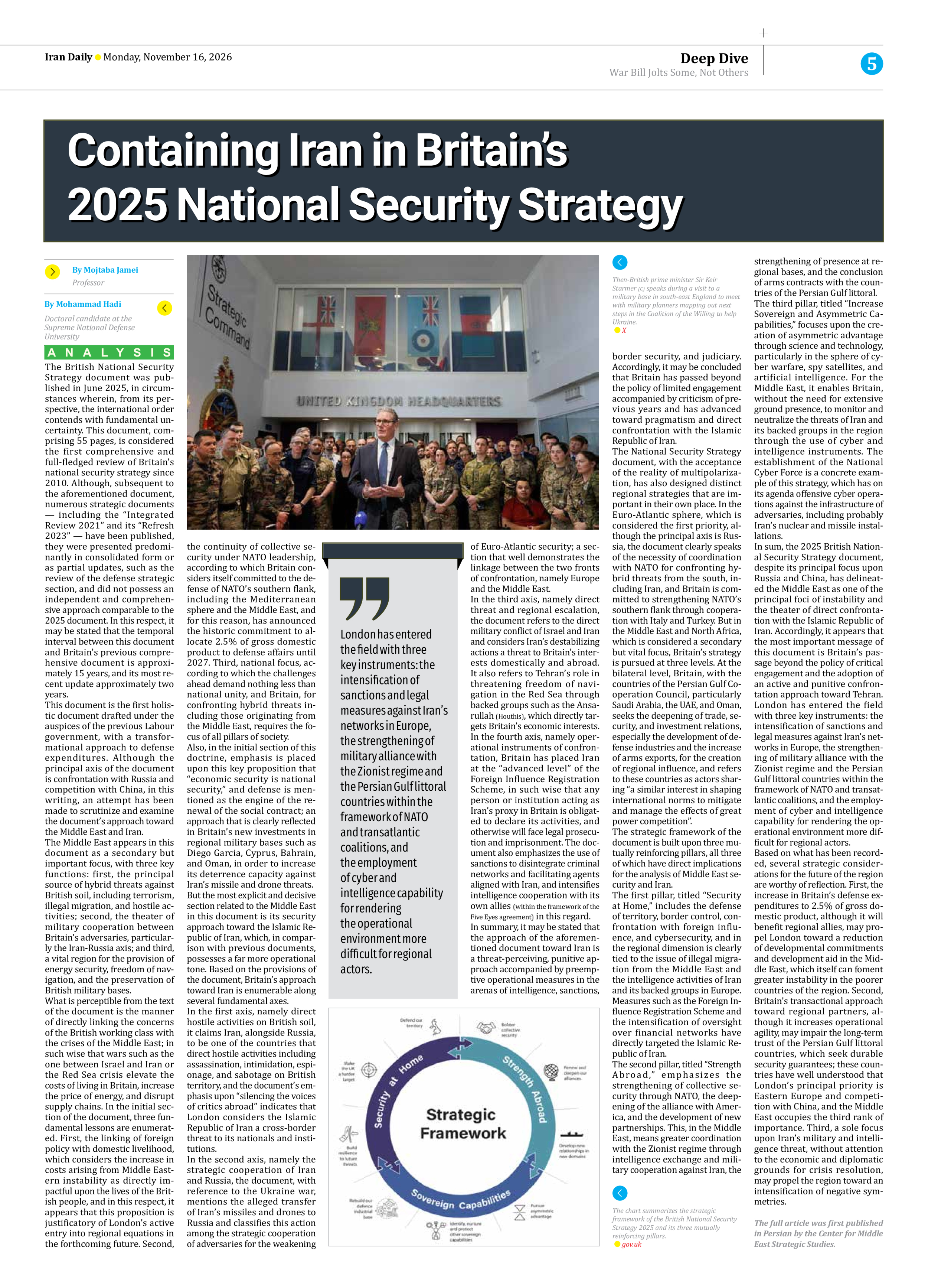
The strategic framework of the document is built upon three mutually reinforcing pillars, all three of which have direct implications for the analysis of Middle East security and Iran.
The first pillar, titled “Security at Home,” includes the defense of territory, border control, confrontation with foreign influence, and cybersecurity, and in the regional dimension is clearly tied to the issue of illegal migration from the Middle East and the intelligence activities of Iran and its backed groups in Europe. Measures such as the Foreign Influence Registration Scheme and the intensification of oversight over financial networks have directly targeted the Islamic Republic of Iran.
The second pillar, titled “Strength Abroad,” emphasizes the strengthening of collective security through NATO, the deepening of the alliance with America, and the development of new partnerships. This, in the Middle East, means greater coordination with the Zionist regime through intelligence exchange and military cooperation against Iran, the strengthening of presence at regional bases, and the conclusion of arms contracts with the countries of the Persian Gulf littoral.
The third pillar, titled “Increase Sovereign and Asymmetric Capabilities,” focuses upon the creation of asymmetric advantage through science and technology, particularly in the sphere of cyber warfare, spy satellites, and artificial intelligence. For the Middle East, it enables Britain, without the need for extensive ground presence, to monitor and neutralize the threats of Iran and its backed groups in the region through the use of cyber and intelligence instruments. The establishment of the National Cyber Force is a concrete example of this strategy, which has on its agenda offensive cyber operations against the infrastructure of adversaries, including probably Iran’s nuclear and missile installations.
In sum, the 2025 British National Security Strategy document, despite its principal focus upon Russia and China, has delineated the Middle East as one of the principal foci of instability and the theater of direct confrontation with the Islamic Republic of Iran. Accordingly, it appears that the most important message of this document is Britain’s passage beyond the policy of critical engagement and the adoption of an active and punitive confrontation approach toward Tehran. London has entered the field with three key instruments: the intensification of sanctions and legal measures against Iran’s networks in Europe, the strengthening of military alliance with the Zionist regime and the Persian Gulf littoral countries within the framework of NATO and transatlantic coalitions, and the employment of cyber and intelligence capability for rendering the operational environment more difficult for regional actors.
Based on what has been recorded, several strategic considerations for the future of the region are worthy of reflection. First, the increase in Britain’s defense expenditures to 2.5% of gross domestic product, although it will benefit regional allies, may propel London toward a reduction of developmental commitments and development aid in the Middle East, which itself can foment greater instability in the poorer countries of the region. Second, Britain’s transactional approach toward regional partners, although it increases operational agility, may impair the long-term trust of the Persian Gulf littoral countries, which seek durable security guarantees; these countries have well understood that London’s principal priority is Eastern Europe and competition with China, and the Middle East occupies the third rank of importance. Third, a sole focus upon Iran’s military and intelligence threat, without attention to the economic and diplomatic grounds for crisis resolution, may propel the region toward an intensification of negative symmetries.
The full article was first published in Persian by the Center for Middle East Strategic Studies.