


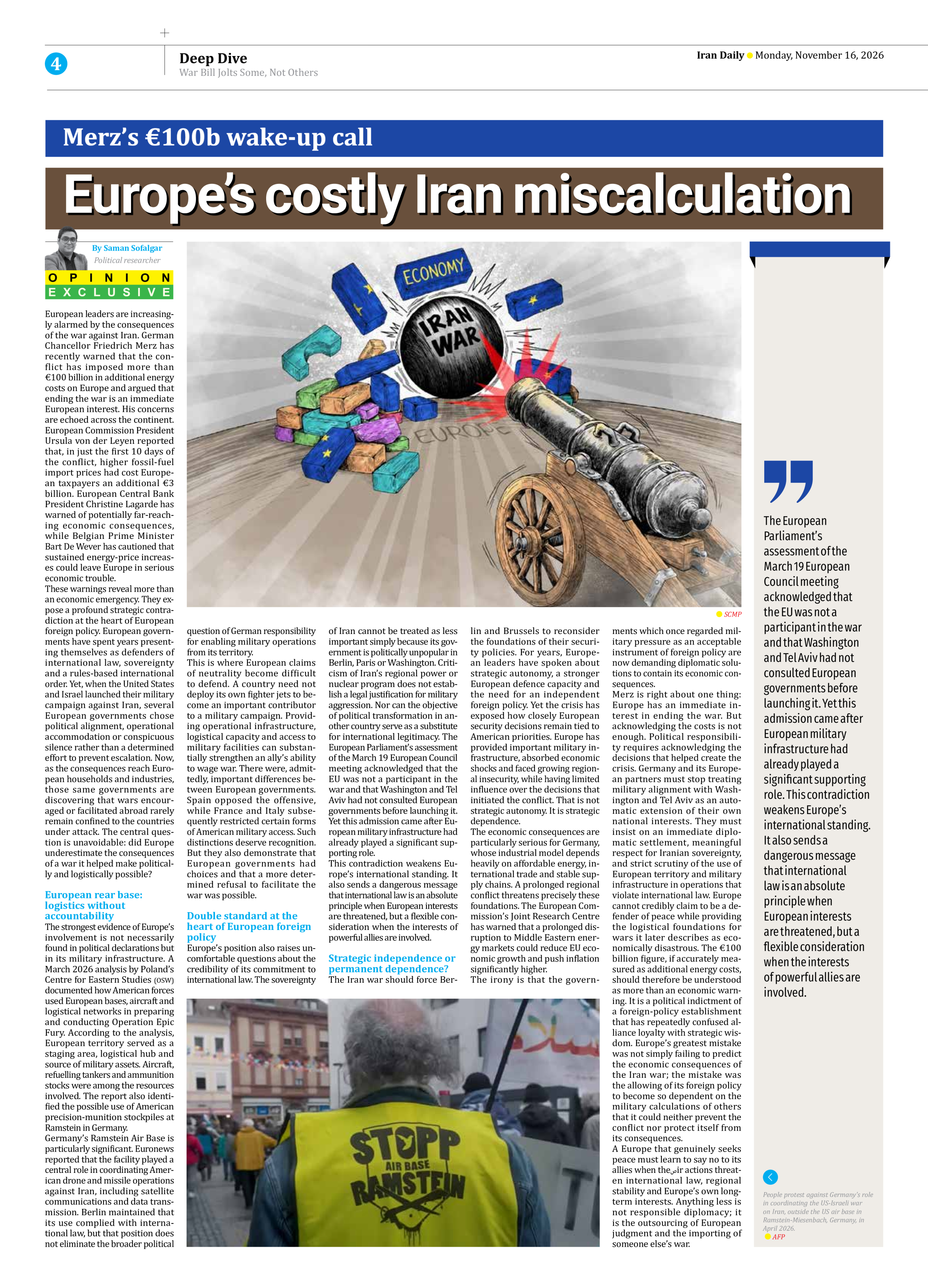


Merz’s €100b wake-up call
Europe’s costly Iran miscalculation
Political researcher
European leaders are increasingly alarmed by the consequences of the war against Iran. German Chancellor Friedrich Merz has recently warned that the conflict has imposed more than €100 billion in additional energy costs on Europe and argued that ending the war is an immediate European interest. His concerns are echoed across the continent. European Commission President Ursula von der Leyen reported that, in just the first 10 days of the conflict, higher fossil-fuel import prices had cost European taxpayers an additional €3 billion. European Central Bank President Christine Lagarde has warned of potentially far-reaching economic consequences, while Belgian Prime Minister Bart De Wever has cautioned that sustained energy-price increases could leave Europe in serious economic trouble.
These warnings reveal more than an economic emergency. They expose a profound strategic contradiction at the heart of European foreign policy. European governments have spent years presenting themselves as defenders of international law, sovereignty and a rules-based international order. Yet, when the United States and Israel launched their military campaign against Iran, several European governments chose political alignment, operational accommodation or conspicuous silence rather than a determined effort to prevent escalation. Now, as the consequences reach European households and industries, those same governments are discovering that wars encouraged or facilitated abroad rarely remain confined to the countries under attack. The central question is unavoidable: did Europe underestimate the consequences of a war it helped make politically and logistically possible?
European rear base: logistics without accountability
The strongest evidence of Europe’s involvement is not necessarily found in political declarations but in its military infrastructure. A March 2026 analysis by Poland’s Centre for Eastern Studies (OSW) documented how American forces used European bases, aircraft and logistical networks in preparing and conducting Operation Epic Fury. According to the analysis, European territory served as a staging area, logistical hub and source of military assets. Aircraft, refuelling tankers and ammunition stocks were among the resources involved. The report also identified the possible use of American precision-munition stockpiles at Ramstein in Germany.
Germany’s Ramstein Air Base is particularly significant. Euronews reported that the facility played a central role in coordinating American drone and missile operations against Iran, including satellite communications and data transmission. Berlin maintained that its use complied with international law, but that position does not eliminate the broader political question of German responsibility for enabling military operations from its territory.
This is where European claims of neutrality become difficult to defend. A country need not deploy its own fighter jets to become an important contributor to a military campaign. Providing operational infrastructure, logistical capacity and access to military facilities can substantially strengthen an ally’s ability to wage war. There were, admittedly, important differences between European governments. Spain opposed the offensive, while France and Italy subsequently restricted certain forms of American military access. Such distinctions deserve recognition. But they also demonstrate that European governments had choices and that a more determined refusal to facilitate the war was possible.
Double standard at the heart of European foreign policy
Europe’s position also raises uncomfortable questions about the credibility of its commitment to international law. The sovereignty of Iran cannot be treated as less important simply because its government is politically unpopular in Berlin, Paris or Washington. Criticism of Iran’s regional power or nuclear program does not establish a legal justification for military aggression. Nor can the objective of political transformation in another country serve as a substitute for international legitimacy. The European Parliament’s assessment of the March 19 European Council meeting acknowledged that the EU was not a participant in the war and that Washington and Tel Aviv had not consulted European governments before launching it. Yet this admission came after European military infrastructure had already played a significant supporting role.
This contradiction weakens Europe’s international standing. It also sends a dangerous message that international law is an absolute principle when European interests are threatened, but a flexible consideration when the interests of powerful allies are involved.
Strategic independence or permanent dependence?
The Iran war should force Berlin and Brussels to reconsider the foundations of their security policies. For years, European leaders have spoken about strategic autonomy, a stronger European defence capacity and the need for an independent foreign policy. Yet the crisis has exposed how closely European security decisions remain tied to American priorities. Europe has provided important military infrastructure, absorbed economic shocks and faced growing regional insecurity, while having limited influence over the decisions that initiated the conflict. That is not strategic autonomy. It is strategic dependence.
The economic consequences are particularly serious for Germany, whose industrial model depends heavily on affordable energy, international trade and stable supply chains. A prolonged regional conflict threatens precisely these foundations. The European Commission’s Joint Research Centre has warned that a prolonged disruption to Middle Eastern energy markets could reduce EU economic growth and push inflation significantly higher.
The irony is that the governments which once regarded military pressure as an acceptable instrument of foreign policy are now demanding diplomatic solutions to contain its economic consequences.
Merz is right about one thing: Europe has an immediate interest in ending the war. But acknowledging the costs is not enough. Political responsibility requires acknowledging the decisions that helped create the crisis. Germany and its European partners must stop treating military alignment with Washington and Tel Aviv as an automatic extension of their own national interests. They must insist on an immediate diplomatic settlement, meaningful respect for Iranian sovereignty, and strict scrutiny of the use of European territory and military infrastructure in operations that violate international law. Europe cannot credibly claim to be a defender of peace while providing the logistical foundations for wars it later describes as economically disastrous. The €100 billion figure, if accurately measured as additional energy costs, should therefore be understood as more than an economic warning. It is a political indictment of a foreign-policy establishment that has repeatedly confused alliance loyalty with strategic wisdom. Europe’s greatest mistake was not simply failing to predict the economic consequences of the Iran war; the mistake was the allowing of its foreign policy to become so dependent on the military calculations of others that it could neither prevent the conflict nor protect itself from its consequences.
A Europe that genuinely seeks peace must learn to say no to its allies when theصir actions threaten international law, regional stability and Europe’s own long-term interests. Anything less is not responsible diplomacy; it is the outsourcing of European judgment and the importing of someone else’s war.