


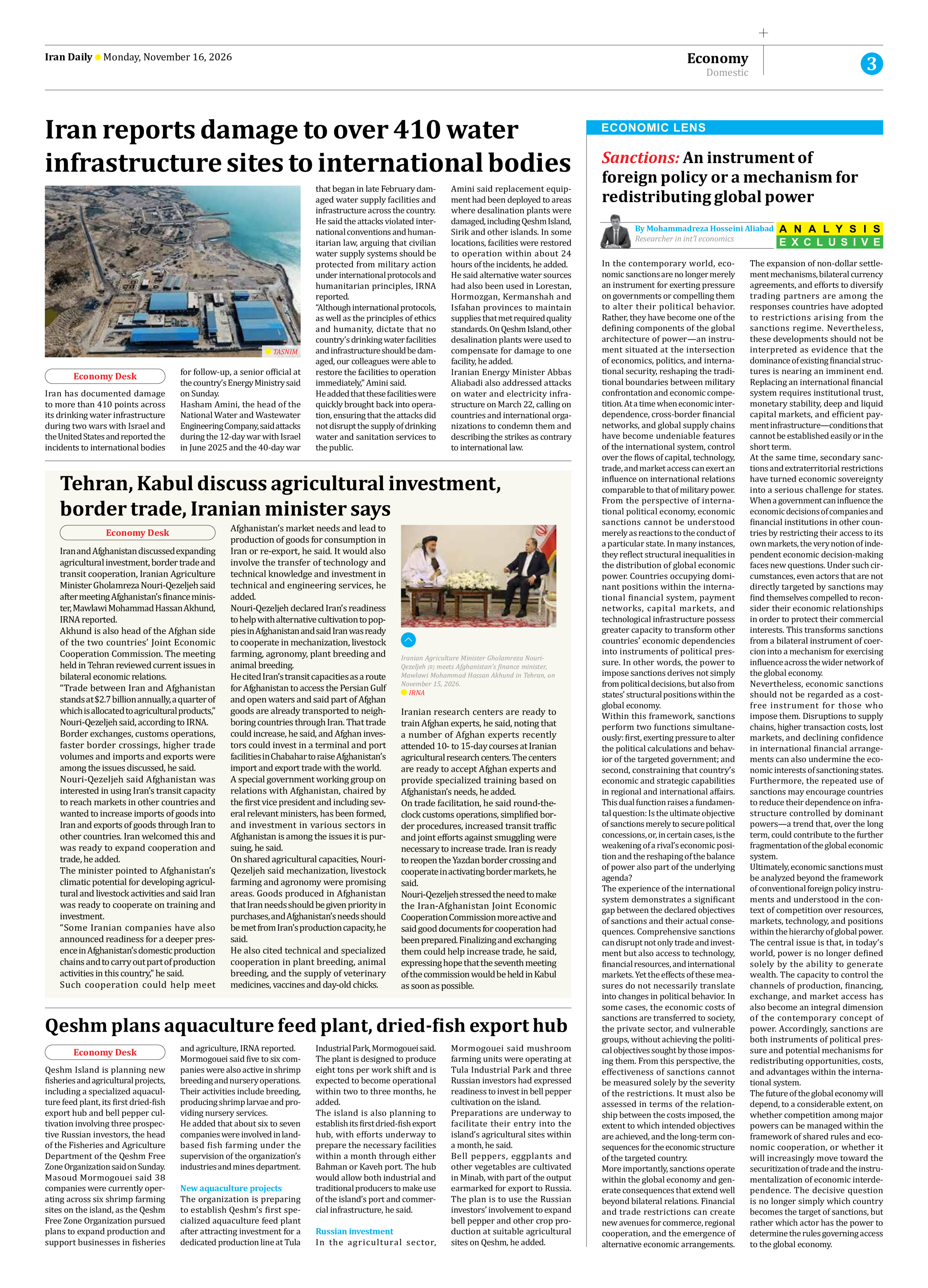


Tehran, Kabul discuss agricultural investment, border trade, Iranian minister says
Iran and Afghanistan discussed expanding agricultural investment, border trade and transit cooperation, Iranian Agriculture Minister Gholamreza Nouri-Qezeljeh said after meeting Afghanistan’s finance minister, Mawlawi Mohammad Hassan Akhund, IRNA reported.
Akhund is also head of the Afghan side of the two countries’ Joint Economic Cooperation Commission. The meeting held in Tehran reviewed current issues in bilateral economic relations.
“Trade between Iran and Afghanistan stands at $2.7 billion annually, a quarter of which is allocated to agricultural products,” Nouri-Qezeljeh said, according to IRNA.
Border exchanges, customs operations, faster border crossings, higher trade volumes and imports and exports were among the issues discussed, he said.
Nouri-Qezeljeh said Afghanistan was interested in using Iran’s transit capacity to reach markets in other countries and wanted to increase imports of goods into Iran and exports of goods through Iran to other countries. Iran welcomed this and was ready to expand cooperation and trade, he added.
The minister pointed to Afghanistan’s climatic potential for developing agricultural and livestock activities and said Iran was ready to cooperate on training and investment.
“Some Iranian companies have also announced readiness for a deeper presence in Afghanistan’s domestic production chains and to carry out part of production activities in this country,” he said.
Such cooperation could help meet Afghanistan’s market needs and lead to production of goods for consumption in Iran or re-export, he said. It would also involve the transfer of technology and technical knowledge and investment in technical and engineering services, he added.
Nouri-Qezeljeh declared Iran’s readiness to help with alternative cultivation to poppies in Afghanistan and said Iran was ready to cooperate in mechanization, livestock farming, agronomy, plant breeding and animal breeding.
He cited Iran’s transit capacities as a route for Afghanistan to access the Persian Gulf and open waters and said part of Afghan goods are already transported to neighboring countries through Iran. That trade could increase, he said, and Afghan investors could invest in a terminal and port facilities in Chabahar to raise Afghanistan’s import and export trade with the world.
A special government working group on relations with Afghanistan, chaired by the first vice president and including several relevant ministers, has been formed, and investment in various sectors in Afghanistan is among the issues it is pursuing, he said.
On shared agricultural capacities, Nouri-Qezeljeh said mechanization, livestock farming and agronomy were promising areas. Goods produced in Afghanistan that Iran needs should be given priority in purchases, and Afghanistan’s needs should be met from Iran’s production capacity, he said.
He also cited technical and specialized cooperation in plant breeding, animal breeding, and the supply of veterinary medicines, vaccines and day-old chicks.
Iranian research centers are ready to train Afghan experts, he said, noting that a number of Afghan experts recently attended 10- to 15-day courses at Iranian agricultural research centers. The centers are ready to accept Afghan experts and provide specialized training based on Afghanistan’s needs, he added.
On trade facilitation, he said round-the-clock customs operations, simplified border procedures, increased transit traffic and joint efforts against smuggling were necessary to increase trade. Iran is ready to reopen the Yazdan border crossing and cooperate in activating border markets, he said.
Nouri-Qezeljeh stressed the need to make the Iran-Afghanistan Joint Economic Cooperation Commission more active and said good documents for cooperation had been prepared. Finalizing and exchanging them could help increase trade, he said, expressing hope that the seventh meeting of the commission would be held in Kabul as soon as possible.