


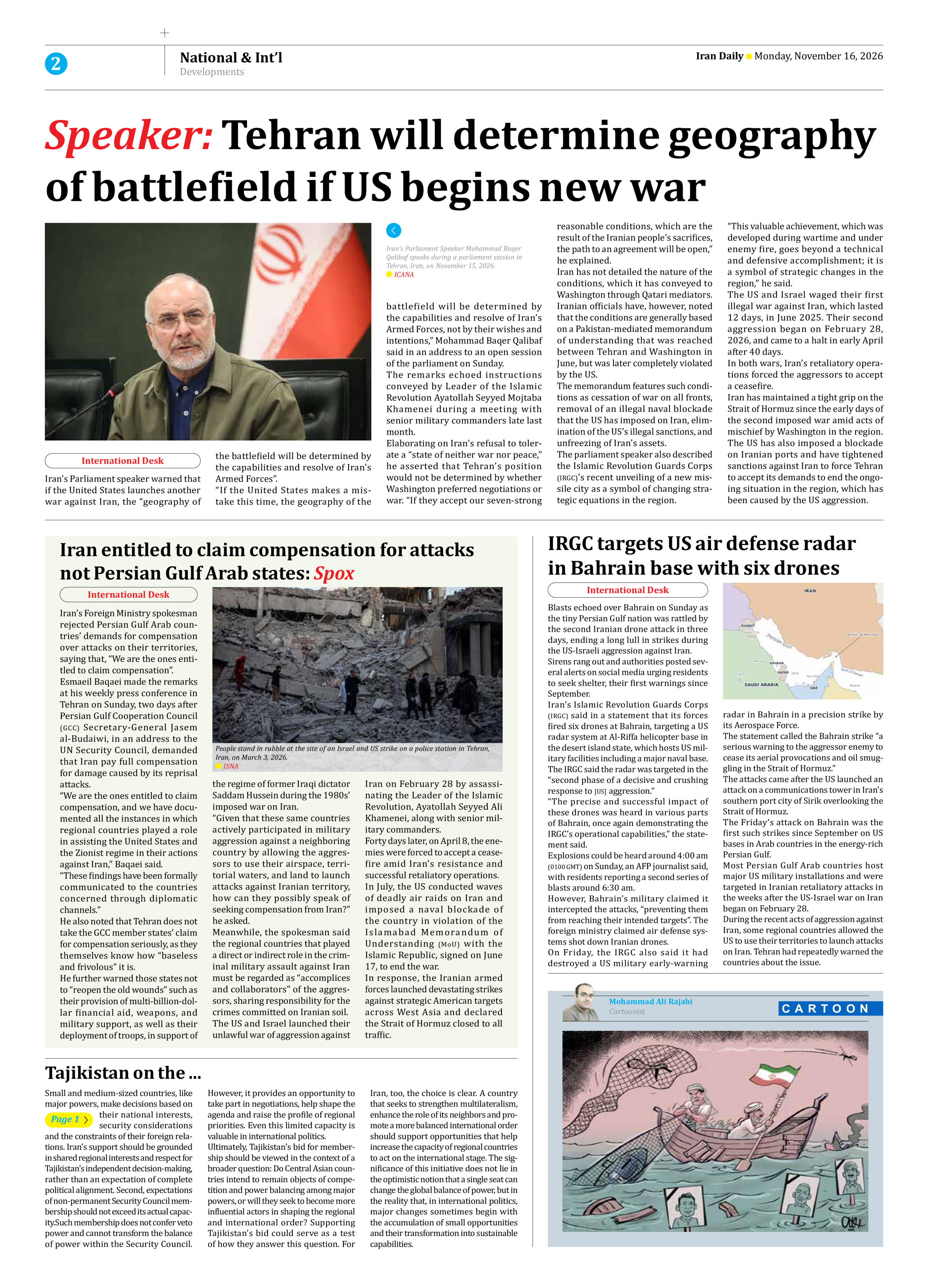


Iran entitled to claim compensation for attacks not Persian Gulf Arab states: Spox
Iran’s Foreign Ministry spokesman rejected Persian Gulf Arab countries’ demands for compensation over attacks on their territories, saying that, “We are the ones entitled to claim compensation”.
Esmaeil Baqaei made the remarks at his weekly press conference in Tehran on Sunday, two days after Persian Gulf Cooperation Council (GCC) Secretary-General Jasem al-Budaiwi, in an address to the UN Security Council, demanded that Iran pay full compensation for damage caused by its reprisal attacks.
“We are the ones entitled to claim compensation, and we have documented all the instances in which regional countries played a role in assisting the United States and the Zionist regime in their actions against Iran,” Baqaei said.
“These findings have been formally communicated to the countries concerned through diplomatic channels.”
He also noted that Tehran does not take the GCC member states’ claim for compensation seriously, as they themselves know how “baseless and frivolous” it is.
He further warned those states not to “reopen the old wounds” such as their provision of multi-billion-dollar financial aid, weapons, and military support, as well as their deployment of troops, in support of the regime of former Iraqi dictator Saddam Hussein during the 1980s’ imposed war on Iran.
“Given that these same countries actively participated in military aggression against a neighboring country by allowing the aggressors to use their airspace, territorial waters, and land to launch attacks against Iranian territory, how can they possibly speak of seeking compensation from Iran?” he asked.
Meanwhile, the spokesman said the regional countries that played a direct or indirect role in the criminal military assault against Iran must be regarded as “accomplices and collaborators” of the aggressors, sharing responsibility for the crimes committed on Iranian soil.
The US and Israel launched their unlawful war of aggression against Iran on February 28 by assassinating the Leader of the Islamic Revolution, Ayatollah Seyyed Ali Khamenei, along with senior military commanders.
Forty days later, on April 8, the enemies were forced to accept a ceasefire amid Iran’s resistance and successful retaliatory operations.
In July, the US conducted waves of deadly air raids on Iran and imposed a naval blockade of the country in violation of the Islamabad Memorandum of Understanding (MoU) with the Islamic Republic, signed on June 17, to end the war.
In response, the Iranian armed forces launched devastating strikes against strategic American targets across West Asia and declared the Strait of Hormuz closed to all traffic.