


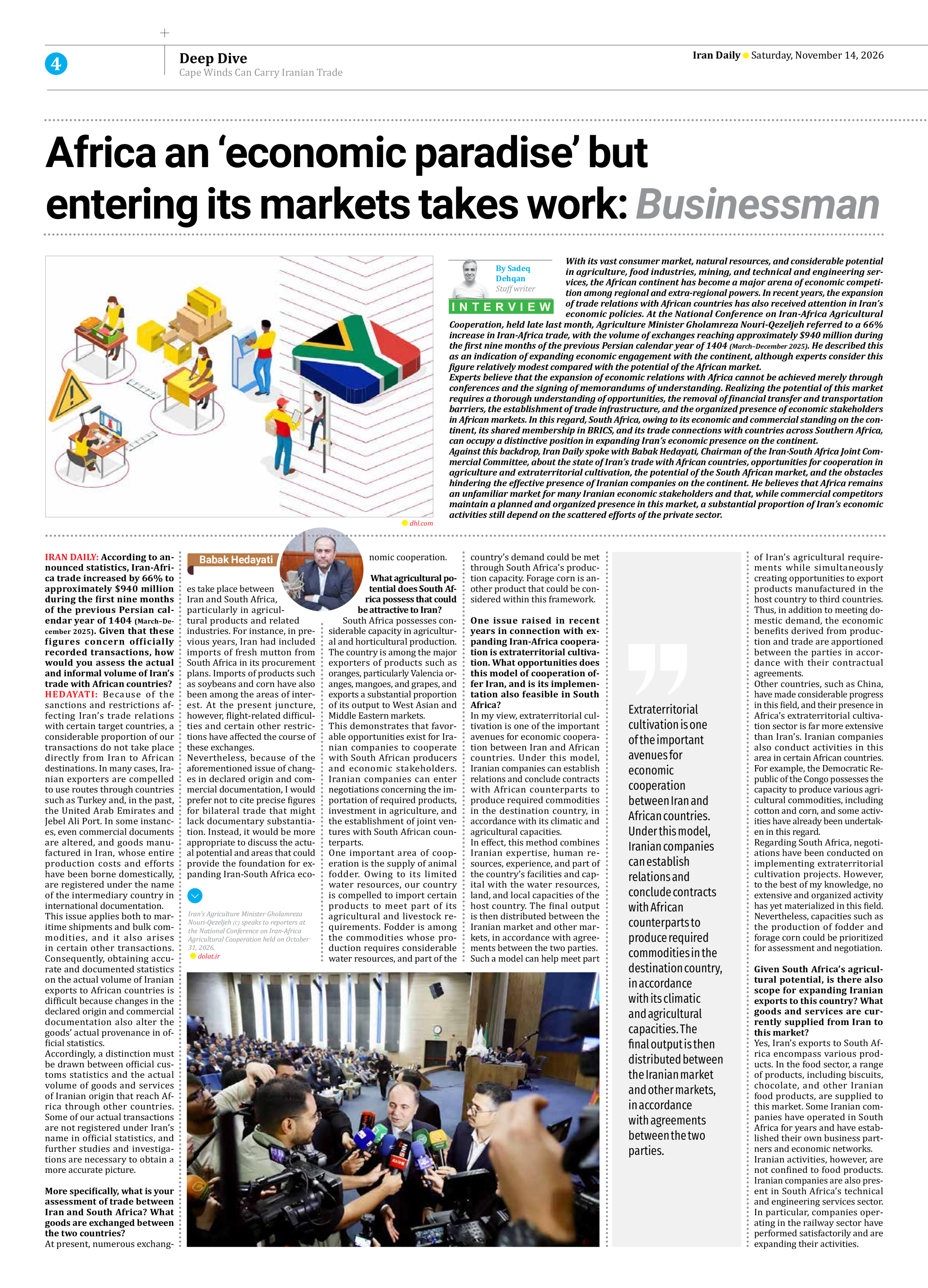


Africa an ‘economic paradise’ but entering its markets takes work: Businessman
With its vast consumer market, natural resources, and considerable potential in agriculture, food industries, mining, and technical and engineering services, the African continent has become a major arena of economic competition among regional and extra-regional powers. In recent years, the expansion of trade relations with African countries has also received attention in Iran’s economic policies. At the National Conference on Iran-Africa Agricultural Cooperation, held late last month, Agriculture Minister Gholamreza Nouri-Qezeljeh referred to a 66% increase in Iran-Africa trade, with the volume of exchanges reaching approximately $940 million during the first nine months of the previous Persian calendar year of 1404 (March–December 2025). He described this as an indication of expanding economic engagement with the continent, although experts consider this figure relatively modest compared with the potential of the African market. Experts believe that the expansion of economic relations with Africa cannot be achieved merely through conferences and the signing of memorandums of understanding. Realizing the potential of this market requires a thorough understanding of opportunities, the removal of financial transfer and transportation barriers, the establishment of trade infrastructure, and the organized presence of economic stakeholders in African markets. In this regard, South Africa, owing to its economic and commercial standing on the continent, its shared membership in BRICS, and its trade connections with countries across Southern Africa, can occupy a distinctive position in expanding Iran’s economic presence on the continent. Against this backdrop, Iran Daily spoke with Babak Hedayati, Chairman of the Iran-South Africa Joint Commercial Committee, about the state of Iran’s trade with African countries, opportunities for cooperation in agriculture and extraterritorial cultivation, the potential of the South African market, and the obstacles hindering the effective presence of Iranian companies on the continent. He believes that Africa remains an unfamiliar market for many Iranian economic stakeholders and that, while commercial competitors maintain a planned and organized presence in this market, a substantial proportion of Iran’s economic activities still depend on the scattered efforts of the private sector.
By Sadeq
Dehqan
Staff writer
IRAN DAILY: According to announced statistics, Iran-Africa trade increased by 66% to approximately $940 million during the first nine months of the previous Persian calendar year of 1404 (March–December 2025). Given that these figures concern officially recorded transactions, how would you assess the actual and informal volume of Iran’s trade with African countries?
HEDAYATI: Because of the sanctions and restrictions affecting Iran’s trade relations with certain target countries, a considerable proportion of our transactions do not take place directly from Iran to African destinations. In many cases, Iranian exporters are compelled to use routes through countries such as Turkey and, in the past, the United Arab Emirates and Jebel Ali Port. In some instances, even commercial documents are altered, and goods manufactured in Iran, whose entire production costs and efforts have been borne domestically, are registered under the name of the intermediary country in international documentation.
This issue applies both to maritime shipments and bulk commodities, and it also arises in certain other transactions. Consequently, obtaining accurate and documented statistics on the actual volume of Iranian exports to African countries is difficult because changes in the declared origin and commercial documentation also alter the goods’ actual provenance in official statistics.
Accordingly, a distinction must be drawn between official customs statistics and the actual volume of goods and services of Iranian origin that reach Africa through other countries. Some of our actual transactions are not registered under Iran’s name in official statistics, and further studies and investigations are necessary to obtain a more accurate picture.
More specifically, what is your assessment of trade between Iran and South Africa? What goods are exchanged between the two countries?
At present, numerous exchanges take place between Iran and South Africa, particularly in agricultural products and related industries. For instance, in previous years, Iran had included imports of fresh mutton from South Africa in its procurement plans. Imports of products such as soybeans and corn have also been among the areas of interest. At the present juncture, however, flight-related difficulties and certain other restrictions have affected the course of these exchanges.
Nevertheless, because of the aforementioned issue of changes in declared origin and commercial documentation, I would prefer not to cite precise figures for bilateral trade that might lack documentary substantiation. Instead, it would be more appropriate to discuss the actual potential and areas that could provide the foundation for expanding Iran-South Africa economic cooperation.
What agricultural potential does South Africa possess that could be attractive to Iran?
South Africa possesses considerable capacity in agricultural and horticultural production. The country is among the major exporters of products such as oranges, particularly Valencia oranges, mangoes, and grapes, and exports a substantial proportion of its output to West Asian and Middle Eastern markets.
This demonstrates that favorable opportunities exist for Iranian companies to cooperate with South African producers and economic stakeholders. Iranian companies can enter negotiations concerning the importation of required products, investment in agriculture, and the establishment of joint ventures with South African counterparts.
One important area of cooperation is the supply of animal fodder. Owing to its limited water resources, our country is compelled to import certain products to meet part of its agricultural and livestock requirements. Fodder is among the commodities whose production requires considerable water resources, and part of the country’s demand could be met through South Africa’s production capacity. Forage corn is another product that could be considered within this framework.
One issue raised in recent years in connection with expanding Iran-Africa cooperation is extraterritorial cultivation. What opportunities does this model of cooperation offer Iran, and is its implementation also feasible in South Africa?
In my view, extraterritorial cultivation is one of the important avenues for economic cooperation between Iran and African countries. Under this model, Iranian companies can establish relations and conclude contracts with African counterparts to produce required commodities in the destination country, in accordance with its climatic and agricultural capacities.
In effect, this method combines Iranian expertise, human resources, experience, and part of the country’s facilities and capital with the water resources, land, and local capacities of the host country. The final output is then distributed between the Iranian market and other markets, in accordance with agreements between the two parties.
Such a model can help meet part of Iran’s agricultural requirements while simultaneously creating opportunities to export products manufactured in the host country to third countries. Thus, in addition to meeting domestic demand, the economic benefits derived from production and trade are apportioned between the parties in accordance with their contractual agreements.
Other countries, such as China, have made considerable progress in this field, and their presence in Africa’s extraterritorial cultivation sector is far more extensive than Iran’s. Iranian companies also conduct activities in this area in certain African countries. For example, the Democratic Republic of the Congo possesses the capacity to produce various agricultural commodities, including cotton and corn, and some activities have already been undertaken in this regard.
Regarding South Africa, negotiations have been conducted on implementing extraterritorial cultivation projects. However, to the best of my knowledge, no extensive and organized activity has yet materialized in this field. Nevertheless, capacities such as the production of fodder and forage corn could be prioritized for assessment and negotiation.
Given South Africa’s agricultural potential, is there also scope for expanding Iranian exports to this country? What goods and services are currently supplied from Iran to this market?
Yes, Iran’s exports to South Africa encompass various products. In the food sector, a range of products, including biscuits, chocolate, and other Iranian food products, are supplied to this market. Some Iranian companies have operated in South Africa for years and have established their own business partners and economic networks.
Iranian activities, however, are not confined to food products. Iranian companies are also present in South Africa’s technical and engineering services sector. In particular, companies operating in the railway sector have performed satisfactorily and are expanding their activities.
Overall, considerable potential exists for cooperation between the two countries across various sectors, including railways, mining, agriculture, food industries, and general trade. If the relevant authorities in Iran demonstrate greater commitment to providing facilities and practical support for economic stakeholders, Iranian companies can establish a more extensive presence in this market.
The important point is that trade must be reciprocal. We can meet part of our requirements through South Africa while supplying this market with Iranian products, services, and industrial and technical capabilities. Naturally, however, the production cost and competitive advantage of each product must be carefully assessed, since importing certain goods may not be economically viable because of production or transportation costs.
For years, Africa has been described as one of the most significant untapped opportunities in Iran’s foreign trade and even as a paradise for economic cooperation. Nevertheless, there appears to be a considerable gap between this potential and Iran’s actual performance. What accounts for this discrepancy?
The point you have raised is extremely important. Unfortunately, expressions such as “Africa, a paradise of economic opportunities” have been repeated so frequently that they have sometimes become ends in themselves. Numerous conferences and meetings on Africa are held in our country, and considerable sums are expended on them. Ultimately, however, the outcomes of many of these programs remain confined to the same appealing statements, banners, posters, and memorandums of understanding.
Africa remains an unfamiliar territory for many of our economic stakeholders, whereas countries that have properly understood this market have been capitalizing on its potential for years.
The reality is that many Iranian economic stakeholders who have succeeded in Africa have attained their positions through their own personal efforts and initiative, rather than as a result of an organized program and sustained government support. Our activities on the continent remain fragmented, and the degree of coordination necessary for an effective presence in a large and competitive market is still insufficient.
Of course, this does not mean that no positive measures have been undertaken. The Trade Promotion Organization of Iran, the Iran Chamber of Commerce, provincial chambers of commerce, and trade centers have made efforts in recent years to introduce the respective capacities of both sides and establish connections among economic stakeholders. Constructive interactions have also developed with the embassies of African countries in Iran and with African businesspeople.
Nevertheless, all these measures must culminate in practical support, the facilitation of corporate activities, and ultimately the conclusion of commercial contracts. The objective should not merely be to hold conferences and sign memorandums of understanding. Rather, we must establish conditions under which every economic stakeholder, commensurate with their capabilities and business scale, can identify a suitable market in Africa or meet part of their requirements through the continent.
An economic paradise cannot be attained without effort and planning. Merely declaring Africa a paradise of opportunities changes nothing. Capitalizing on these opportunities requires knowledge, investment, organization, and sustained follow-up.
Which countries are Iran’s competitors in the African market, and how have they managed to consolidate their positions?
Because we lack an effective and organized presence in this market, virtually any country can be considered a competitor to Iran in Africa. We should not assume that we face only a handful of competitors in this market. Various countries, including those from China, Turkey, and other economies active in international trade, are present in Africa and are striving to expand their market shares.
Allow me to cite an example. Bitumen is one of the products that Iran has the capacity to manufacture and export to African markets. Nevertheless, Turkey is extremely active in supplying bitumen to this market, despite not being a major bitumen producer itself and procuring part of its supplies from Iran and Iraq. However, owing to its commercial networks and marketing capabilities, it can supply the product to African customers through more effective commercial mechanisms.
This example demonstrates that possessing resources and production capacity alone is insufficient for success in international trade. We may be the manufacturer of a product, but our competitor can use its commercial network, superior services, and more effective mechanisms to supply that same product to the destination market and secure a larger market share.
One major difference between Iran and certain countries that have succeeded in Africa concerns the organization of trade delegations. In some countries, when government and political delegations travel to Africa, a considerable proportion of their accompanying members consists of economic stakeholders and businesspeople. This demonstrates that trade development occupies a priority position in those countries’ agendas.
In Iran, however, economic delegations sometimes assume a predominantly ceremonial character, and the outcomes of their visits remain confined to meetings, commemorative photographs, and the signing of memorandums of understanding. Some members of Iranian delegations also have no direct role in commercial interactions. Economic stakeholders, however, must occupy a central position in these visits, and negotiations must culminate in executable contracts and substantive cooperation.
In your view, what measures should Iran undertake in its trade policymaking to change this situation?
The first measure is to establish a coherent and operational program for entering African markets. We must move beyond the stage of introducing potential and develop specific plans for each country, economic sector, and even target product.
The second issue is facilitating private-sector activities. Government agencies must assume a facilitating role and establish conditions under which economic stakeholders can enter negotiations and expand their activities with sufficient knowledge of the destination market.
In this process, trade centers, the Trade Promotion Organization of Iran, the Iran Chamber of Commerce, and provincial chambers can play an important role. These institutions must introduce Iran’s economic capacities to African counterparts while also familiarizing Iranian economic stakeholders with the opportunities available in African countries.
Support must also extend from major corporations to small and medium-sized enterprises. Not every economic stakeholder is expected to undertake projects worth hundreds of millions of dollars. A small company might identify a suitable opportunity in exporting a food product or supplying an industrial commodity. What matters is establishing the necessary mechanisms to facilitate the participation of all such stakeholders.
Alongside these considerations, issues such as transportation, financial transfers, insurance, financing, and familiarity with the regulations of destination countries must also receive attention. Without resolving these issues, translating even substantial economic potential into sustainable trade will remain difficult.
Given that South Africa is one of the continent’s major countries and a member of BRICS, what position can it occupy in Iran’s trade strategy for establishing a presence in Africa?
South Africa and Iran are both core members of BRICS, and this alone creates numerous opportunities for defining trade and economic cooperation between the two countries. We must capitalize on the existing capacities within the BRICS framework to expand economic relations.
Another important consideration is South Africa’s position within the economic and commercial structure of the Southern African region. South Africa is one of the major economies on the African continent and is, in effect, the leading country in its southern region. In addition to its considerable domestic market, its membership in regional economic cooperation arrangements provides access to neighboring countries’ markets as well. Our estimate is that, through production and economic activity in South Africa, it is possible to gain access to the markets of approximately 15 to 16 countries by capitalizing on regional trade agreements and, in certain cases, benefiting from preferential or zero tariffs. Naturally, the conditions for enjoying these advantages depend on the type of commodity and applicable rules of origin.
From this perspective, South Africa is not merely an export destination; it can also serve as a base from which Iranian companies can expand their operations and gradually enter broader African markets. Accordingly, a company that successfully establishes its production or economic activities in South Africa can explore opportunities to access regional markets in addition to the South African market itself.
This advantage can be extremely important for Iranian companies because, rather than concentrating exclusively on South Africa’s domestic market, they can use the country as a point of departure for expanding their commercial activities into other countries across the region.
What infrastructure and facilities are available to Iranian economic stakeholders in South Africa to facilitate their presence in the market?
One of the important capacities available to Iranian economic stakeholders in South Africa is the Iran Trade Center, established through the efforts of the Trade Promotion Organization of Iran. This center can assist Iranian companies in understanding the market, establishing connections with commercial counterparts, and expanding their economic activities.
Furthermore, the Iran Chamber of Commerce in South Africa has an Iran-South Africa Joint Commercial Committee, whose capacities traders and economic stakeholders can utilize.
Alongside these facilities, the presence of a commercial counselor and the establishment of a BRICS trade center in the country are additional instruments that can serve the expansion of economic relations.
The important point is that these facilities should not be regarded merely as administrative structures and organizational bodies. Rather, they must become instruments for resolving companies’ actual problems, identifying commercial partners, introducing products, and establishing enduring business relationships.
Given these facilities and capacities, can South Africa be regarded as one of Iran’s principal gateways into the African market?
Yes. In my view, South Africa can serve as one of the gateways for Iranian companies into the vast African market. However, I do not intend to claim categorically that this country is more suitable for Iran than every other African country since each African country possesses its own particular capacities and characteristics, and decisions must be made in accordance with the nature of the economic activity concerned.
Nevertheless, owing to its economic standing, regional connections, shared BRICS membership, and the facilities established there for Iranian economic stakeholders, South Africa can constitute a suitable starting point for expanding commercial activities in the region.
A company that succeeds in consolidating its commercial position in this country and establishing appropriate relations with local partners can have multiple avenues of cooperation with other African countries at its disposal. Therefore, South Africa should be viewed not merely as a consumer market, but also as a platform for expanding Iran’s economic activities in parts of the African continent.