




Minister urges ITU follow-up on war damage assessment request
Iran’s communications minister has urged the International Telecommunication Union (ITU) to follow up on Tehran’s request for a comprehensive assessment of damage to the country’s communications and broadcasting infrastructure and technical recommendations for its reconstruction, while stressing the need to preserve the organization’s nonpolitical and technical mandate.
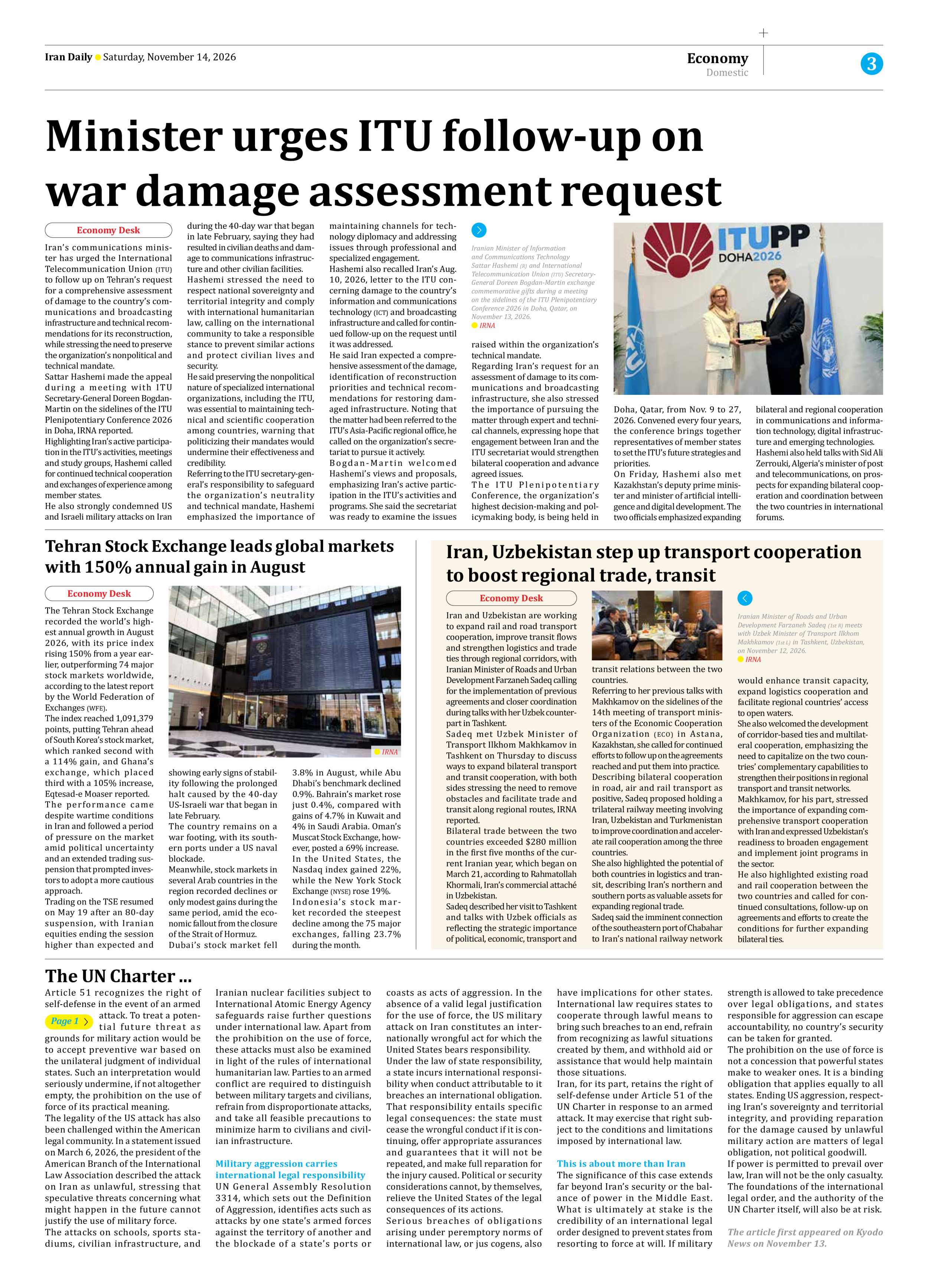
Sattar Hashemi made the appeal during a meeting with ITU Secretary-General Doreen Bogdan-Martin on the sidelines of the ITU Plenipotentiary Conference 2026 in Doha, IRNA reported.
Highlighting Iran’s active participation in the ITU’s activities, meetings and study groups, Hashemi called for continued technical cooperation and exchanges of experience among member states.
He also strongly condemned US and Israeli military attacks on Iran during the 40-day war that began in late February, saying they had resulted in civilian deaths and damage to communications infrastructure and other civilian facilities.
Hashemi stressed the need to respect national sovereignty and territorial integrity and comply with international humanitarian law, calling on the international community to take a responsible stance to prevent similar actions and protect civilian lives and security.
He said preserving the nonpolitical nature of specialized international organizations, including the ITU, was essential to maintaining technical and scientific cooperation among countries, warning that politicizing their mandates would undermine their effectiveness and credibility.
Referring to the ITU secretary-general’s responsibility to safeguard the organization’s neutrality and technical mandate, Hashemi emphasized the importance of maintaining channels for technology diplomacy and addressing issues through professional and specialized engagement.
Hashemi also recalled Iran’s Aug. 10, 2026, letter to the ITU concerning damage to the country’s information and communications technology (ICT) and broadcasting infrastructure and called for continued follow-up on the request until it was addressed.
He said Iran expected a comprehensive assessment of the damage, identification of reconstruction priorities and technical recommendations for restoring damaged infrastructure. Noting that the matter had been referred to the ITU’s Asia-Pacific regional office, he called on the organization’s secretariat to pursue it actively.
Bogdan-Martin welcomed Hashemi’s views and proposals, emphasizing Iran’s active participation in the ITU’s activities and programs. She said the secretariat was ready to examine the issues raised within the organization’s technical mandate.
Regarding Iran’s request for an assessment of damage to its communications and broadcasting infrastructure, she also stressed the importance of pursuing the matter through expert and technical channels, expressing hope that engagement between Iran and the ITU secretariat would strengthen bilateral cooperation and advance agreed issues.
The ITU Plenipotentiary Conference, the organization’s highest decision-making and policymaking body, is being held in Doha, Qatar, from Nov. 9 to 27, 2026. Convened every four years, the conference brings together representatives of member states to set the ITU’s future strategies and priorities.
On Friday, Hashemi also met Kazakhstan’s deputy prime minister and minister of artificial intelligence and digital development. The two officials emphasized expanding bilateral and regional cooperation in communications and information technology, digital infrastructure and emerging technologies.
Hashemi also held talks with Sid Ali Zerrouki, Algeria’s minister of post and telecommunications, on prospects for expanding bilateral cooperation and coordination between the two countries in international forums.