


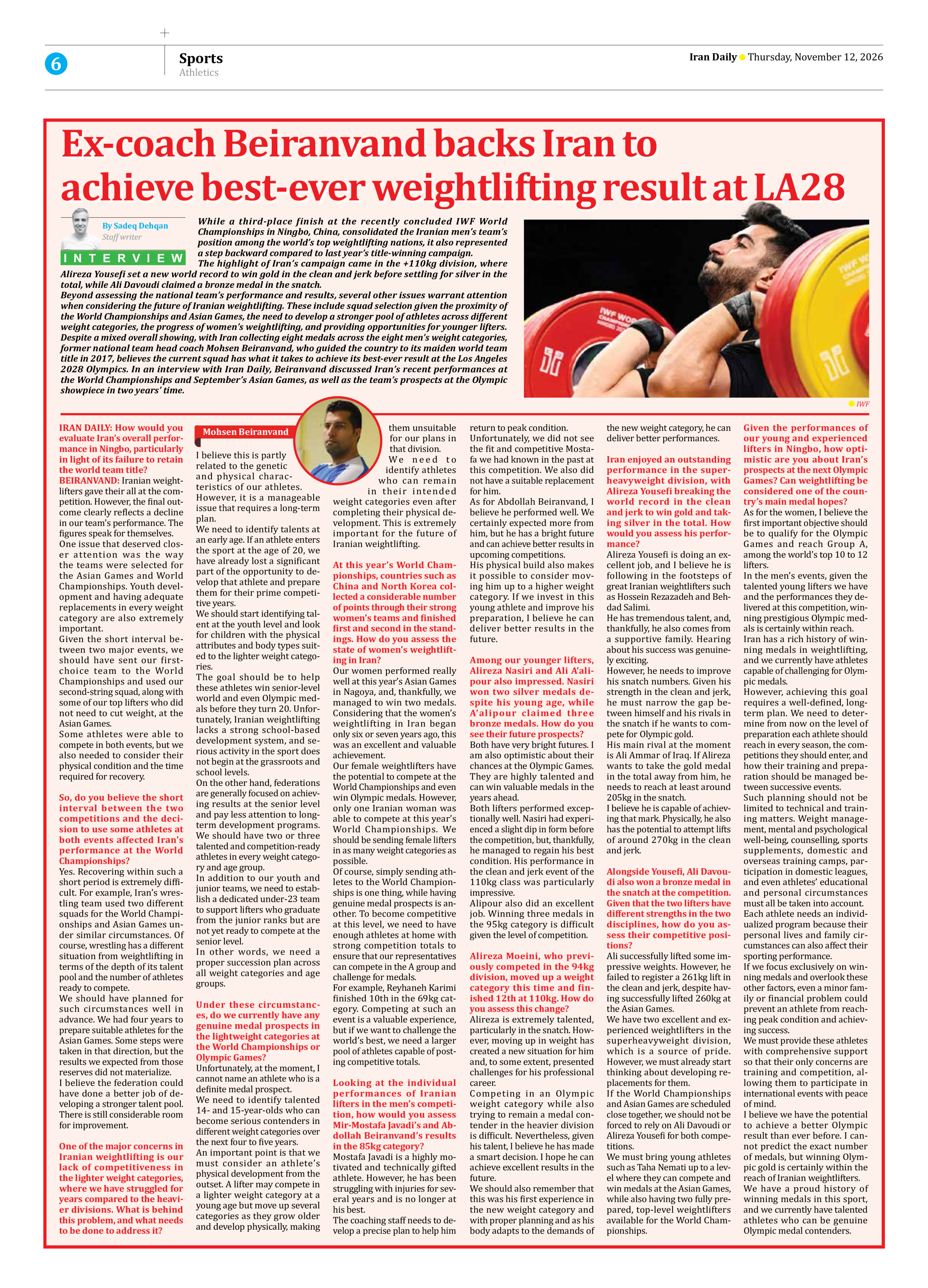


Ex-coach Beiranvand backs Iran to achieve best-ever weightlifting result at LA28
While a third-place finish at the recently concluded IWF World Championships in Ningbo, China, consolidated the Iranian men’s team’s position among the world’s top weightlifting nations, it also represented a step backward compared to last year’s title-winning campaign. The highlight of Iran’s campaign came in the +110kg division, where Alireza Yousefi set a new world record to win gold in the clean and jerk before settling for silver in the total, while Ali Davoudi claimed a bronze medal in the snatch. Beyond assessing the national team’s performance and results, several other issues warrant attention when considering the future of Iranian weightlifting. These include squad selection given the proximity of the World Championships and Asian Games, the need to develop a stronger pool of athletes across different weight categories, the progress of women’s weightlifting, and providing opportunities for younger lifters. Despite a mixed overall showing, with Iran collecting eight medals across the eight men’s weight categories, former national team head coach Mohsen Beiranvand, who guided the country to its maiden world team title in 2017, believes the current squad has what it takes to achieve its best-ever result at the Los Angeles 2028 Olympics. In an interview with Iran Daily, Beiranvand discussed Iran’s recent performances at the World Championships and September’s Asian Games, as well as the team’s prospects at the Olympic showpiece in two years’ time.
By Sadeq Dehqan
Staff writer
IRAN DAILY: How would you evaluate Iran’s overall performance in Ningbo, particularly in light of its failure to retain the world team title?
BEIRANVAND: Iranian weightlifters gave their all at the competition. However, the final outcome clearly reflects a decline in our team’s performance. The figures speak for themselves.
One issue that deserved closer attention was the way the teams were selected for the Asian Games and World Championships. Youth development and having adequate replacements in every weight category are also extremely important.
Given the short interval between two major events, we should have sent our first-choice team to the World Championships and used our second-string squad, along with some of our top lifters who did not need to cut weight, at the Asian Games.
Some athletes were able to compete in both events, but we also needed to consider their physical condition and the time required for recovery.
So, do you believe the short interval between the two competitions and the decision to use some athletes at both events affected Iran’s performance at the World Championships?
Yes. Recovering within such a short period is extremely difficult. For example, Iran’s wrestling team used two different squads for the World Championships and Asian Games under similar circumstances. Of course, wrestling has a different situation from weightlifting in terms of the depth of its talent pool and the number of athletes ready to compete.
We should have planned for such circumstances well in advance. We had four years to prepare suitable athletes for the Asian Games. Some steps were taken in that direction, but the results we expected from those reserves did not materialize.
I believe the federation could have done a better job of developing a stronger talent pool. There is still considerable room for improvement.
One of the major concerns in Iranian weightlifting is our lack of competitiveness in the lighter weight categories, where we have struggled for years compared to the heavier divisions. What is behind this problem, and what needs to be done to address it?
I believe this is partly related to the genetic and physical characteristics of our athletes. However, it is a manageable issue that requires a long-term plan.
We need to identify talents at an early age. If an athlete enters the sport at the age of 20, we have already lost a significant part of the opportunity to develop that athlete and prepare them for their prime competitive years.
We should start identifying talent at the youth level and look for children with the physical attributes and body types suited to the lighter weight categories.
The goal should be to help these athletes win senior-level world and even Olympic medals before they turn 20. Unfortunately, Iranian weightlifting lacks a strong school-based development system, and serious activity in the sport does not begin at the grassroots and school levels.
On the other hand, federations are generally focused on achieving results at the senior level and pay less attention to long-term development programs. We should have two or three talented and competition-ready athletes in every weight category and age group.
In addition to our youth and junior teams, we need to establish a dedicated under-23 team to support lifters who graduate from the junior ranks but are not yet ready to compete at the senior level.
In other words, we need a proper succession plan across all weight categories and age groups.
Under these circumstances, do we currently have any genuine medal prospects in the lightweight categories at the World Championships or Olympic Games?
Unfortunately, at the moment, I cannot name an athlete who is a definite medal prospect.
We need to identify talented 14- and 15-year-olds who can become serious contenders in different weight categories over the next four to five years.
An important point is that we must consider an athlete’s physical development from the outset. A lifter may compete in a lighter weight category at a young age but move up several categories as they grow older and develop physically, making them unsuitable for our plans in that division.
We need to identify athletes who can remain in their intended weight categories even after completing their physical development. This is extremely important for the future of Iranian weightlifting.
At this year’s World Championships, countries such as China and North Korea collected a considerable number of points through their strong women’s teams and finished first and second in the standings. How do you assess the state of women’s weightlifting in Iran?
Our women performed really well at this year’s Asian Games in Nagoya, and, thankfully, we managed to win two medals. Considering that the women’s weightlifting in Iran began only six or seven years ago, this was an excellent and valuable achievement.
Our female weightlifters have the potential to compete at the World Championships and even win Olympic medals. However, only one Iranian woman was able to compete at this year’s World Championships. We should be sending female lifters in as many weight categories as possible.
Of course, simply sending athletes to the World Championships is one thing, while having genuine medal prospects is another. To become competitive at this level, we need to have enough athletes at home with strong competition totals to ensure that our representatives can compete in the A group and challenge for medals.
For example, Reyhaneh Karimi finished 10th in the 69kg category. Competing at such an event is a valuable experience, but if we want to challenge the world’s best, we need a larger pool of athletes capable of posting competitive totals.
Looking at the individual performances of Iranian lifters in the men’s competition, how would you assess Mir-Mostafa Javadi’s and Abdollah Beiranvand’s results in the 85kg category?
Mostafa Javadi is a highly motivated and technically gifted athlete. However, he has been struggling with injuries for several years and is no longer at his best.
The coaching staff needs to develop a precise plan to help him return to peak condition.
Unfortunately, we did not see the fit and competitive Mostafa we had known in the past at this competition. We also did not have a suitable replacement for him.
As for Abdollah Beiranvand, I believe he performed well. We certainly expected more from him, but he has a bright future and can achieve better results in upcoming competitions.
His physical build also makes it possible to consider moving him up to a higher weight category. If we invest in this young athlete and improve his preparation, I believe he can deliver better results in the future.
Among our younger lifters, Alireza Nasiri and Ali A’alipour also impressed. Nasiri won two silver medals despite his young age, while A’alipour claimed three bronze medals. How do you see their future prospects?
Both have very bright futures. I am also optimistic about their chances at the Olympic Games. They are highly talented and can win valuable medals in the years ahead.
Both lifters performed exceptionally well. Nasiri had experienced a slight dip in form before the competition, but, thankfully, he managed to regain his best condition. His performance in the clean and jerk event of the 110kg class was particularly impressive.
Alipour also did an excellent job. Winning three medals in the 95kg category is difficult given the level of competition.
Alireza Moeini, who previously competed in the 94kg division, moved up a weight category this time and finished 12th at 110kg. How do you assess this change?
Alireza is extremely talented, particularly in the snatch. However, moving up in weight has created a new situation for him and, to some extent, presented challenges for his professional career.
Competing in an Olympic weight category while also trying to remain a medal contender in the heavier division is difficult. Nevertheless, given his talent, I believe he has made a smart decision. I hope he can achieve excellent results in the future.
We should also remember that this was his first experience in the new weight category and with proper planning and as his body adapts to the demands of the new weight category, he can deliver better performances.
Iran enjoyed an outstanding performance in the superheavyweight division, with Alireza Yousefi breaking the world record in the clean and jerk to win gold and taking silver in the total. How would you assess his performance?
Alireza Yousefi is doing an excellent job, and I believe he is following in the footsteps of great Iranian weightlifters such as Hossein Rezazadeh and Behdad Salimi.
He has tremendous talent, and, thankfully, he also comes from a supportive family. Hearing about his success was genuinely exciting.
However, he needs to improve his snatch numbers. Given his strength in the clean and jerk, he must narrow the gap between himself and his rivals in the snatch if he wants to compete for Olympic gold.
His main rival at the moment is Ali Ammar of Iraq. If Alireza wants to take the gold medal in the total away from him, he needs to reach at least around 205kg in the snatch.
I believe he is capable of achieving that mark. Physically, he also has the potential to attempt lifts of around 270kg in the clean and jerk.
Alongside Yousefi, Ali Davoudi also won a bronze medal in the snatch at the competition. Given that the two lifters have different strengths in the two disciplines, how do you assess their competitive positions?
Ali successfully lifted some impressive weights. However, he failed to register a 261kg lift in the clean and jerk, despite having successfully lifted 260kg at the Asian Games.
We have two excellent and experienced weightlifters in the superheavyweight division, which is a source of pride. However, we must already start thinking about developing replacements for them.
If the World Championships and Asian Games are scheduled close together, we should not be forced to rely on Ali Davoudi or Alireza Yousefi for both competitions.
We must bring young athletes such as Taha Nemati up to a level where they can compete and win medals at the Asian Games, while also having two fully prepared, top-level weightlifters available for the World Championships.
Given the performances of our young and experienced lifters in Ningbo, how optimistic are you about Iran’s prospects at the next Olympic Games? Can weightlifting be considered one of the country’s main medal hopes?
As for the women, I believe the first important objective should be to qualify for the Olympic Games and reach Group A, among the world’s top 10 to 12 lifters.
In the men’s events, given the talented young lifters we have and the performances they delivered at this competition, winning prestigious Olympic medals is certainly within reach.
Iran has a rich history of winning medals in weightlifting, and we currently have athletes capable of challenging for Olympic medals.
However, achieving this goal requires a well-defined, long-term plan. We need to determine from now on the level of preparation each athlete should reach in every season, the competitions they should enter, and how their training and preparation should be managed between successive events.
Such planning should not be limited to technical and training matters. Weight management, mental and psychological well-being, counselling, sports supplements, domestic and overseas training camps, participation in domestic leagues, and even athletes’ educational and personal circumstances must all be taken into account.
Each athlete needs an individualized program because their personal lives and family circumstances can also affect their sporting performance.
If we focus exclusively on winning medals and overlook these other factors, even a minor family or financial problem could prevent an athlete from reaching peak condition and achieving success.
We must provide these athletes with comprehensive support so that their only concerns are training and competition, allowing them to participate in international events with peace of mind.
I believe we have the potential to achieve a better Olympic result than ever before. I cannot predict the exact number of medals, but winning Olympic gold is certainly within the reach of Iranian weightlifters.
We have a proud history of winning medals in this sport, and we currently have talented athletes who can be genuine Olympic medal contenders.