


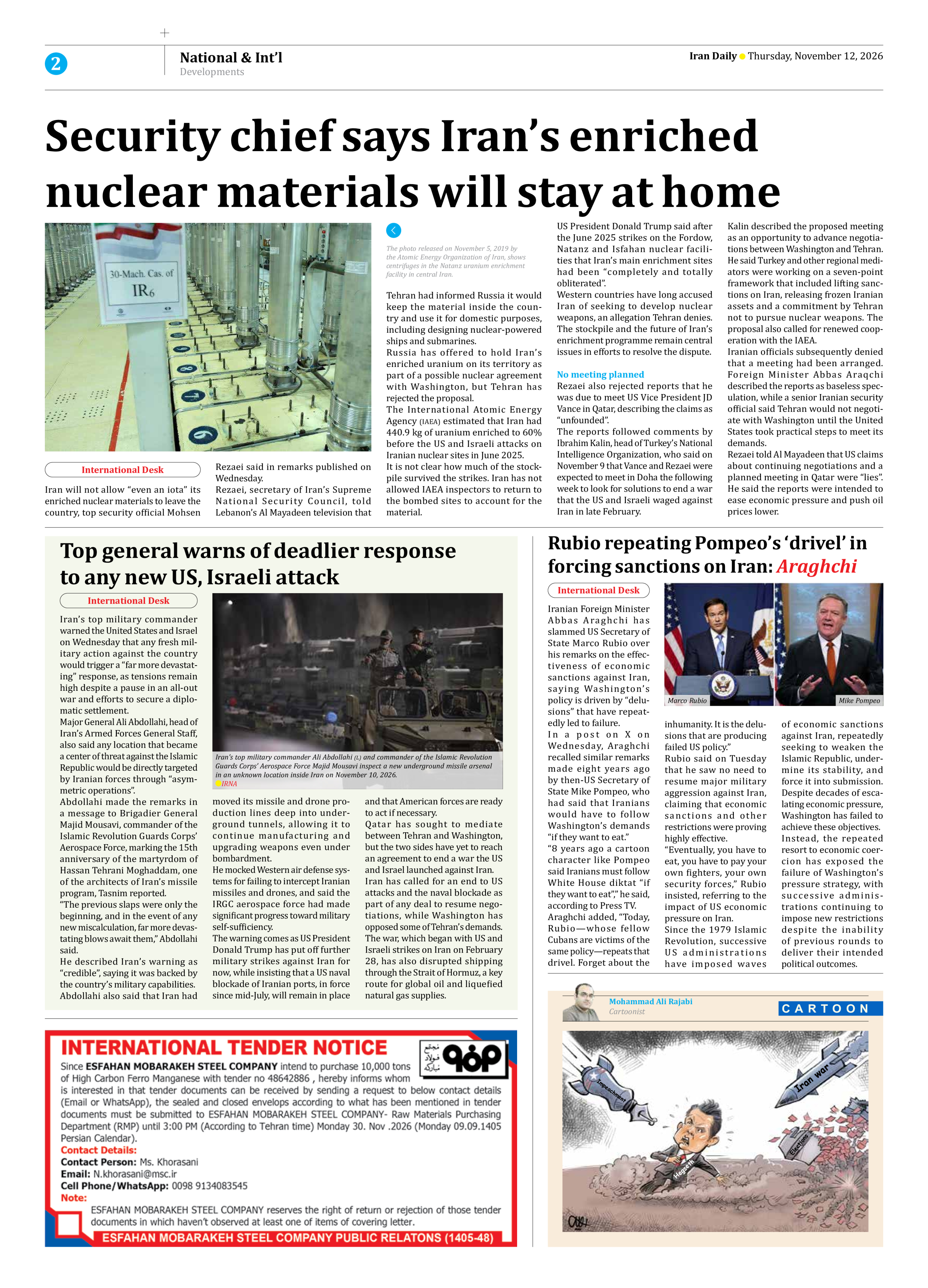


Security chief says Iran’s enriched nuclear materials will stay at home
Iran will not allow “even an iota” its enriched nuclear materials to leave the country, top security official Mohsen Rezaei said in remarks published on Wednesday.
Rezaei, secretary of Iran’s Supreme National Security Council, told Lebanon’s Al Mayadeen television that Tehran had informed Russia it would keep the material inside the country and use it for domestic purposes, including designing nuclear-powered ships and submarines.
Russia has offered to hold Iran’s enriched uranium on its territory as part of a possible nuclear agreement with Washington, but Tehran has rejected the proposal.
The International Atomic Energy Agency (IAEA) estimated that Iran had 440.9 kg of uranium enriched to 60% before the US and Israeli attacks on Iranian nuclear sites in June 2025.
It is not clear how much of the stockpile survived the strikes. Iran has not allowed IAEA inspectors to return to the bombed sites to account for the material.
US President Donald Trump said after the June 2025 strikes on the Fordow, Natanz and Isfahan nuclear facilities that Iran’s main enrichment sites had been “completely and totally obliterated”.
Western countries have long accused Iran of seeking to develop nuclear weapons, an allegation Tehran denies. The stockpile and the future of Iran’s enrichment programme remain central issues in efforts to resolve the dispute.
No meeting planned
Rezaei also rejected reports that he was due to meet US Vice President JD Vance in Qatar, describing the claims as “unfounded”.
The reports followed comments by Ibrahim Kalin, head of Turkey’s National Intelligence Organization, who said on November 9 that Vance and Rezaei were expected to meet in Doha the following week to look for solutions to end a war that the US and Israeli waged against Iran in late February.
Kalin described the proposed meeting as an opportunity to advance negotiations between Washington and Tehran.
He said Turkey and other regional mediators were working on a seven-point framework that included lifting sanctions on Iran, releasing frozen Iranian assets and a commitment by Tehran not to pursue nuclear weapons. The proposal also called for renewed cooperation with the IAEA.
Iranian officials subsequently denied that a meeting had been arranged. Foreign Minister Abbas Araqchi described the reports as baseless speculation, while a senior Iranian security official said Tehran would not negotiate with Washington until the United States took practical steps to meet its demands.
Rezaei told Al Mayadeen that US claims about continuing negotiations and a planned meeting in Qatar were “lies”. He said the reports were intended to ease economic pressure and push oil prices lower.