


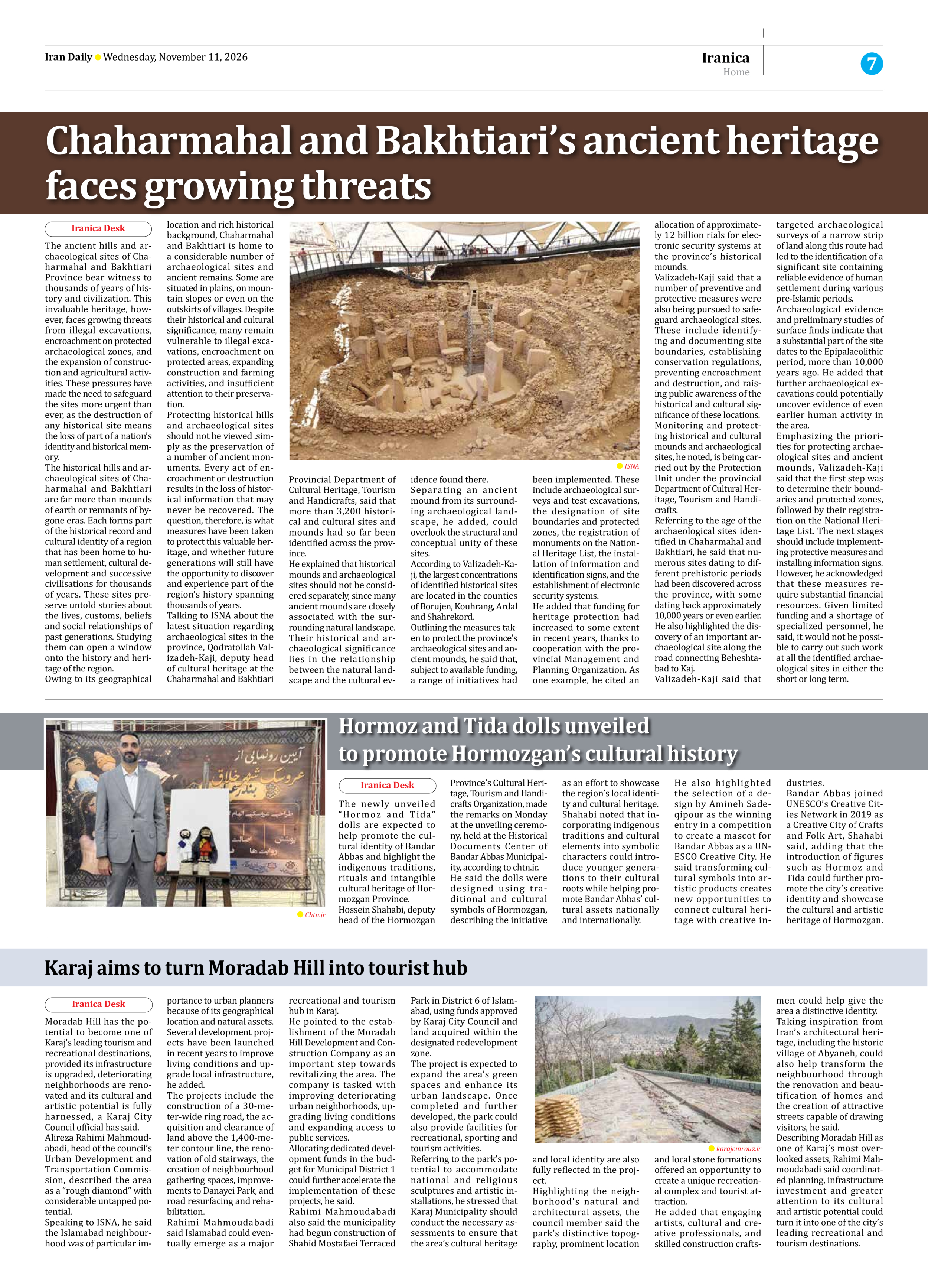


Chaharmahal and Bakhtiari’s ancient heritage faces growing threats
The ancient hills and archaeological sites of Chaharmahal and Bakhtiari Province bear witness to thousands of years of history and civilization. This invaluable heritage, however, faces growing threats from illegal excavations, encroachment on protected archaeological zones, and the expansion of construction and agricultural activities. These pressures have made the need to safeguard the sites more urgent than ever, as the destruction of any historical site means the loss of part of a nation’s identity and historical memory.
The historical hills and archaeological sites of Chaharmahal and Bakhtiari are far more than mounds of earth or remnants of bygone eras. Each forms part of the historical record and cultural identity of a region that has been home to human settlement, cultural development and successive civilisations for thousands of years. These sites preserve untold stories about the lives, customs, beliefs and social relationships of past generations. Studying them can open a window onto the history and heritage of the region.
Owing to its geographical location and rich historical background, Chaharmahal and Bakhtiari is home to a considerable number of archaeological sites and ancient remains. Some are situated in plains, on mountain slopes or even on the outskirts of villages. Despite their historical and cultural significance, many remain vulnerable to illegal excavations, encroachment on protected areas, expanding construction and farming activities, and insufficient attention to their preservation.
Protecting historical hills and archaeological sites should not be viewed .simply as the preservation of a number of ancient monuments. Every act of encroachment or destruction results in the loss of historical information that may never be recovered. The question, therefore, is what measures have been taken to protect this valuable heritage, and whether future generations will still have the opportunity to discover and experience part of the region’s history spanning thousands of years.
Talking to ISNA about the latest situation regarding archaeological sites in the province, Qodratollah Valizadeh-Kaji, deputy head of cultural heritage at the Chaharmahal and Bakhtiari Provincial Department of Cultural Heritage, Tourism and Handicrafts, said that more than 3,200 historical and cultural sites and mounds had so far been identified across the province.
He explained that historical mounds and archaeological sites should not be considered separately, since many ancient mounds are closely associated with the surrounding natural landscape.
Their historical and archaeological significance lies in the relationship between the natural landscape and the cultural evidence found there.
Separating an ancient mound from its surrounding archaeological landscape, he added, could overlook the structural and conceptual unity of these sites.
According to Valizadeh-Kaji, the largest concentrations of identified historical sites are located in the counties of Borujen, Kouhrang, Ardal and Shahrekord.
Outlining the measures taken to protect the province’s archaeological sites and ancient mounds, he said that, subject to available funding, a range of initiatives had been implemented. These include archaeological surveys and test excavations, the designation of site boundaries and protected zones, the registration of monuments on the National Heritage List, the installation of information and identification signs, and the establishment of electronic security systems.
He added that funding for heritage protection had increased to some extent in recent years, thanks to cooperation with the provincial Management and Planning Organization. As one example, he cited an allocation of approximately 12 billion rials for electronic security systems at the province’s historical mounds.
Valizadeh-Kaji said that a number of preventive and protective measures were also being pursued to safeguard archaeological sites. These include identifying and documenting site boundaries, establishing conservation regulations, preventing encroachment and destruction, and raising public awareness of the historical and cultural significance of these locations.
Monitoring and protecting historical and cultural mounds and archaeological sites, he noted, is being carried out by the Protection Unit under the provincial Department of Cultural Heritage, Tourism and Handicrafts.
Referring to the age of the archaeological sites identified in Chaharmahal and Bakhtiari, he said that numerous sites dating to different prehistoric periods had been discovered across the province, with some dating back approximately 10,000 years or even earlier.
He also highlighted the discovery of an important archaeological site along the road connecting Beheshtabad to Kaj.
Valizadeh-Kaji said that targeted archaeological surveys of a narrow strip of land along this route had led to the identification of a significant site containing reliable evidence of human settlement during various pre-Islamic periods.
Archaeological evidence and preliminary studies of surface finds indicate that a substantial part of the site dates to the Epipalaeolithic period, more than 10,000 years ago. He added that further archaeological excavations could potentially uncover evidence of even earlier human activity in the area.
Emphasizing the priorities for protecting archaeological sites and ancient mounds, Valizadeh-Kaji said that the first step was to determine their boundaries and protected zones, followed by their registration on the National Heritage List. The next stages should include implementing protective measures and installing information signs.
However, he acknowledged that these measures require substantial financial resources. Given limited funding and a shortage of specialized personnel, he said, it would not be possible to carry out such work at all the identified archaeological sites in either the short or long term.